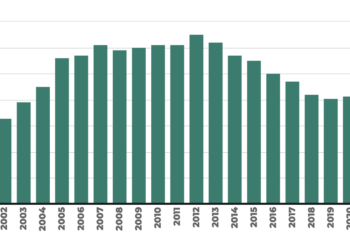
Michigan’s job growth has been weak during the Whitmer administration. Employment is up by 41,255 people, a 0.9% increase. That’s the 13th-worst among the states. The national average is 4.4%.
With 4.7 million people employed in the state, a 41,255-person increase over six years is not much. The state offered the automakers and battery manufacturers companies $1.45 billion in taxpayer money to projects that pledged to create 14,800 jobs. That sounds like subsidies should be able to make a dent in Michigan’s trends.
It’s much harder to influence the state’s economic trends than politicians typically make it seem. It comes down to the difference between gross and net job gains.
Let’s say that you were unemployed when Gretchen Whitmer became governor, but you and got a job sometime afterwards. You might think that you’re part of the 41,255-person increase in employment during her administration. Yet this overstates your contribution to employment gains. That’s because there have been a lot more than 41,255 people who found a job during the period.
The 41,255 is the difference between the number of people employed in January 2019 and the number of people employed in August 2025, the most recent month for which data is available. This net change hides the fact that millions of people have either found a job or lost a job (or sometimes did both) between those two months.
Job losses and gains are literally in the millions. The Bureau of Labor Statistics surveys business establishments every quarter about how many jobs they have. With this, we can see how many jobs are created each quarter by the companies creating new jobs, as well as the number of jobs lost each quarter at the companies that cut jobs. The survey shows that Michigan businesses created 5.31 million jobs from 2019 to 2024 (the figures here are lagged more than the monthly job reports) and lost 5.28 million jobs. Michigan employers create and eliminate more than 800,000 jobs every year.
While your new job during Whitmer’s term does count as part of the 41,255-person net increase in employment, your contribution to job gains was just 1 out of 5.31 million.
The Drudge Report made this mistake years ago, if memory serves, when it noted the monthly job gains at something like 50,000 jobs, and a separate story announced that McDonald’s had added roughly 25,000 jobs. The site naturally asked whether half of the job gains were at McDonald’s. No. The 25,000-job increase at the fast food giant would only be responsible for a small portion of the millions of jobs created during the month.
This distinction between gross and net job creation matters to state economic development policy. Lawmakers seem to believe that they can influence the direction of the state’s economy by writing big checks to select firms. Whitmer offered $1.45 billion to nine businesses to create 14,800 jobs. None of those jobs materialized, according to the latest state report, but taxpayers have spent $720 million.
These deals have had no influence over the state’s job picture. Even if they had lived up to expectations — and only 9% of the jobs announced in deals materialize — they would still not have been at the scope necessary to influence the state’s job trends. The 14,800 promised jobs would have contributed just 0.2% of the total job gains during Whitmer’s term. It is a small ripple in the larger tide of the state’s economic trends.
Trends matter, and Michigan’s economy is falling well behind the national average. Many policies can make a difference, as they deal with broader issues in the business climate. Getting those right is preferrable to giving special deals to select companies, which falls short of scale sufficient to matter.