Local government officials should use a variety of statistics to assess the health of the communities they serve. Population is one important statistic, but there are others. Union Township in Isabella County provides an example.
We’ve written previously about the township’s population decline. When people move to a community in large numbers, that suggests that local leaders are doing something right. A growing population implies that the community offers a high quality of life, including economic opportunities. A declining population could be a sign of trouble.
“Taxable value” of the land offers local leaders and residents’ insights into community health. Taxable value is a figure used to calculate each parcel’s value for taxing purposes, and Union Township’s record is not a good one. Its taxable value has been falling behind state averages since 2019, up 16.1% compared to the state’s 32.4% growth. It may be worth asking what role local were made to cause this.
Taxable value, by the way, is different from “assessed value,” which represents the market value of property. Assessed value would also be a good measure for evaluating a local government and its community, but the state does not publish these records at the township level.
Rising valuations suggest that homes, businesses and land are more desirable or productive than before. This could be due to rising demand, local improvements or other advantages. Rising valuations generally go hand-in-hand with increased economic activity. When local economies do better, values tend to rise because of higher employment or increasing personal incomes, which bring higher demand for real estate.
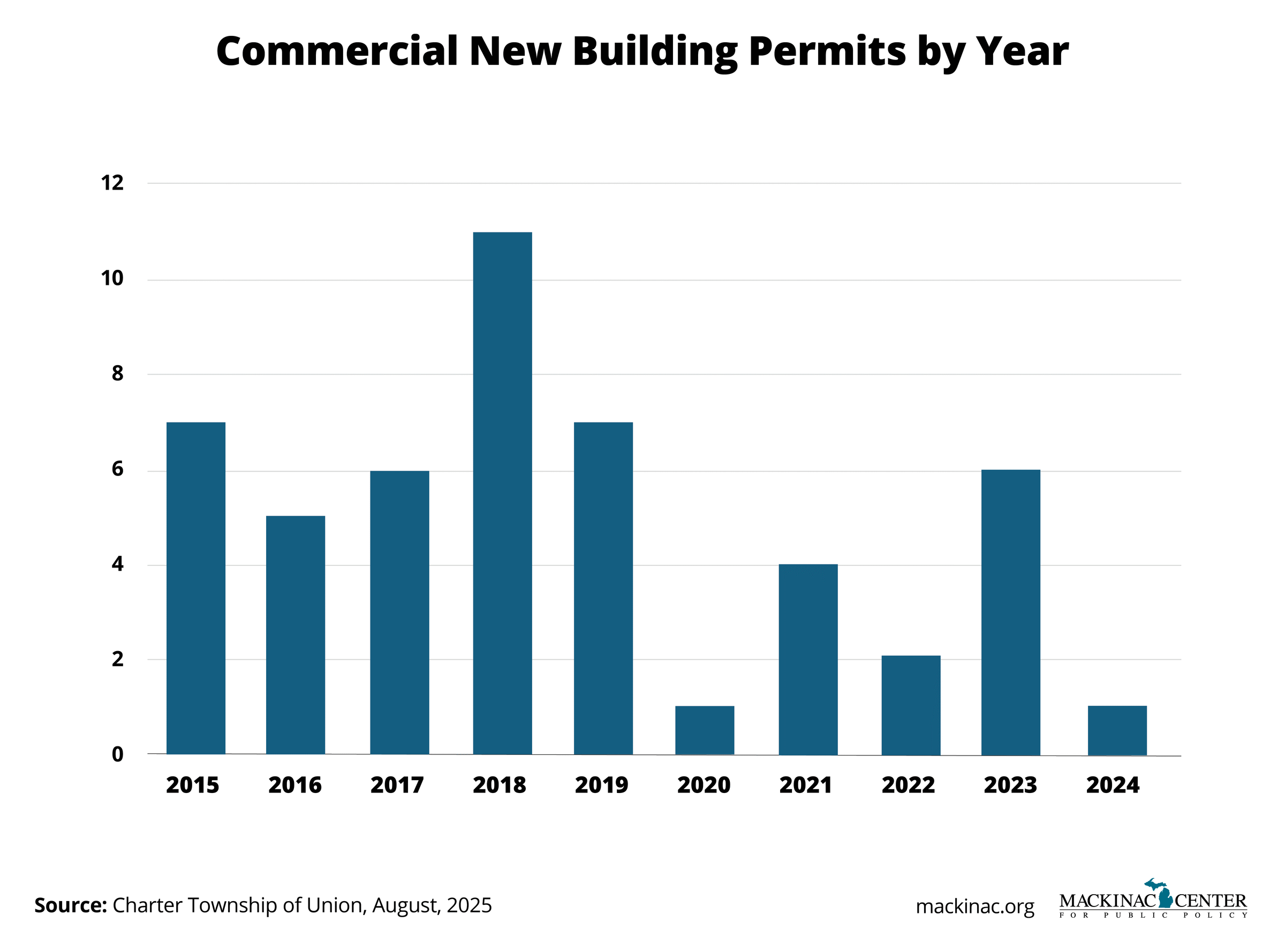
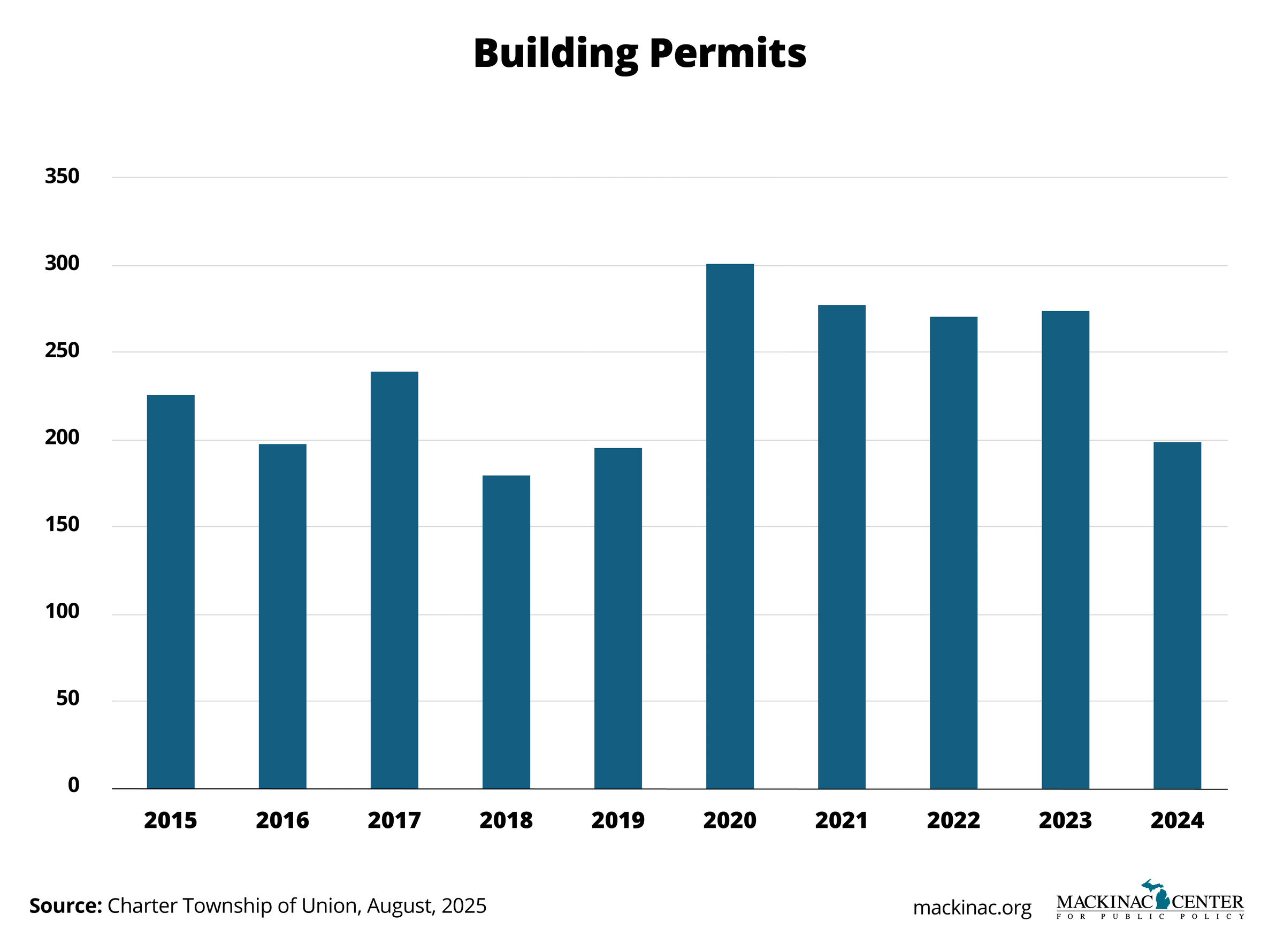
Union Township’s record on taxable value suggests stagnation. So does its performance in issuing building permits. The number of new commercial building permits is a proxy for development activity and the desire of investors to participate in the community. From 2015 to 2024 the township issued 50 new permits, according to official documents.
The number of permits issued has fallen dramatically of late. From 2015 through 2019, the township issued 36, and it issued only 14 since 2020, a 61% drop. But even that overstates the amount of commercial activity. In 2020 only one commercial permit was issued all year, and that was for the Isabella County Road Commission’s new facility on Remus Road. In 2023 the township issued six permits, and one of those was for the new Isabella County jail.
Neither of these taxpayer-funded projects indicate investor confidence in Union Township. Rather, they’re a sign of a local government’s willingness to spend taxpayer money. As for 2025, the township has not issued a single new commercial permit, as of Aug. 19, according to Township Manager Mark Stuldreher.
The Mackinac Center for Public Policy used the Freedom of Information Act to find out how many permits the township issued from 2015 to 2024. The number peaked in 2020 at 301 and then dropped by one-third to 199 through 2024, according to township documents. Officials issued 200 permits from the start of 2025 through Oct. 28, which matches last year’s performance.
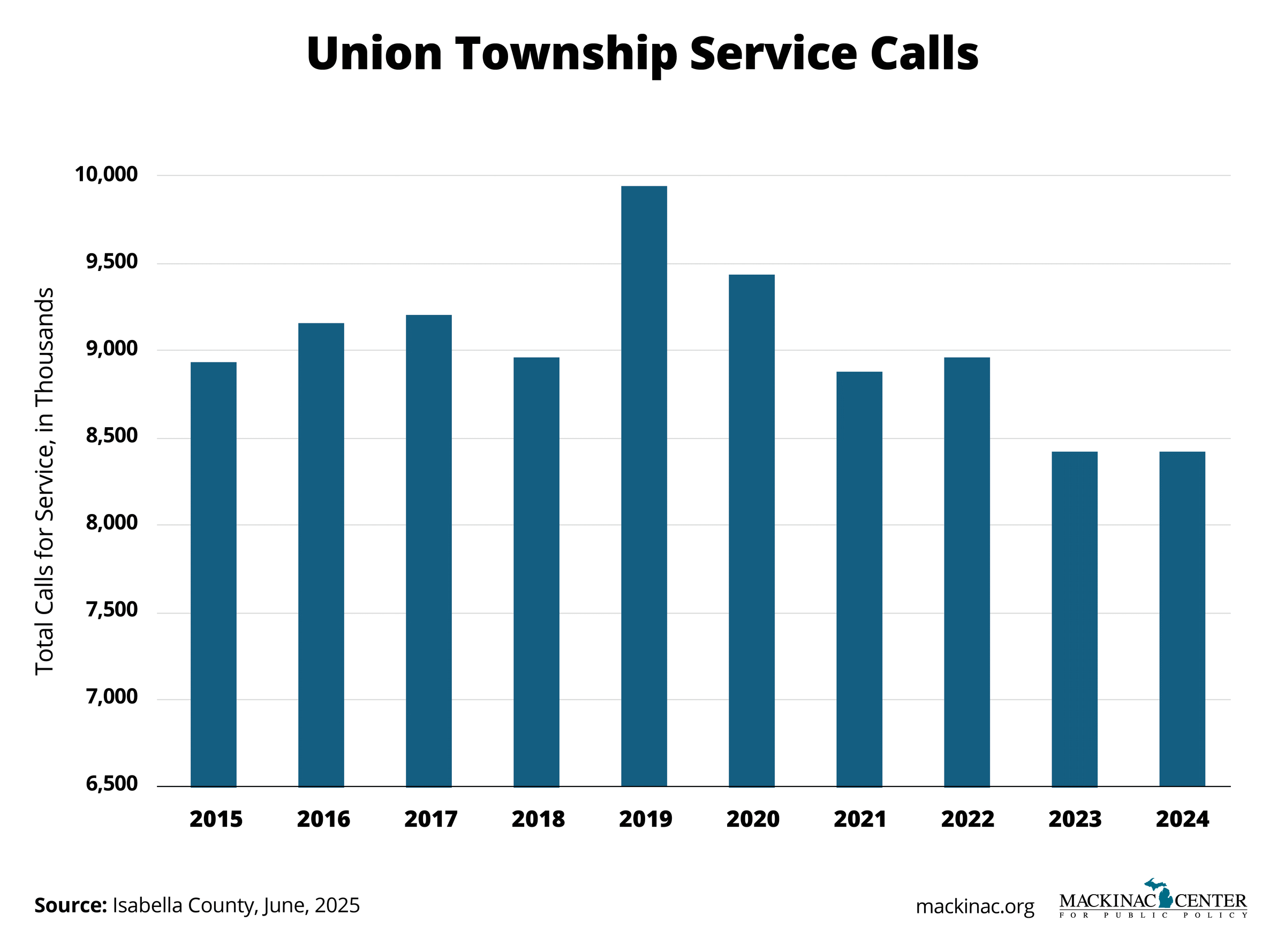
The number of emergency service calls can also reveal the status of a community. One township supervisor in Michigan told me they can reflect economic or population growth in the area. But they also can reflect large community events or an aging population, so caution is advised, this supervisor said.
Calls for emergency service within Union Township numbered 8,932 in 2015, according to Isabella County. The number increased for several years before peaking at 9,902 in 2019 and then steadily falling through 2024.
These metrics — population, taxable value, commercial and new building permits, the number of emergency calls — can give Union Township officials and residents insight into whether the township is growing or in decline.
Officials could help residents and investors by posting convenient, easy-to-locate and easily read dashboards that show various metrics over time. We recommend they start with the measurements mentioned above, using at least 10 years’ worth of data. Union Township’s Global Ends Accomplishment report offers some of this information, but it is insufficient.
A dashboard could also track how many final site plans the township approves each year. A tally of the property tax exemptions given for principal residences could be a proxy for the number of homeowners.
Union Township’s track record of changes in population, taxable value, and building activity all points in the same direction — away from robust growth and vitality. These are not abstract numbers but signals that township leaders, whether elected, appointed or hired, should heed.
Revitalizing any local community will not come when its leaders deny facts or act defensively. Revitalization will come from working to make the community — in this case, Union Township — a place where people want to live, work, and invest. The historical record is not destiny, but it should be a wake-up call.
Other Union Township-Related Publications on the Mackinac Center for Public Policy’s Website:
An Open Letter to Union Township Planning Commission
Open Letter to Union Township Board of Trustees
There’s Something Wrong with Union Township Part 3
There’s Something Wrong with Union Township Part 2
There’s Something Wrong with Union Township Part 1