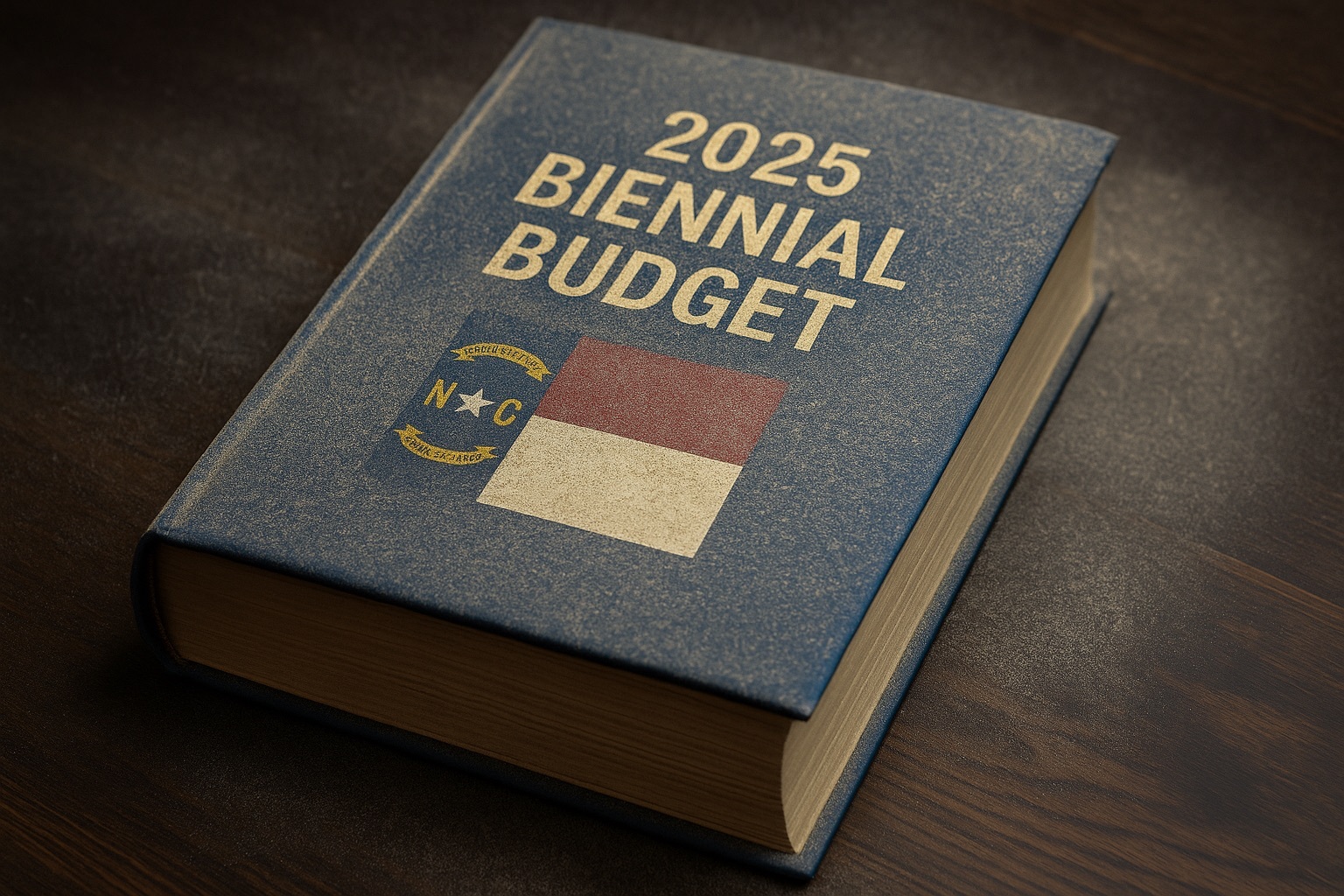
Last month, I urged the North Carolina General Assembly to send a biennial budget to Gov. Josh Stein’s desk before Thanksgiving. I suggested that date for clear reasons:
- Since at least 1995, the General Assembly has always ratified a budget before Thanksgiving. Making teachers, state employees, and taxpayers wait into the holiday season for a budget borders on dereliction of duty.
- During the holiday season, North Carolinians deserve clarity about spending adjustments and policy changes. Instead, the absence of a budget becomes an unavoidable topic of conversation — around Thanksgiving dinner tables, during commercial breaks of football games, and as families decorate their Christmas trees.
Unfortunately, as my colleague Brian Balfour recently explained, a compromise was never reached, and the situation actually deteriorated. What began as a policy debate primarily over personal income tax rate reductions eventually devolved into a procedural dispute when the two chambers clashed over how to fully fund the Medicaid rebase. Each side accused the other of misinterpreting session rules, and as a result, all negotiations came to a halt.
It has now been more than two years since policymakers last sent a comprehensive budget to the governor’s desk
Now, North Carolina stands alone. It is the only state in the nation that was expected to pass a budget in 2025 and failed to do so.
Even more striking: the General Assembly never even sent a budget to the governor’s desk — not for a signature, not for a veto, not at all. This breakdown represents a severe failure of governance, and the legislature is squarely to blame.
Also, this is not an isolated lapse. Last year, the General Assembly failed to send a comprehensive FY 2024–25 budget adjustment to former Gov. Roy Cooper. As a result, it has now been more than two years since policymakers last sent a comprehensive budget to the governor’s desk.
Consequences
North Carolina will gather for Thanksgiving without the General Assembly having ratified a biennial budget. Imagine a typical dinner-table exchange:
“Charlotte, you’ve been teaching for a few years now — what kind of raise did you get this year?”
“None. Teachers and state employees didn’t receive raises because the politicians never passed a budget.”
“Wow. Must be a big standoff between Republicans and Democrats.”
“Actually, no. Republicans control both the House and the Senate. They just failed to send a budget to Gov. Josh Stein’s desk.”
“That’s… unusual. Sounds like serious dysfunction.”
This is precisely the kind of conversation that will unfold across North Carolina this Thanksgiving. To pretend otherwise is to misunderstand how ordinary families talk about politics and how directly they feel the consequences of legislative inaction.
North Carolinians do not care about intraparty rivalries or procedural excuses. They care about whether the government performs its most basic functions. And ratifying a budget is the one responsibility the General Assembly must fulfill to demonstrate basic competence.
This uncertainty also puts local school districts in a bind. Because the state provides roughly two-thirds of their funding, districts can’t properly finalize staffing plans, adjust for enrollment changes, or budget for salary updates.
However, a failure of this magnitude doesn’t just delay spending adjustments; it blocks policies that both chambers broadly support. This year’s stalemate sidelined several shared priorities that should have been straightforward wins.
For example, policymakers in both chambers agreed on the need to reform the state’s relationship with the controversial nonprofit NCInnovation. They also agreed the state’s Savings Reserve should be replenished to its pre-Helene level. These were consensus items, not points of conflict. Yet neither of them moved forward.
Helping to enable this breakdown is the Budget Stability and Continuity Act. The law’s goal was sensible: to prevent government shutdowns by extending prior-year spending levels when a new budget is not in place on time.
Unfortunately, it has created an unintended consequence. Because state agencies can continue operating under the previous budget, lawmakers face less urgency to resolve disagreements, even when consensus exists. Stability was the intent; complacency has been the result.
This needs to be remedied. Ultimately, voters remain the most substantial incentive, and they can insist on a General Assembly that meets its most basic responsibility. However, for the sake of the institution and the state, the General Assembly should strongly consider implementing an incentive structure that will motivate them to ratify budgets promptly.