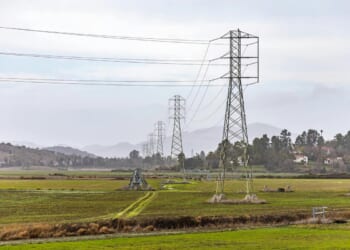
- With the MVP Southgate project getting a critical state water permit, North Carolina is finally set to get its second interstate natural gas pipeline
- The state would have already had more pipelines were it not for Gov. Roy Cooper’s machinations and obstruction
- Access to more natural gas is paramount for North Carolina electricity customers and industrial consumers
After years of denials and delays, on Nov. 13 the Mountain Valley Pipeline (MVP) Southgate project finally received 401 Water Quality Certification (WCQ) from the North Carolina Department of Environmental Quality (DEQ). It is a key permit required by Section 401 of the federal Clean Water Act that the project needs to advance. This development is excellent news for North Carolina’s electricity customers and industrial consumers.
Despite being one of the fastest-growing states in the nation, North Carolina has languished with only one interstate natural gas pipeline, Transco. For many years, of course, it has been fully subscribed, meaning that there have already been buyers under contract for all its capacity. A major expansion of Transco has been announced, at least, but getting more natural gas capacity into North Carolina has been a clear market need for years. It has gone unmet thanks to political shenanigans and ideological obstruction.
The political travails of the MVP project (which will transport natural gas from West Virginia into Virginia) and its extension into North Carolina, the Southgate project, have been lengthy. They are discussed in a recent report from the John Locke Foundation’s Center for Food, Power, and Life called “Power Plays: How an Activist Bureaucracy Obstructs NC’s Energy Future, and What to Do About It.”
The pipeline that wasn’t: Cooper’s machinations and the Atlantic Coast Pipeline project
North Carolina should have gotten a second pipeline started in 2017, when the Atlantic Coast Pipeline (ACP) project requested 401 WQC from DEQ. The ACP was to be a 600-mile underground natural gas pipeline originating in West Virginia and extending through Robeson County. Unfortunately, machinations by Gov. Roy Cooper contributed to costly delays that caused the ACP partnership made up of Duke Energy, Dominion Energy, Piedmont Natural Gas, and Southern Company Gas to cancel the project:
“Power Plays” recounts the delays and their eventual — albeit suspicious — resolution. The ACP’s certification was announced “the same day as a $57.8 million mitigation fund to be controlled by the governor.” A second announcement four days later revealed that “a dispute between Duke and solar facilities had been settled in the solar facilities’ favor.”
The timing being suspect, the Joint Legislative Commission on Government Operations of the North Carolina General Assembly commissioned private investigators from Eagle Intel Services to look into the matter. Their report to the legislature stated that it would be “reasonable to conclude” that:
- “Cooper improperly used the authority and influence of his Office to cause the ACP partnership to commit to a $55 million ‘Mitigation Fund’ that the Governor placed under his complete control [and then] continued to use his authority and influence to delay the ACP permitting process until the ACP partners agreed to increase the fund amount to $57.8 million.”
- “Cooper used the influence and authority of his Office to pressure parties … to enter an agreement that favored the solar industry at the cost of $100 Million to the ratepayers of North Carolina.”
If at first you don’t succeed, deny, deny again: The Cooper administration vs. MVP Southgate
In August 2019, the MVP Southgate project requested 401 WQC from DEQ. The following August, DEQ denied the permit based mostly on the “uncertainty” of the MVP project, with federal permitting still pending or under litigation. Nevertheless, the Hearing Officer’s report for DEQ suggested the option of “conditional approval” depending on the outcome of the MVP project.
The MVP Southgate partners sued, and the Fourth Circuit Court of Appeals struck down the denial in March 2020. The court ruled that DEQ had failed to explain its reasons for issuing the denial adequately — especially why it had chosen outright denial over a conditional approval.
A month later, DEQ again denied the permit. The department added to its rationale that the suggested conditional approval was “too vague to be enforceable” and that “MVP’s acquisition of various permits … provides no guarantee that it will move forward, given several lawsuits” against it.
Since then, three major changes have shifted circumstances in MVP Southgate’s favor:
- June 2023: Congress passed the federal Fiscal Responsibility Act, which included approval of all federal authorizations, permits, and so forth needed by the MVP project
- October 2023: The General Assembly passed House Bill 600, which created statutory requirements for DEQ’s handling of 401 WQC requests, placed time limits for DEQ to act on those requests, and barred DEQ from imposing outside conditions on a certification other than those necessary to comply with state water quality requirements
- December 2023: The Federal Energy Regulatory Commission granted an extension to the MVP Southgate project, which had undergone substantial redesigns, including shortening how far it would extend into North Carolina (31 miles instead of 75) and making “substantially fewer water crossings”
More supply comes at a critical juncture for North Carolina electricity consumers
Electricity demand is expected to grow rapidly by 2030, driven especially by “manufacturing, re-industrialization, and data centers driving artificial intelligence (AI) innovation,” according to a recent Resource Adequacy Report from the U.S. Department of Energy (DOE). That report warns of a serious risk of future blackouts owing to states’ plans to retire working power plants (primarily coal plants) and replace them mostly with renewable energy facilities and not enough traditional, thermal generation sources like natural gas and nuclear power plants.
Specifically, the DOE warns that the blackout risk in the Carolinas will be 27 times greater by 2030 under the current status quo (including phasing out all coal-fired power plants).
In its “2021 Long-Term Energy Assessment,” the North American Electric Reliability Corporation called natural gas “the reliability ‘fuel that keeps the lights on’” and said that “policy must reflect this reality.”
Duke estimates power generation to increase by 48.9 percent from 2026 to 2040. Access to more natural gas — made possible with the Transco expansion and especially with MVP Southgate project finally obtaining 401 WQC from DEQ — is paramount for North Carolina electricity consumers.