As part of the John Locke Foundation’s NC250: Freedom’s Vanguard initiative, this essay contest invited students, scholars, historians, and writers to explore North Carolina’s pivotal role in the American Revolution and the founding of the United States. The project highlights the state’s contributions to independence, liberty, and the shaping of the American Republic.
Preamble
“Patriotism,” argued Charles Caldwell in the preface to his memoir of Nathanael Greene, “holds no alliance with apathy and indifference. It is an active and comprehensible virtue, which essentially influences life and conduct.”[1] For Caldwell, patriotism was “comprehensible,” and in order to comprehend it, we must look to past examples.[2] The Battle of Guilford Courthouse on March 15, 1781, was one such example. This battle was merely one of many in America’s struggle for independence, as the soldiers near the courthouse exercised their natural right to overthrow a corrupt government. Though the Battle of Guilford Courthouse was an American defeat, it turned the tide of the Southern Campaign by ensuring that the British would not muster sufficient loyalist support to conquer the American South. In the long term, the battle paved the road to Yorktown, setting the stage for the end of the American Revolution and the rise of a new nation.
The context of the battle
In 1778, the British turned their attention from the New England colonies to the South after the disastrous battle at Monmouth. As infamous British Lieutenant-General Banastre Tarleton — who fought in the Battle of Guilford Courthouse — stated in his history of the Southern Campaign, at this point “the whole aspect of the American war experienced a change the most critical and interesting.”[1]
The British believed that Southern loyalists, particularly in the Carolinas, would rise up and fight alongside them. Much to their dismay, they overestimated the numbers and commitment of their supporters. Despite this misfortune, the British were still able to capture Savannah, Georgia, in 1778. They then pushed north until they captured Charleston under Sir Henry Clinton in 1780. Confident that “the Carolinas have been conquered in Charleston,” Clinton left the Southern Campaign to Lord Charles Cornwallis, who made the fatal decision to invade North Carolina in September 1780.[2] Major General Nathanael Greene of the Continental Army, George Washington’s close friend, determined to crush Cornwallis’ hopes. They were already dampening: In the backwoods colony, Cornwallis’ men grew sick and weary, unaccustomed to marching through the densely wooded terrain.
Writing to General Sumter in Western North Carolina on January 30, 1781, Greene stated, “The question is what is to be done with Lord Cornwallis. He seems to be pushing into the Country … Methinks if the militia could be generally brought out in aid of the Continental Army he might be ruined.”[3] Both Cornwallis and Greene counted on their armies being supported by the locals: the former, on North Carolina Tories, the latter on North Carolina militia. But only Greene would enjoy significant support from the North Carolinians. At the battle, Cornwallis had 130 loyalist volunteers — although he also had Hessian troops — whereas Greene had 1,000 members of the local North Carolina militia to serve on the front line.[4]
Greene’s soldiers were by no means professional. Most came from an agrarian background, although a significant number were engaged in maritime pursuits. Interestingly, at least 110 free black soldiers fought in Greene’s Continental forces, constituting over 12.5 percent of the Continentals present.[5] This number included Sergeant Isaac Brown, who had authority over white privates and corporals.
According to Guilford veteran Charles Stedman’s history of the Revolution, the people of Georgia and South Carolina were “ignorant, idle, and inactive,” but the people of North Carolina were “hardy and robust … and [found] their principle amusement in shooting, for wagers, with rifles at a mark.”[6] Whether or not Stedman was fair in his assessment, Cornwallis realized that North Carolina would not be as easily won as Charleston. Cornwallis endeavored to draw Greene into battle in the months preceding March 1781. Once the Continental brigades from Virginia and Maryland arrived, Greene allowed the armies to meet while his forces camped by the small rural Guilford Courthouse. As Stedman stated, Greene was “offering battle to lord Cornwallis.”[7] Cornwallis “embraced with much satisfaction the proffered opportunity of giving him battle.”[8]
The battle
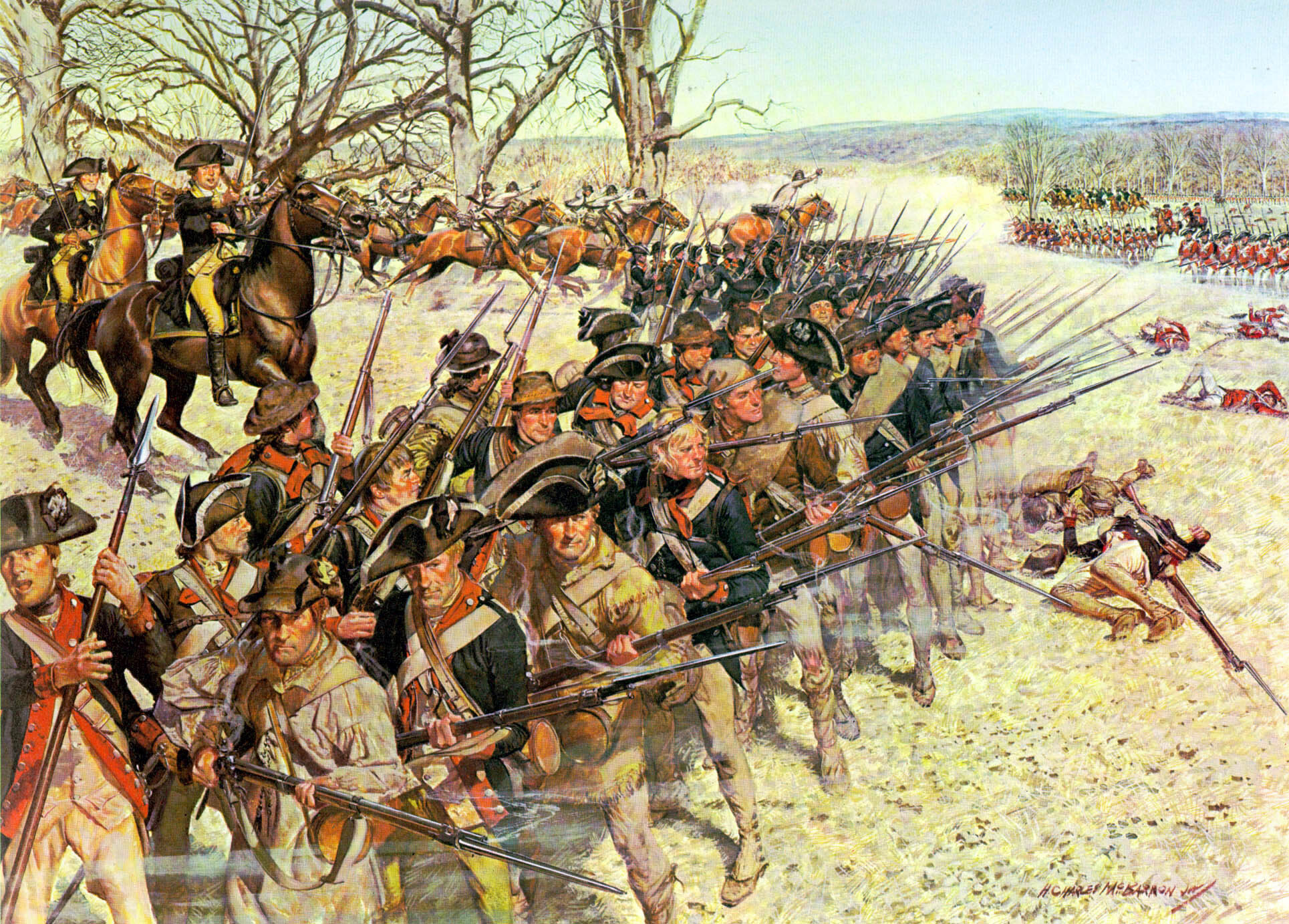
Cornwallis’ troops headed toward the courthouse from their station in Hillsborough, North Carolina, engaging in a “sharp conflict” along the way with the skilled “Light Horse Harry” Lee and his men.[1] The skirmish bought Greene two hours and thirty minutes to position his forces. As Tarleton stated, Greene divided “[s]even thousand men into three lines … and waited the attack.”[2] The Major-General had the advantage of knowing the sloped and wooded terrain around the courthouse. He positioned his first line, consisting of North Carolina militia, close to a split-rail fence.[3] About 400 yards behind them, the second line was “composed of the Virginia militia … who formed their brigades in the woods parallel to the front line” with a few Continental veterans interspersed with the militia.[4] Greene reserved the Continental Army, his best trained soldiers, for the last line. He “posted” his two Continental brigades — Brigadier-General Huger’s brigades, comprised of the 4th and 5th Virginia regiments, and Colonel Williams’ Brigade, comprised of the 1st and 2nd Maryland Regiments — “facing the wood where the two lines of militia were drawn up” in an open area that was cleared by farmers.[5] Greene instructed the first line to give two volleys of fire, then retreat. His goal was to utilize the first and second lines to weaken Cornwallis’ forces before they encountered the most valuable and formidable regiments in the third line.
When the British regulars reached the courthouse in the early afternoon, their two front regiments trudged across a wet cornfield toward the North Carolina militia. The militia fired a devastating initial volley at the British, but once the British fired back, the overwhelming majority retreated without firing a second or third volley as Greene had commanded. Greene was thoroughly displeased with their behavior, complaining in a letter to George Washington that “had the North Carolina Militia seconded the endeavors of their officers, victory was certain. But they left the most advantageous position I ever saw without scarcely firing a gun.”[6]
In all of Greene’s accounts of the battle, his anger at the front line was evident. Other observers took into account the militia’s lack of training and the substantial injuries inflicted on the British. However, Greene was a brilliant, educated strategist, and his expectations of the North Carolina militia were high. Many other accounts of the battle tend to stress the damage the North Carolinians inflicted on the British army. A member of the North Carolina militia, William Montgomery, stated that “[t]he part of the British line at which [the militia] aimed looked like the scattering stalks of a wheat field, when the harvest man has passed over it with his cradle.”[7] Montgomery’s statement reveals that North Carolina militia did significantly weaken the army before it reached the second and third lines.
Greene was pleased with the performance of the second line, writing that the “Virginia Militia behaved with great gallantry.”[8] Stedman agreed that the “second line … made a much braver and stouter resistance than the first.”[9] Since the second line of Greene’s forces were stationed at the edge of the dense wood, the British regulars were forced to break ranks in order to maneuver throughout the trees. After holding out for a good while, Cornwallis himself — both he and Greene were notable for fighting in the thick of battle — led a charge which finally broke the Virginia line, the remaining members of which retreated to join the third line. Nearly all accounts of the battle mention the courage of the Virginia militia, who would not retreat until receiving a direct order.
Exhausted by the first two lines of Greene’s forces, the remaining British forces advanced at around 2:30 p.m., to be met by the disciplined Continental brigades. Greatly outnumbered by the Continentals, the British met a volley of cannon fire. The Hessian soldiers joined the British in marching and firing upon the Continentals at first from the front, then from the rear. Had it not been for their efforts, the British would perhaps not have succeeded in ending “the hard-fought action at Guilford Courthouse.”[10] Greene and his men abandoned the field, leaving their wounded to be cared for by the British. Since most of the cavalry horses were killed, Greene left the four Continental cannons to the British. Having gained a field, four cannons, and nothing more, the British set about to bury their dead.
Aftermath
To the extent it can be called a victory, Cornwallis’ was a stunning one. As Stedman stated, the British “defeated an army of more than three times their own number, not taken by surprise, but … strongly and judiciously posted, on ground chosen with care, and most excellently adapted to the nature of the troops that occupied it.”[1] Yet Stedman also observed that the Light Brigade–like valor of Cornwallis’ troops gained them little, as the “consequences [of the battle] were of no real advantage to the cause in which they were engaged … the expence at which it [the victory] was obtained rendered it of no utility.”[2] In fact, the high number of casualties the British suffered — about a third of all troops who fought were lost — meant that across the Atlantic, Englishmen cried out for the war to end, with politician and writer Horace Walpole predicting a British defeat. Member of Parliament Charles Fox famously stated, “Another such victory would be the ruin of the British army.”[3] This “most hazardous, as well as severe battle” had the effect of causing English morale for the war to plummet.[4] Most importantly, the British victory, which was “neither useful nor advantageous,” meant that the disillusioned Cornwallis could no longer depend upon loyalist support.[5] After the battle, Cornwallis issued a proclamation urging loyalists to join him. He was “greatly disappointed” by the lack of loyalist aid.[6]
In contrast, in a letter to Thomas Jefferson the day after the battle, Greene did not appear particularly downcast, writing that “except the honor of the field,” the British had “nothing to boast of.”[7] Greene declared that he had “nothing to lament except the loss of several valuable Officers.”[8] By March 23, Greene considered his prospects “flattering in Virginia” and “not discouraging” in North Carolina.[9]
After the battle Greene retreated with his men to the ironworks near Troublesome Creek, some miles away from the courthouse. On March 18, the British left their hard-earned field, traveling to Cross Creek and not in any position to make another attack. Greene hoped “to convince the Enemy that while they attempt new conquests they lose their old possessions.”[10] The field by Guilford Courthouse was one such new conquest. By his victory, Cornwallis soon lost Charleston. When he attempted to win Virginia, Cornwallis effectively lost every claim he had in the British colonies.
The battle turned the tide of the Southern Campaign. Instead of Cornwallis chasing Greene, Greene began to take the initiative. Before the battle, Greene had complained to Henry Lee, “Cornwallis would not give us an opportunity to act offensively.”[11] The British began to move south, relinquishing their goal of capturing North Carolina. Cornwallis wrote to Major General Phillips, “The idea of our friends [loyalists] rising in any number and to any purpose totally failed … let us quit the Carolinas.”[12] On April 10, 1781, Cornwallis wrote to Clinton, “North Carolina is of all the provinces in America the most difficult to attack.”[13] Cornwallis found the wooded North Carolina terrain difficult to navigate and the people of North Carolina largely unwilling to flock to his cause.
While Greene marched into South Carolina, Cornwallis made the ill-fated decision to abandon Georgia and the Carolinas and endeavor to take Virginia. George III was no longer king of the American South. The British would not surrender until several months later, but they were already marching toward defeat at Yorktown.
Analysis
In his memoir of Greene, Caldwell stressed the gratitude that the nation owed to the Major General. If a republic were ungrateful to past leaders, he argued, “the fact would constitute a weighty objection against the reputed advantages of that form of government, and render doubtful its preference to others.”[1] The Battle of Guilford Courthouse should be remembered, especially in this year, the 250th anniversary of the Revolutionary War. Without this little-known battle, the British might have held the South, including Charleston. Cornwallis would not have moved into Virginia and would not have surrendered the war at Yorktown.
Back in England, Clinton and Cornwallis argued over who was to blame for the surrender at Yorktown, yet both of them emphasized the importance of Cornwallis’ move out of the Carolinas, prompted by the Battle of Guilford Courthouse. While Clinton stated that he “had every reason to disapprove of Earl Cornwallis’ march into Virginia,” he conveniently avoided discussing that Cornwallis had few other options.[2] He could possibly have kept on fighting Greene in North Carolina, but his men were exhausted and his troops a remnant of what they once were. To meet Greene again in similar circumstances would have effected instant doom.
Despite his displeasure with the front line, Greene did pose one solution as to how to involve the militia in battle, despite their lack of training. Though he situated the North Carolina militia in the front line, they were not expected to maintain their ground, and he provided the Virginia militia with the cover of trees. In this way, Greene incorporated the militia into his strategy without needlessly sacrificing lives. Tarleton himself admitted that Greene’s positioning of his men was “extremely well chosen.”[3]
The battle highlights the role that local militia and common people played in the American Revolution. If Cornwallis had received the degree of loyalist support that he had expected, he could have won the battle more decisively and eradicated Greene’s army. In truth, the revolution was a movement of the people, from its very inception in Lexington where farmer militia battled the regulars. Even the Continental soldiers generally came from modest backgrounds, and while better trained, were often poorer than the militia. Those who fought in the American Revolution were exerting their right to overthrow a government which would no longer listen to the voices of the people. As Henry Lee IV, son of the quick-witted skirmisher who delayed Cornwallis, later stated, “[t]here is no point of modern history, upon which the eyes of posterity will be turned with more frequency and interest, than upon the American Revolution,” as it “vindicat[es] the adequacy of man to self government.”[4]
Lee’s idea can be understood in light of the fact that the Revolutionary War took abstract principles of self-governance and tested them in real life. The success of the American Revolution proved that it was possible for a people to set up a viable government based on the consent of the governed. The Battle of Guilford Courthouse was instrumental in the Revolution’s success. It was a first step down the path to the British surrender at Yorktown and thus played a key role in forming American democracy.
[1] Caldwell, viii.
[2] Sir Henry Clinton, Narrative of Lieutenant-General Sir Henry Clinton, K. B. relative to his conduct during part of his command of the king’s troops in North America; particularly to that which respects the unfortunate issue of the campaign in 1781 (London: J. Debrett, 1783), 17.
[3] Tarleton, 277.
[4] Lee, The Campaign of 1781 in the Carolinas, 109.
[1] Stedman, 382.
[2] Stedman, 382.
[3] Qtd in Burke Davis, The Cowpens–Guilford Courthouse Campaign (Philadelphia: The University of Pennsylvania Press, 2003), 175.
[4] Tarleton, 277.
[5] Tarleton, 277.
[6] Stedman, 386.
[7] Nathanael Greene, “To Thomas Jefferson from Nathanael Greene, 16 March 1781,” in The Papers of Thomas Jefferson, vol. 5, 25 February 1781 – 20 May 1781, ed. Julian P. Boyd (Princeton: Princeton University Press), 1952, 156.
[8] Greene, “To Thomas Jefferson from Nathanael Greene, 16 March 1781,” in The Papers of Thomas Jefferson, vol. 5, 25 February 1781 – 20 May 1781, ed. Boyd, 156.
[9] Greene and Sumter, “Official correspondence between Brigadier- General Thomas Sumter and Major- General Nathanael Greene, from A.D. 1780 to 1783,” 84.
[10] Greene and Sumter, 82.
[11] Henry Lee, The Campaign of 1781 in the Carolinas (Philadelphia: E. Littell, 1824), 1.
[12] Qtd in Davis, The Cowpens–Guilford Courthouse Campaign, 180.
[13] Qtd in Davis, 181.
[1] Stedman, 366; Thomas E Baker, Another Such Victory (New York: Eastern Acorn Press, 1981), 50.
[2] Tarleton, A history of the campaigns of 1780 and 1781, in the southern provinces of North America, 271.
[3] Tarleton, 271.
[4] Tarleton, 271.
[5] Tarleton, 271.
[6] Nathanael Greene, “To George Washington from Nathanael Greene, 18 March 1781,” Founders Online, National Archives, 1781, accessed May 3, 2025, https://founders.archives.gov/?q=Author%3A%22Greene%2C%20Nathanael%22&s=1111311113&r=282.
[7] Qtd in Babits and Howard, 142.
[8] Nathanael Greene, “To George Washington from Nathanael Greene, 18 March 1781.”
[9] Stedman, 377.
[10] Stedman, 381.
[1] Lieutenant-General Banastre Tarleton, A history of the campaigns of 1780 and 1781, in the southern provinces of North America (London: T. Cadell, 1787), 21.
[2] Qtd in Lawrence E. Babits and Joshua B. Howard, Long, Obstinate, and Bloody: The Battle of Guilford Courthouse (Chapel Hill: The University of North Carolina Press, 2009), 6.
[3] Thomas Sumter and Nathanael Greene, “Official correspondence between Brigadier- General Thomas Sumter and Major- General Nathanael Greene, from A.D. 1780 to 1783,” in Year Book, 1899, City of Charleston, So. Ca. (Charleston: Lucas & Richardson Company, 1899), 79.
[4] Angus Konstam, Guilford Courthouse 1781: Lord Cornwallis’ Ruinous Victory (Oxford: Osprey Publishing, 2002), 62.
[5] Babits and Howard, Long, Obstinate, and Bloody: The Battle of Guilford Courthouse, 75.
[6] Charles Stedman, The History of the Origin, Progress, and Termination of the American War, Volume I (London: Charles Stedman, 1794), 6.
[7] Stedman, The History of the Origin, Progress, and Termination of the American War, Volume I, 375.
[8] Stedman, 375.
[1] Charles Caldwell, Memoirs of the life and campaigns of the Hon. Nathaniel Greene, major general in the army of the United States, and commander of the Southern department, in the war of the revolution (Philadelphia: Robert Desilver and Thomas Desilver, 1819), ix.
[2] Caldwell, Memoirs of the life and campaigns of the Hon. Nathaniel Greene, major general in the army of the United States, and commander of the Southern department, in the war of the revolution, ix.