- Democrats dominated North Carolina politics for generations after the 1898 election
- The Democratic share of the electorate has declined for decades, while the number of Republicans in the state has increased
- While North Carolina flipping red is an important milestone, other factors (such as the rise of unaffiliated registrations) mean that its impact on future voting behavior is limited
Soon, and for the first time since at least the Reconstruction era, Republicans will overtake Democrats as North Carolina’s largest political party. While that is an important milestone, North Carolina will remain a competitive, if slightly red-leaning, state for the foreseeable future.
Decades of Democratic dominance
Like the rest of the South, North Carolina had a period of electoral competitiveness during and immediately after Reconstruction. Unlike much of the South, however, Republicans remained competitive here through the 1890s.
The reason for that competitiveness was a unique combination of Republican Unionists in the west and black Republicans in the east:
The size of these two Republican strongholds in the state was unique in the South, and it meant that North Carolina had a larger Republican Party and a more closely divided electorate. There were always numerous Republicans, and even continuous officeholding by African Americans, in North Carolina’s General Assemblies from 1865 to 1899.
That came to an end with the white supremacy campaign of 1898. Democrats followed that victory with Jim Crow laws that stripped blacks of their voting rights, which entrenched their dominance in North Carolina for generations. After Rep. George White left office in 1901, there was not another Republican elected to Congress from eastern North Carolina until Jim Garner in 1966.
Republicans would not regain competitiveness in statewide elections until the 1970s.
A long Democratic decline
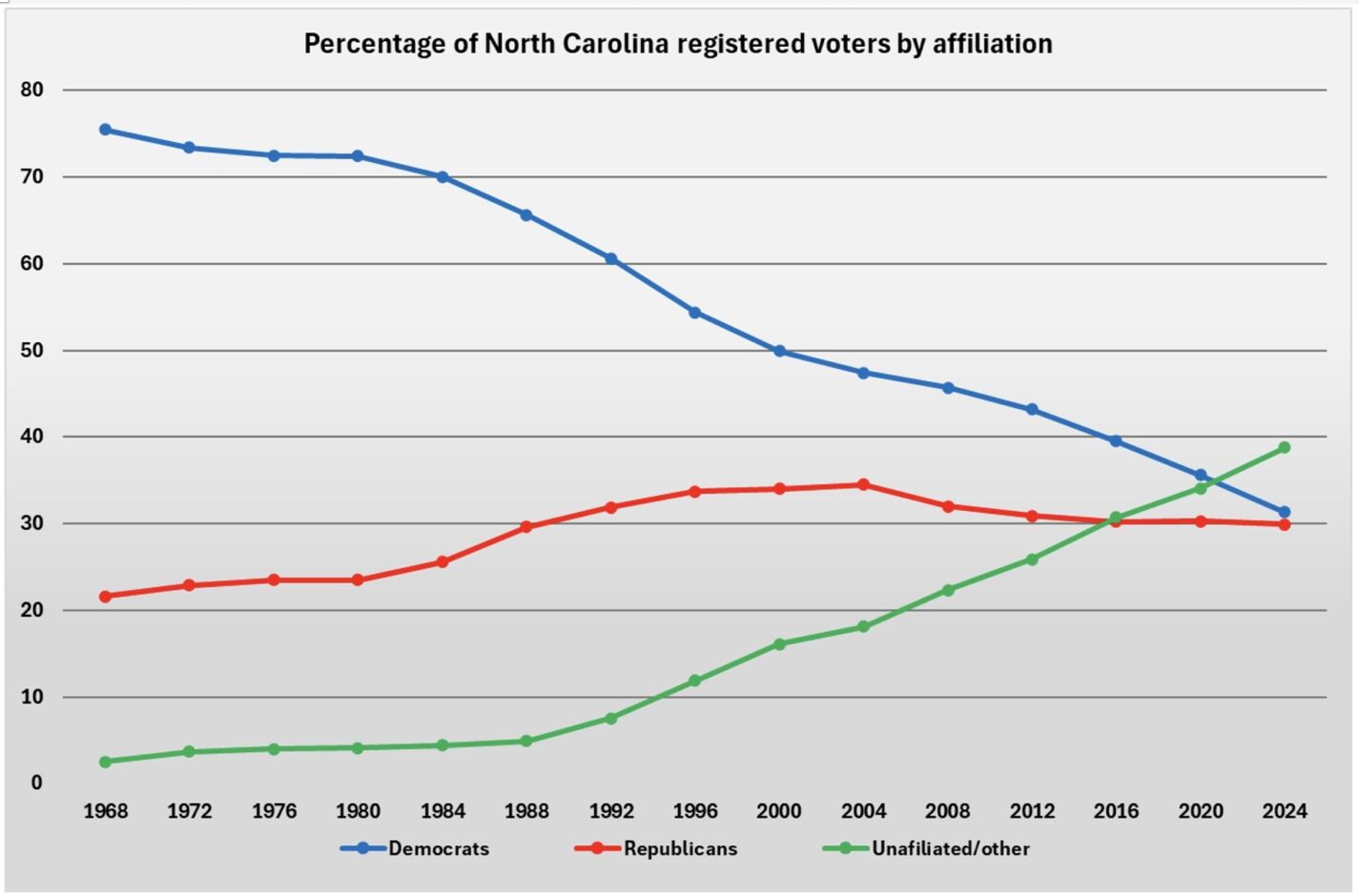
Garner’s election coincided with the start of a gradual increase in the number of Republicans in North Carolina. Republicans comprised just 21.6 percent of North Carolina’s electorate in 1968, rising to 25.6 percent in 1980. The proportion of voters who were Democrats during that period declined from 75.5 to 70.0 percent. Despite continued Democratic dominance in registrations, Republicans achieved some electoral successes, regularly winning races for governor and U.S. senator over that period.
The Republicans’ rise, and a corresponding decline in Democratic registrations, accelerated in the 1980s and 1990s as President Ronald Reagan helped Republicans make gains across the South.
The 1990s also saw a rapid increase in the number of unaffiliated voters, a trend that continues to this day. While dissatisfaction with the two major parties may have contributed to the rise in unaffiliated voters, a structural change also fueled it. Unaffiliated voters have been allowed to vote in either party’s primary since the mid-1990s, negating the need to register with a specific party. Unaffiliated registrations surpassed Republicans in 2017 and Democrats in 2022.
The rapid rise of unaffiliated voters, combined with North Carolina’s population growth, has resulted in the proportion of registered Republicans remaining steady over the past three decades, despite an increase in their absolute numbers. During that time, the number and proportion of Democrats have continued to decline.
The figure below shows the proportions of the North Carolina electorate registered as Democratic, Republican, or unaffiliated/other (which includes a small number of individuals from minor parties) from 1968 through 2024.
Percentage of North Carolina registered voters by affiliation
Data sources: NC Center for Public Policy Research, NC Free, North Carolina State Board of Elections, the John Locke Foundation’s Carolina Elections
North Carolina’s partisan flip means less than it might seem
The improved political fortunes of Republicans in North Carolina preceded their relative rise in registrations. Part of the reason for that was the so-called “Jessecrats,” registered Democrats who regularly voted for Republican candidates. The term is named after Sen Jesse Helms, who regularly secured the votes of conservative and moderate Democrats, especially in the eastern half of the state.
By the 2020s, those Jessecrats have largely disappeared, either through party switching or death. Their disappearance is why Democrats have stayed competitive in North Carolina despite their proportion of registered voters declining precipitously over the past several decades.
Voter registrations in North Carolina, by affiliation
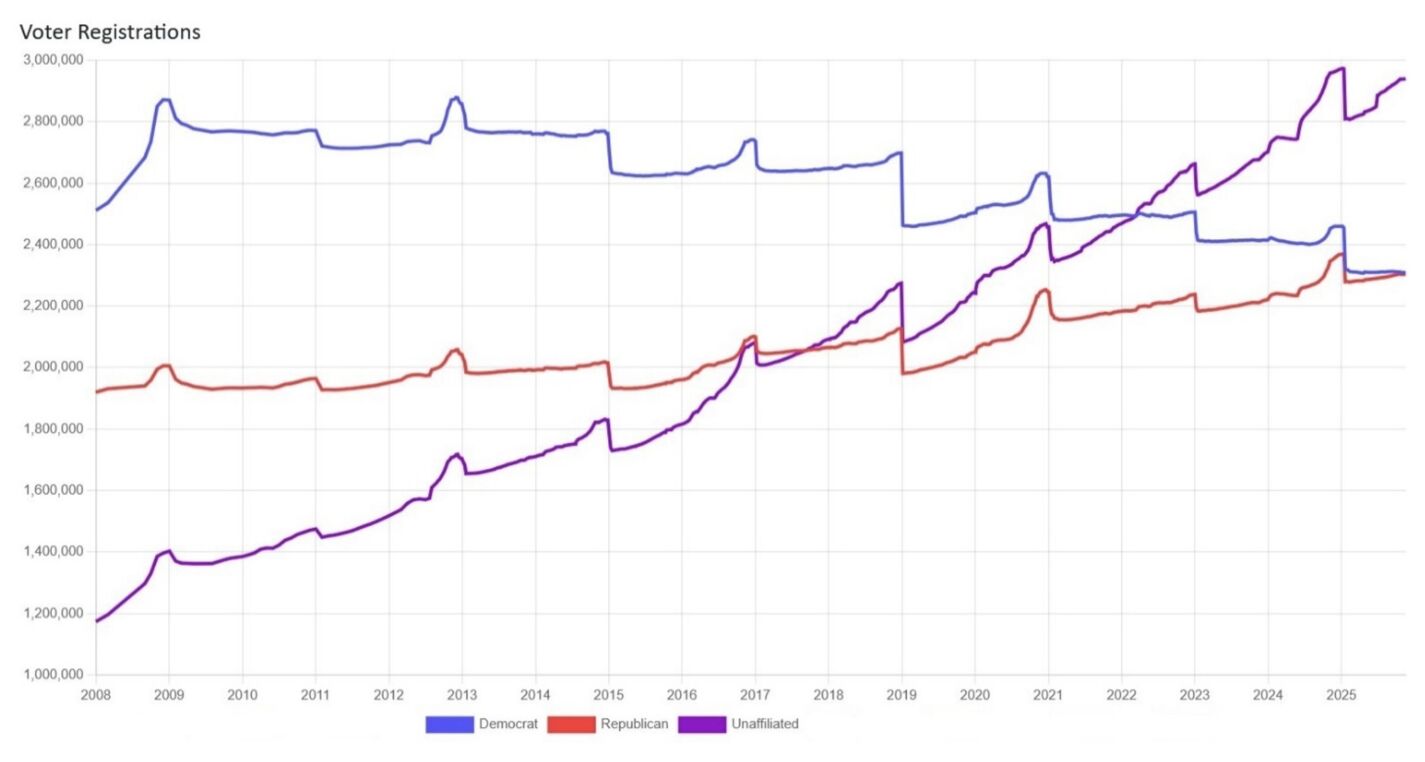
Screenshot from the John Locke Foundation’s Carolina Elections. The legend has been modified to remove references to data other than Democrats, Republicans, and unaffiliated.
The rise in unaffiliated voters also complicates the picture. A study of North Carolina unaffiliated voting behavior in the 2020 election found that the “explanatory power of the Unaffiliated precinct electorate was close to zero,” although it leaned slightly Republican, meaning that neither party had an appreciable advantage among unaffiliated voters.
Another study by the same group of political scientists found that “Unaffiliated North Carolina voters contain both shadow partisans [who consistently vote for one party] and partisan floaters [who are ‘unmoored’ to either party].” That finding is consistent with other studies and the experience of election professionals. They indicate that, as the number of unaffiliated voters increases, North Carolina’s elections will remain volatile and competitive, even as Republicans surpass Democrats and then expand their registration advantage.
While it is always better to be North Carolina’s largest political party than it is to be the state’s second largest party, that prize is less important than it once was.