Written by
Originally published in Utah News Dispatch.
As Utah lawmakers pursue legislation on redistricting — both in special session and in the upcoming 2026 legislative session — sound constitutional principles that respect the people’s will ought to prevail. Sadly, in the redistricting debate that has been occurring primarily in courtrooms in the last several years, both principle and the people have often taken a back seat to national partisan interest.
Judicial decisions around redistricting have undermined sound constitutional ideas while simultaneously transforming Utah into a national partisan battleground over the 2026 midterm elections. Driving the debate is Proposition 4, which created a redistricting commission to assist the Utah Legislature in redistricting decisions, and also planted in Utah law the concept of using lawsuits to dispute legislative redistricting decisions.
As a recent Sutherland Institute/Y2 Analytics poll recently revealed, Utah voters are being left behind by all sides.
Two high-level trends clearly stood out from the poll of Utah voters:
First, voters clearly want people they elect to be primarily responsible for defining boundaries in congressional districts, while rejecting the idea of that responsibility falling to judges. Fully 71% of Utah voters want people who are elected (an elected body or individual elected official at the state or county level) to be primarily responsible for defining boundaries for congressional maps. By contrast, only 8% of voters prefer judges making the decision. This rejects the idea of a judiciary-driven outcome envisioned by Proposition 4, and which is playing out before our eyes.
Second, voters clearly want a redistricting commission involved in the process with the Utah Legislature. When asked about the roles of the Utah Legislature and a commission in the redistricting process, 91% of Utah voters prefer some meaningful role for a commission, while only 9% of Utah voters say the Legislature should be solely responsible for determining district boundaries. This argues against the pre-Proposition 4 status quo.
A 2024 decision by the Utah Supreme Court further complicates enacting a policy solution that reflects the will of voters. The Legislature in 2020 replaced Proposition 4 with an advisory redistricting commission that eliminated the judicial enforcement provision of Proposition 4. The Utah Supreme Court’s ruling struck it down.
This means the current unsatisfactory process must be changed via ballot initiative or constitutional amendment, both of which require a vote of the people. If the current effort to repeal Proposition 4 proves successful, it would give the Legislature an opportunity to establish the kind of redistricting commission process that voters desire (without judicial encroachment). Similarly, the Utah Legislature could place a constitutional amendment on the ballot that defines the role of the Legislature and any commission created by law in redistricting.
Both are possible avenues today, but national partisan interests pose a challenge. One side seems to view Proposition 4 as the best means to accomplish their partisan ends, while the other side seems to view simple repeal of Proposition 4 in the same way.
Voters want more than what partisan interests are offering. They want the people they elect in the driver’s seat, with a redistricting commission to help, and without final decisions being made by judges. Policymakers can and should deliver those reforms.
More Insights
Read More
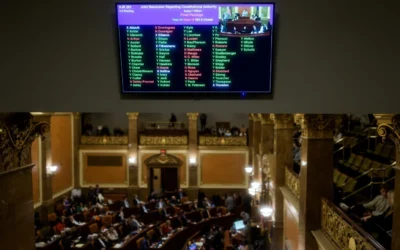
Utah voters want more out of redistricting, and policymakers should give it to them
As Utah revisits redistricting laws, voters overwhelmingly prefer elected leaders and a commission, not judges, shaping congressional maps. Polling reveals a clear path for reforms that reflect the people’s will.
Why the Supreme Court should rein in lawfare against nonprofits
The Supreme Court’s First Choice v. Platkin case highlights how lawfare threatens donor privacy, free speech, and religious nonprofits.
Determining the mission of the state education agency
Utah’s education priorities show how state education agencies can reassess their duties, refine their mission, and better support parents in a new policy era.
Connect with Sutherland Institute
Join Our Donor Network
Follow Us
The post Utah voters want more out of redistricting, and policymakers should give it to them appeared first on Sutherland Institute.