Share this Story on Facebook, X, Text, LinkedIn, Gmail, Yahoo Mail, or Outlook
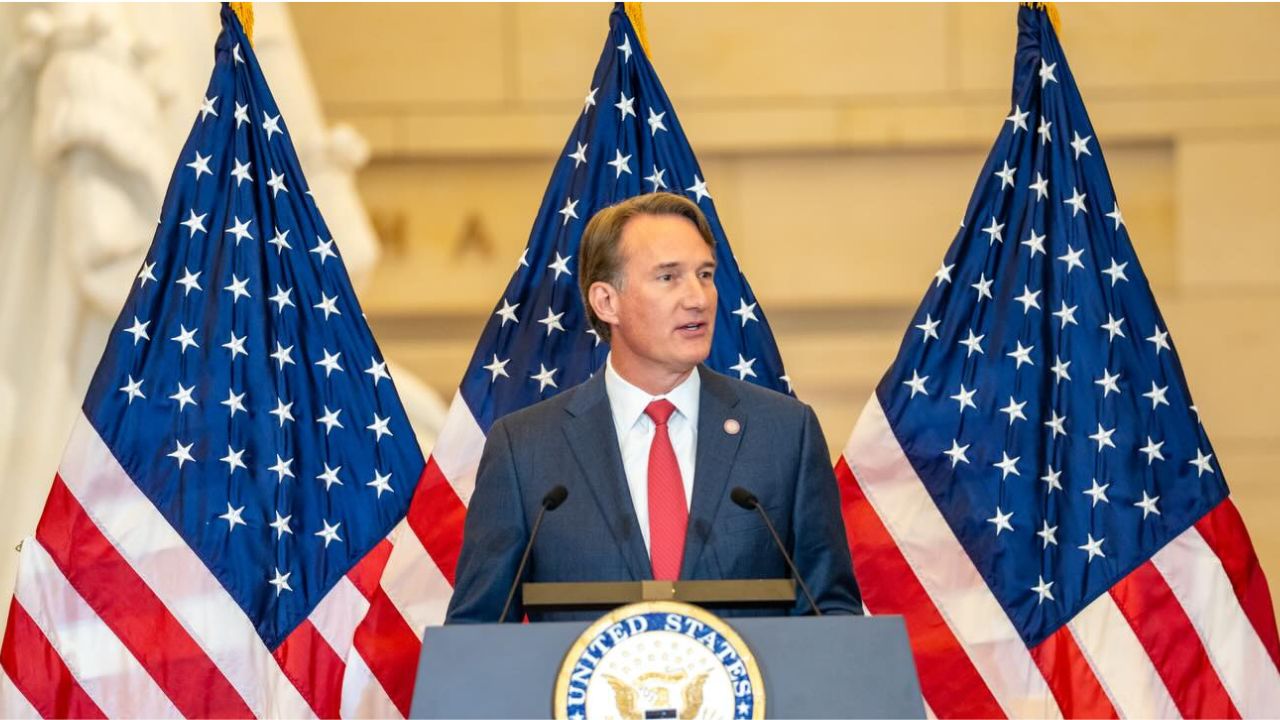
Governor Glenn Youngkin has proposed that Virginia conform its tax rules to most of the changes in federal taxes adopted by Congress last summer, including recognizing a state tax deduction for tip income, overtime pay and interest payments on car loans.
Those tax policy recommendations are part of the Republican’s final introduced state budget package, which he presented to legislators on Wednesday at a joint meeting of the House and Senate financial committees. Their fate will be decided early next year by the legislators and incoming Democratic Governor Abigail Spanberger.
The departing Governor also proposed to make other tax cuts he enacted during his term permanent, including the state’s current standard deduction amount of $8,750 per person or $17,500 per couple and the higher Earned Income Tax Credit. Without legislative action the standard deduction would revert to the $6,000 per couple, which was the allowed deduction at the start of his term. The higher deduction saves a married couple up to $661 per year, so losing it would hurt.
“There is no need for any new taxes and there is no need for tax increases,” Youngkin told the assembled legislators and Spanberger, who was watching in the front row. He included in that admonition the carbon tax on electricity imposed by the Regional Greenhouse Gas Initiative (RGGI), which he ended but which Spanberger has pledged to reimpose, reaping half a billion dollars per year from energy customers.
Youngkin is proposing only partial compliance with the new federal deductions for tips and overtime income, and the car loan interest. Deductions would not be available this current year, unlike the federal deductions. Starting with tax year 2026, a taxpayer who qualified for those deductions at the federal level could take 25% of that amount off on their state tax return, and in subsequent years it rises to 50% of the federal amount.
For example, someone who deducts $5,000 from their federal taxable income because they earned tips or overtime pay would get a $1,250 Virginia deduction in 2026, and then another $2,500 Virginia deduction in 2027 and later years. This approach is clearly a compromise intended to head off complaints that the deductions have too deep an impact on state revenue.
With the proposed budget – even after the tax changes – still setting new records for revenue and spending, it is hard to argue seriously that those deductions will impair the state’s operations. In the next two fiscal years the state’s operating budgets will reach $100 billion annually (up from $71 billion per year four years ago), with more for capital projects. Some will want more, inevitably.
Youngkin is also proposing that the state only conforms to some, but not all, of the other ways the federal bill changed the definitions of taxable income, again blunting their impact. For example, a major business deduction for spending on research and development, retroactive to past years under the new federal law, would only apply in future years to Virginia’s business taxpayers. He is proposing that the state abandons the cost-of-service model for taxing business income and instead adopt market-based sourcing, now used by most other states with a corporate income tax.
By afternoon, the liberal-leaning Commonwealth Institute for Fiscal Analysis was complaining: “Unfortunately, Governor Youngkin has chosen to hand out over $400 million to corporations, businesses, and ultra-wealthy investors by mostly conforming to the tax provisions in HR1. That is money that could be better used to invest in Virginia families.” It has its own plan for your taxes, which we reviewed in an earlier article.
Youngkin argued that the tax changes he has made during his four years have contributed to Virginia’s financial success, which he sees continuing despite some slowing down during 2025. The business tax changes in his conformity package will help with that momentum, he argued.
During his term the tax changes he approved saved taxpayers $6 billion over four years, with an additional $3 billion in tax relief returned as individual rebates. Making the tax rules permanent and adding the conformity provisions he endorses would save another $7.5 billion over the next four years.
“This high rate of revenue growth should continue as long as Virginia stays with the winning formula. Indeed, despite the predictions for financial calamity. Financial calamity that was predicted by many this year and I have to say by many in this room… financial calamity hasn’t happened, and Virginia is again running a significant surplus,” Youngkin told the committees.
After the tax policy changes, Youngkin and his staff still project state revenue will grow 3% annually during the next budget period, and they based their budget on that prediction. Revenue has grown an average of 8% annually during his term, and even in this slower year it is still rising about 5% so far. To budget based on 3% is quite cautious.
But the cautious projection still provides sufficient funds for the state to provide $1 billion more for paying state and local employees, including raises and a bonus. More than half of the new spending for the period goes to just one program, Medicaid, which will get another $2.4 billion in state general fund money and reach a total state-federal combined spend of $62.5 billion over two years.
The other big winner in Youngkin’s proposal is education, with $695 million in additional spending from general funds over two years for local public schools and another $435 million from general funds for colleges and universities. The budget does not include many new proposals, except for a $2 billion capital spending plan.
It is a quirk of Virginia’s system that a departing Governor introduces a full two-year budget in the final month of his term. He doesn’t have to stick around and watch it get carved up. This effort deserves more respect than it is likely to get.
Secretary of Finance Stephen Cummings went into deeper detail with the legislators on the data behind the economic optimism (45 slides for the curious), despite Virginia being on the front line of many policy challenges coming out of Washington. Then Youngkin’s Director of Planning and Budget, Michael Maul, detailed the proposed spending for the two-year budget period beginning next July 1 (21 slides). A spreadsheet version of the proposed budget is here.

Steve Haner is a Senior Fellow for Environment and Energy Policy. Steve Haner can be reached at Steve@thomasjeffersoninst.org.
Share this Story on Facebook, X, Text, LinkedIn, Gmail, Yahoo Mail, or Outlook