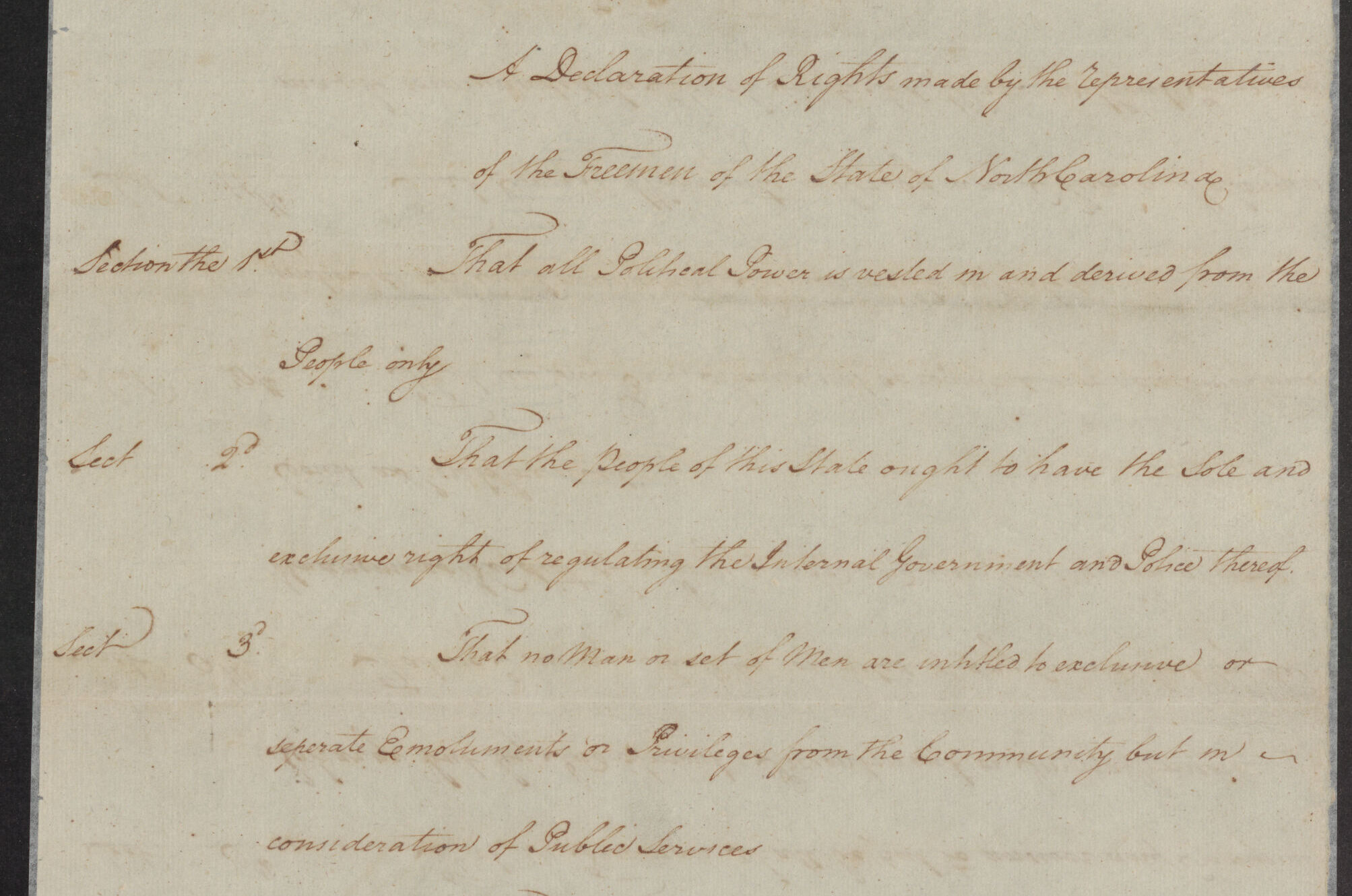
- North Carolina prioritized individual rights over government power, adopting its Declaration of Rights before ratifying its first constitution, to ensure that liberty constrained government from the outset
- The Declaration established foundational principles that shaped American constitutionalism, including protections later reflected in the U.S. Bill of Rights
- The Declaration’s enduring legacy reminds us that constitutional limits on government are essential to preserving liberty, especially amid modern expansions of regulatory and bureaucratic power
When North Carolina’s Fifth Provincial Congress convened in Halifax on November 12, 1776, the delegates undertook a daunting task that would define North Carolina. In just five weeks, they debated, drafted, and ultimately adopted two foundational documents. On December 17, they ratified the North Carolina Declaration of Rights. The next day, they ratified the state’s first constitution. That sequence wasn’t accidental; it was revolutionary.
By passing the Declaration of Rights first, North Carolina’s founders made clear that individual liberties and limitations on government power would form the foundation for everything else. Government exists to protect pre-existing liberties, not to grant them. The delegates had lived under abusive royal governors who exercised arbitrary power without accountability. They weren’t about to recreate such a system.
The delegates understood that no matter how carefully they structured their new government, without explicit constraints on power, the liberty they were fighting for would remain vulnerable. Thus, to provide the needed constraints, they adopted the Declaration of Rights before adopting the constitution itself. They put the people’s rights first, governmental power second.
This approach drew from English constitutional traditions — the Magna Carta’s limitation of royal authority and the English Bill of Rights’ assertion of individual liberties. But North Carolina’s founders went further. Having just thrown off British rule, they were determined to bind their own new government from the beginning.
The Declaration was incorporated directly into the constitution to emphasize North Carolinians’ strong commitment to individual freedoms. Article XLIV of the 1776 Constitution provided: “That the Declaration of Rights is hereby declared to be Part of the Constitution of this State, and ought never to be violated, on any pretence whatsoever.” The Declaration wasn’t aspirational; it wasn’t a wish list of “nice-to-haves.” It was binding constitutional law. The Declaration of Rights would be a bulwark against the very government the delegates were creating.
North Carolina’s Declaration of Rights was revolutionary both in timing and substance. Adopted in 1776, it preceded the U.S. Bill of Rights by 15 years and established protections that would later influence federal constitutional thinking:
- Popular Sovereignty: Section I declared that “all political power is vested in and derived from the people only” — a radical notion that sovereignty resided not in a monarch but in the people themselves.
- Separation of Powers: Section IV mandated “that the Legislative, Executive and Supreme Judicial Powers of Government ought to be forever separate and distinct from each other.” This wasn’t some kind of corporate organizational chart. It established the tripartite system as a firewall against the consolidation of power.
- Religious Freedom: Section XIX guaranteed “that all Men have a natural and unalienable Right to worship Almighty God according to the Dictates of their own Conscience.”
- Criminal Justice Protections: The Declaration set forth several rights that closely paralleled what would later become the Fourth, Fifth, Sixth, and Eighth Amendments — protections against unreasonable searches and self-incrimination, the right to confront witnesses, trial by jury, and prohibitions against excessive bail and cruel punishment.
- Freedom of the Press: Section XV declared freedom of the press essential to liberty, presaging the First Amendment.
- Right to Bear Arms: Section XVII affirmed the right to bear arms. North Carolina and its sister states were just beginning the American Revolution. They knew well the need for arms.
Importantly, the delegates also declared that “a frequent Recurrence to fundamental Principles is absolutely necessary to preserve the Blessings of Liberty.” Our delegates recognized that future generations would need to revisit these founding principles, not to abandon them, but to safeguard them against future threats to freedom.
The 1776 Constitution created a government structure radically different from colonial rule. The delegates had lived under abusive royal governors who exercised arbitrary power without accountability. They weren’t about to recreate such a system.
Lasting legacy and continuing evolution
With only minor changes, North Carolina’s Declaration of Rights became Article I of the 1868 Constitution and remains the first article of our current 1971 Constitution. This continuity, spanning nearly 250 years, demonstrates the enduring wisdom of the original principles.
The delegates in Halifax understood the nature of government power. Without explicit limits, it grows beyond its proper sphere. They declared those limits first, before establishing the mechanisms of government, to preserve liberty for future generations.
That insight matters just as much now as it did in 1776. Federal and state agencies issue regulations with the force of law. Legislatures delegate broad power to unelected bureaucrats. Local governments impose mandates and restrictions that previous generations would have considered unimaginable. And constitutional limits? Too often dismissed as obstacles to progress rather than what they are: protections for freedom. North Carolina’s example shows us that the best government recognizes its own limits.
The Halifax founders weren’t naïve. Power, once granted, is rarely surrendered voluntarily. They knew future generations would face constant pressure to trade liberty for security and to sacrifice freedom for convenience. That’s why they put rights first, defining the relationship between government and the governed.
As North Carolina marks America’s 250th anniversary next year, we should remember why our founders did what they did. They weren’t building a government to solve every problem or meet every need. They created a framework to protect individual liberty while providing for common defense and general welfare. They grasped a truth we too often forget: free people need protection from government power.
On December 17, 1776, the Fifth Provincial Congress created a hierarchy: rights first, government power second. Nearly 250 years later, that principle still needs defending.