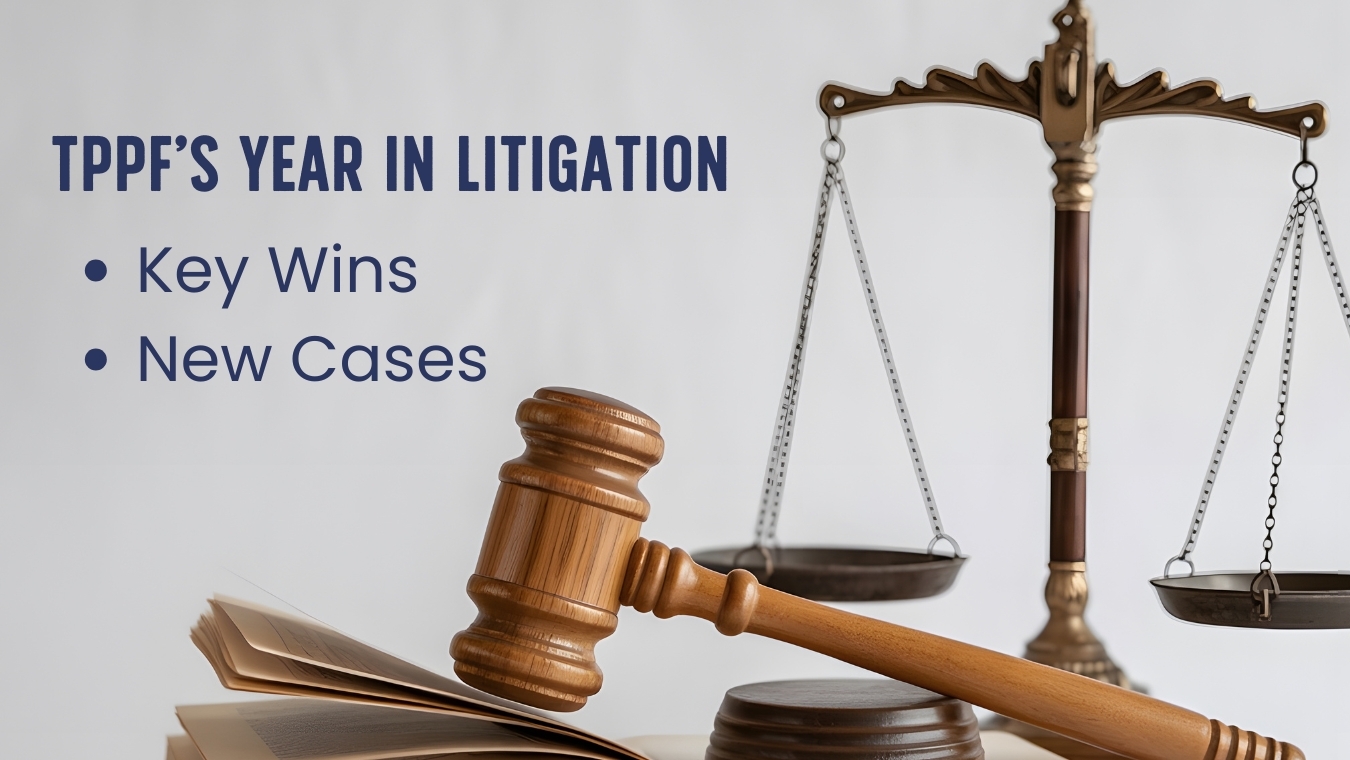
The Texas Public Policy Foundation’s Center for the American Future had a busy and successful year defending the Constitution. Below is a list of key victories, along with some new cases that launched in the last 12 months.
VICTORIES
1. ATF Reverses “Zero Tolerance” Policy for Revoking Gun Store Licenses
The Bureau of Alcohol, Tobacco, Firearms, and Explosives (“ATF”) under President Biden reversed a policy that required inspectors to revoke the federal firearms license (“FFL”) of American gun stores over simple paperwork errors and other non-willful violations of the Gun Control Act.
Austin gun store owner Michael Cargill had sued the ATF over the “zero tolerance” approach, which was illegal under the Gun Control Act that only allows revocation for “willful” violations, and the Second Amendment, which protects the rights of Americans not only to own guns, but to purchase them, as well. Read more>>
2. The Corporate Transparency Act Remains Stayed Thanks to TPPF
The Corporate Transparency Act (CTA) imposed burdensome reporting requirements on small businesses as part of the National Defense Authorization Act for FY 2021. TPPF secured a stay in the Eastern District of Texas that stopped the law from taking effect.
TPPF’s argument centers on the Act exceeding Congress’s power under the Commerce Clause. As the judge who issued the order emphasized, TPPF’s case is based on different facts and arguments from the one in front of the Supreme Court, and is not affected by the Supreme Court’s previous order. Read more>>

3. Texas Residents Successfully Opt Out of Extraterritorial Jurisdiction
Extraterritorial jurisdictions (ETJs), originally conceived as temporary buffer zones for annexation, force residents living outside city limits to adhere to municipal regulations — without receiving city services or having a voice in city elections. TPPF’s lawsuit, filed in May 2022, claimed that this practice violates the Texas Constitution.
The Texas Supreme Court issued a ruling on May 9 affirming that Texans may opt out of an ETJ. Plaintiffs Shana Elliott and Larry Kalke then successfully petitioned for removal from their ETJ. This win for the constitutional guarantee of a republican form of government paves a crucial pathway for individuals across the state of Texas to reclaim their property rights and ensure their voices are heard. Read more>>
4. Federal Government Proposes Re-Opening Half of Closed Moab Jeep Routes
In promising news for the off-road community, the Bureau of Land Management proposed re-opening approximately half of the 317 miles of off-roading trails near Moab, Utah that were previously closed by the Biden Administration. The closures are the subject of TPPF’s ongoing legal challenge in federal court.
These trails are not open yet, but this is a positive step in the right direction. Hey Joe Canyon, Deadman Point, Dead Cow Loop, Day Canyon Point, Hell Roaring Canyon, Mineral Canyon, and key Green River overlooks could be open for exploration again very soon. Read more>>

5. Feds Withdraw Rule Requiring Speed Limiters on Trucks
Eight years after TPPF submitted comments to the U.S. Department of Transportation, the Federal Motor Carriers Safety Administration, and the National Highway Traffic Administration, the federal government finally decided to withdraw its ill-conceived regulatory proposal to require speed limiting equipment to be installed on heavy duty vehicles operating in interstate commerce. The rule would have had enormous adverse economic consequences and would have increased the risk of collision and injuries on our nation’s highways.
The withdrawal of the speed limiter requirement is consistent with President Trump’s Executive Order 14219, which directs federal agencies to rescind regulations that are unlawful or undermine the national interest. Read more>>

6. Property Rights Case Challenging Historic Preservation Commission Powers Moves Forward
The Fifth Circuit Court of Appeals ruled in favor of property owners represented by TPPF in the Money v. San Marcos case. The Court’s decision reinstates the case for the Plaintiffs, allowing them the opportunity to proceed with their claims. It held that the Plaintiffs had plead valid claims upholding two key principles of law. First, that the government cannot force property owners to keep objects on their land without just compensation. And second, that San Marcos’ zoning authority does not include the power to regulate the aesthetics of a homeowner’s property.
The case centers on whether the City of San Marcos can force a homeowner to retain a decorative object on their property—in this case, a large symbol tied to a KKK-affiliated former owner of the home. This ruling reinforces the principle that government entities cannot indefinitely delay property rights claims through procedural hurdles. Read more>>
NEW CASES
1. Challenging 83 City of Dallas Ordinances Preempted by “Death Star” Bill
TPPF filed a petition on behalf of local taxpayers suing the City of Dallas to void and bar enforcement of a whopping 83 separate city ordinances that are not consistent with state law.
The Texas Regulatory Consistency Act (HB 2127) preempts, and makes unenforceable, city ordinances that duplicate and add to regulations already imposed by the State of Texas. The list of challenged ordinances draws from a memorandum from the City of Dallas specifying the ordinances that would be preempted by the bill’s eventual passage. Read more>>

2. Challenging Occupational Safety and Health Act
TPPF and Southeastern Legal Foundation are suing the federal government for unconstitutionally giving executive branch agencies the power to create boundaryless laws that impose burdensome and unsupported standards on all employers in the United States. The lawsuit asks the court to reaffirm that Congress cannot outsource its lawmaking responsibilities and to halt OSHA’s enforcement of standards issued under this unconstitutional delegation.
While workplace safety is unquestionably important, Congress gave OSHA an extraordinarily broad mandate: the power to issue any rules it considers “reasonably necessary or appropriate” for workplace safety. As a result, folks like our Texas farming association clients now labor under thousands of pages of obscure and costly regulations that most people have never read, and no elected representative has ever voted for. Justice Thomas even said it “may be the broadest delegation of power to an administrative agency found in the United States Code.” Read more>>

3. Suing FinCEN Over Constitutionality of Real Estate Transfer Rule
TPPF filed suit against the Financial Crimes Enforcement Network (“FinCEN”), arguing that in publishing a new rule, FinCEN exceeded the Federal Government’s constitutional authority under the Commerce Clause.
The challenged rule requires the disclosure of personal, sensitive information to the Federal Government whenever a person transfers residential real estate into an LLC, corporation, or a trust in some cases, unless the transfer is financed. Read more>>

4. Challenging Biden Administration’s Chuckwalla National Monument Designation
TPPF filed a lawsuit challenging the constitutionality of the Biden administration’s creation of the 624,000-acre Chuckwalla National Monument in January. This lame duck land grab by the federal government makes public lands less accessible for recreation, amateur mining, and other uses; creates more red tape; and prevents new roads from being opened.
When Congress passed the Antiquities Act of 1906 allowing U.S. presidents to designate national monuments, it was clear at the time that the bill was intended for much smaller areas of land. Presidents have pushed the limits of this power over the years and it is time to return it to Congress. Read more>>

5. Challenging California’s Gas-Powered Vehicle Ban
In 2020, California Governor Gavin Newsom signed an executive order prohibiting the sale of gas-powered cars and trucks by 2035 and requiring all heavy duty trucks after model year 2035 to be electric vehicles.
The federal Clean Air Act regulates emissions and provides uniform federal standards for vehicle manufacturers. However, Congress provided a special exemption for California that allows the EPA to waive federal preemption of California’s emission standards.
After Congress passed resolutions of disapproval to repeal EPA’s waivers this year, the state sued to invalidate those resolutions of disapproval, thereby reviving the EPA waivers and allowing California to enforce its EV mandate. TPPF attorneys filed a motion to intervene in the case, arguing that EPA’s waivers are properly considered rules because they have purely forward-looking effects on a broad category of unidentified individuals, and that California cannot judicially enforce the Senate’s filibuster rule. Read more>>

6. Helping Everyday Americans Secure Their Constitutional Rights
TPPF is re-litigating a federal law that criminalizes the carrying of a firearm onto postal service property (including the parking lot). The Firearms Policy Coalition won a nearly identical case earlier this year in the same court, where gun rights groups secured the right of only their members to carry on postal property. Everyone else, including the plaintiffs in our case, remains subject to the restrictions that the court agreed were unconstitutional.
In addition to securing the rights of the plaintiffs in this case to carry on postal property, this case will test whether the 1984 Supreme Court case of United States v. Mendoza still acts as a judge-created burden on individuals seeking to secure their rights under the Constitution. Under Mendoza, the government can force everybody who wants to secure the same rights as their neighbors to completely relitigate claims that a court has already decided. Read more>>

Thanks for reading! Stay up-to-date on our cases in 2026 by visiting centerfortheamericanfuture.com