Share this Story on Facebook, X, Text, LinkedIn, Gmail, Yahoo Mail, or Outlook
Dominion Energy Virginia’s team building its offshore wind facility spent years working with the U.S. Navy and the air defense agency NORAD on ways to mitigate the problems that would be caused by the 836-foot-tall turbines, reaching several agreements, the utility has told a federal court.
The company – meaning ultimately the company’s customers – agreed to pay NORAD $250,000 for some upgrades to its systems to mitigate interference, and an additional sum to upgrade the electrical circuits for a Navy radar installation in Norfolk.
As recently as two weeks before the Trump Administration issued a stop-work order to the utility on December 22, the company and the Navy were actively planning how to use the first installed turbines as test platforms to better understand their impact on various radar and undersea sensing technologies.
“Never did these long-time or recent discussions indicate that (Coastal Virginia Offshore Wind) was incompatible with national security or that an agency order halting CVOW activities was forthcoming,” Dominion executive Grant T. Hollett wrote in an affidavit filed with the U.S. District Court in Norfolk, which has been asked to overrule the Trump Administration order.
Yet the company must have understood that the government was about to reverse its approvals. The order from the Department of the Interior was issued on Monday, December 22 and the next day the company filed its 186-page petition with the U.S. District Court. This petition to vacate the order or issue a temporary restraining order, also shared with the Virginia State Corporation Commission, is clearly the result of weeks if not months of preparation.
Included with Dominion’s petition was an 18-page timeline (starting on page 166) of its coordination with the various federal agencies: the U.S Navy, NORAD, the Coast Guard and even the National Oceanographic and Atmospheric Administration (NOAA), which has weather and wave measurement radars.
But the Trump Administration is not citing the previously known challenges presented by the towers and rotating blades. It told Dominion the project may need to be cancelled because of “new classified information, including the rapid evolution of relevant adversary technologies and the resulting direct impacts to national security from offshore wind projects.”
The Norfolk judge hearing the case has ordered the government to produce that information on “the rapid evolution of adversary technologies” at a hearing on January 16. That will likely happen behind closed doors.
Along with arguing Dominion made good-faith efforts to comply with known national security concerns, and that the Trump Administration is acting in an arbitrary and capricious manner to satisfy his personal animus toward the technology, the petition provided additional financial details on the impact of the delay in the project.
Dominion estimates that each day of delay costs the company – and again, ultimately its customers – more than $5 million, much of that paying for various seagoing installation vessels and support ships and the construction crews sitting idle. Work was to proceed on weekends and holidays. It was already behind because a new U.S.-built turbine installation ship was late being approved as fully operational.
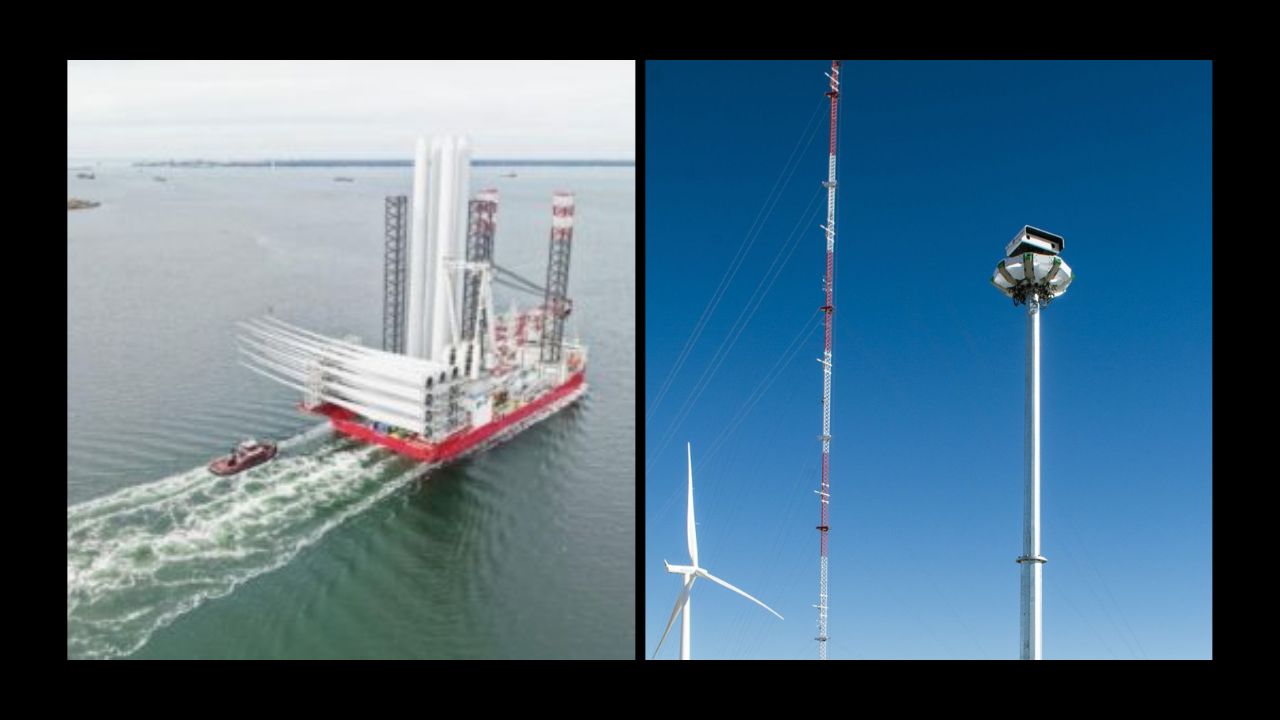
It finally sailed just as the federal government was pulling the plug, the petition states. “At the time of the Order, the Charybdis was on location at the site of the first wind turbine installation, fully loaded with four nacelles, four towers, and 12 blades, and preparing to begin work,” the petition states. A photo of the loaded ship was shared with the court and is reproduced above.
Dominion states it has spent $8.9 billion on the project to date, with much of the money in all the equipment waiting on a Portsmouth dock for final installation or still on its way from factories. The massive onshore transmission upgrades needed to bring up to 2.6 gigawatts of electricity into the grid are also largely complete and will have no use if the project is killed.
At $5 million per day, a 90-day suspension could add $500 million to the final project cost, now set at $11.2 billion. At some point some of the contracted vessels and crews will leave for other jobs, Dominion stated, further delaying final completion beyond the end of this year.
A decision to cancel would carry a far higher cost than just that $8.9 billion plus costs caused by this delay. The company could also seek to collect financing charges on the money, and some of its completed work in the ocean might have to be removed.
The petition does not assert that 100% of that will have to come from customers, but the situation would be parallel to what happened when a South Carolina nuclear plant was cancelled mid-construction in 2017, with about $9 billion already expended. The issues leading to its collapse were cost overruns and delays, and customers of several utilities are still paying off most of the debt on monthly bills and will be for several more years.
Management failures are not the issue with this Dominion’s project but instead a change in the regulatory and political climate. That at least raises the issue of compensation from the federal government if this cancellation is determined to be a taking.
But Virginia’s Clean Economy Act (VCEA) adds another layer of costs onto Dominion’s ratepayers if the project is killed. Dominion told the court it expected the project to produce about 9.5 million megawatt hours of electricity annually once complete, consistent with the promised 42% capacity factor for its output.
Under VCEA, if that power is not produced, Dominion will need to buy renewable energy certificates (RECs) to reach compliance with its renewable energy goals. The REC price in its most recent filing for VCEA compliance costs is $26 per megawatt hour. Buying almost 10 million more RECs would thus add another $250 million to consumer costs, with the future cost dependent on future REC prices.
Then there will be the billions of dollars needed to replace that lost 9.5 million megawatt hours of annual power output, either through construction of some other form of generation or with additional power purchases from outside Virginia. A decision to cancel’s triple whammy on Dominion consumers and Virginia’s economy remains just as predicted almost a year ago.

Steve Haner is a Senior Fellow for Environment and Energy Policy. A previous version of this article was published in Bacon’s Rebellion. Steve Haner can be reached at Steve@thomasjeffersoninst.org.
Share this Story on Facebook, X, Text, LinkedIn, Gmail, Yahoo Mail, or Outlook