Derek Scissors of the American Enterprise Institute assesses communist China’s financial picture.
China’s military advancement, demographic decline, multidimensional trade success, political repression, and perhaps other features may be more important than its macroeconomic performance. Still, the macro trend matters, especially for a large country influencing others. And China’s macroeconomic performance is rarely clear, as the quality and consistency of official data are subordinated to Communist Party prerogatives. This has led to a multi-decade debate about, among other things, the level and trend of the country’s economic size.
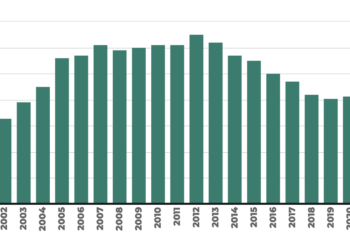
Much of the debate has focused on gross domestic product, incentivizing Beijing to manipulate GDP growth and totals. A simple way to circumvent this problem is to consider national wealth. National wealth funds the military, pensions, strategic industry subsidies, tools of political repression, and so on. A national, annual wealth series is presented below. It is estimated, not modeled, as others have been. Moreover, the estimation uses only official Chinese data. That of course introduces problems, but the data are less prominent than GDP and the like, leaving less reason for statistical authorities to modify them.
The results show Chinese national wealth slowing since 2015 and more sharply in 2022. This is hardly a surprise, but it’s more informative than remarkably smooth official GDP statistics. Further, the China series was created using indicators equivalent to those found in the Federal Reserve’s US net wealth. While this does not mean the two series are perfectly comparable, a long-term comparison should be robust. After China narrowed the absolute and proportional gap in national wealth from 2000 to 2015, the US maintained its proportional wealth advantage and greatly expanded its absolute wealth advantage from 2016 to 2024.
The People’s Republic of China (PRC) manipulates its statistics: The National Bureau of Statistics of China makes that clear by starting its releases by fawning over Communist Party leadership. There’s more reason for Beijing to game headline statistics, such as the unemployment indicator that does not actually measure unemployment, than those scrutinized less closely.