On Sept. 5, 2025, the U.S. Energy Department’s official X account posted an Aug. 23, 2025, Washington Examiner article featuring Energy Secretary Chris Wright. The accompanying text in the post stated, “Wind and solar energy infrastructure is essentially worthless when it is dark outside, and the wind is not blowing.”
Three and a half months later, on Dec. 24, 2025, WRAL posted a PolitiFact “Fact check” of that post, ruling it “False.”
Really? How did they manage that?
Is it not true that wind and solar energy infrastructure is essentially worthless when it is dark (meaning no solar energy generation) and calm (meaning no wind energy generation)?
According to PolitiFact, the answer is “no” because wind and solar energy can be stored in batteries, which can be discharged when it is dark and calm. PolitiFact omitted that batteries are rated only up to four hours and that many provide energy for less time than that.
From this reading, the accuracy of the fact check hinges on the word “essentially.” If battery storage is notessential to wind and solar energy production, then the fact check is wrong. On the other hand, if battery storage is essential, then the fact check is also wrong.
To explain that seeming paradox, see below.
When battery storage is not essential
PolitiFact does not delve into the meaning of the word essentially, an adverb stressing the very essence of a thing. Doing so would mean having to argue that the essence of wind and solar infrastructure includes battery storage.
Any energy generation source, however, can charge battery arrays. For example, analysis provided to the North Carolina Utilities Commission (NCUC) by the John Locke Foundation’s Center for Food, Power, and Life (CFPL) in 2022 showed that the least-cost and most efficient use of battery arrays would be to charge them “using reliable nuclear power plants.”
If charging batteries is not exclusive to wind and solar facilities, then it could not constitute the essence of wind and solar.
Furthermore, advocates of wind and solar energy, including the media and Gov. Josh Stein, stress that they have “no fuel costs,” unlike thermal generators such as nuclear, natural gas, and coal. Nature provides their fuel — sunlight and wind — for free, they say. Advocates tend to avoid the rest of the story, which is not only that nature often withholds those free fuels, but also that nature’s provision is intermittent and also typically misaligned with real-time demand.
Be that as it may, having no fuel costs is a big reason why advocates go on to claim that wind and solar facilities are cheaper than other sources of electricity. Nevertheless, there are many other costs involved for facilities providing electricity to the grid. They include capital costs, operation and maintenance, transmission, property taxes, utility profits, load balancing, imposed costs during times when natural fuel provision is low, and curtailment.
The CFPL’s analysis before the NCUC included the following graph comparing facilities (existing and new) according to all those costs:
More than fuel costs: The different costs facing electricity generating resources
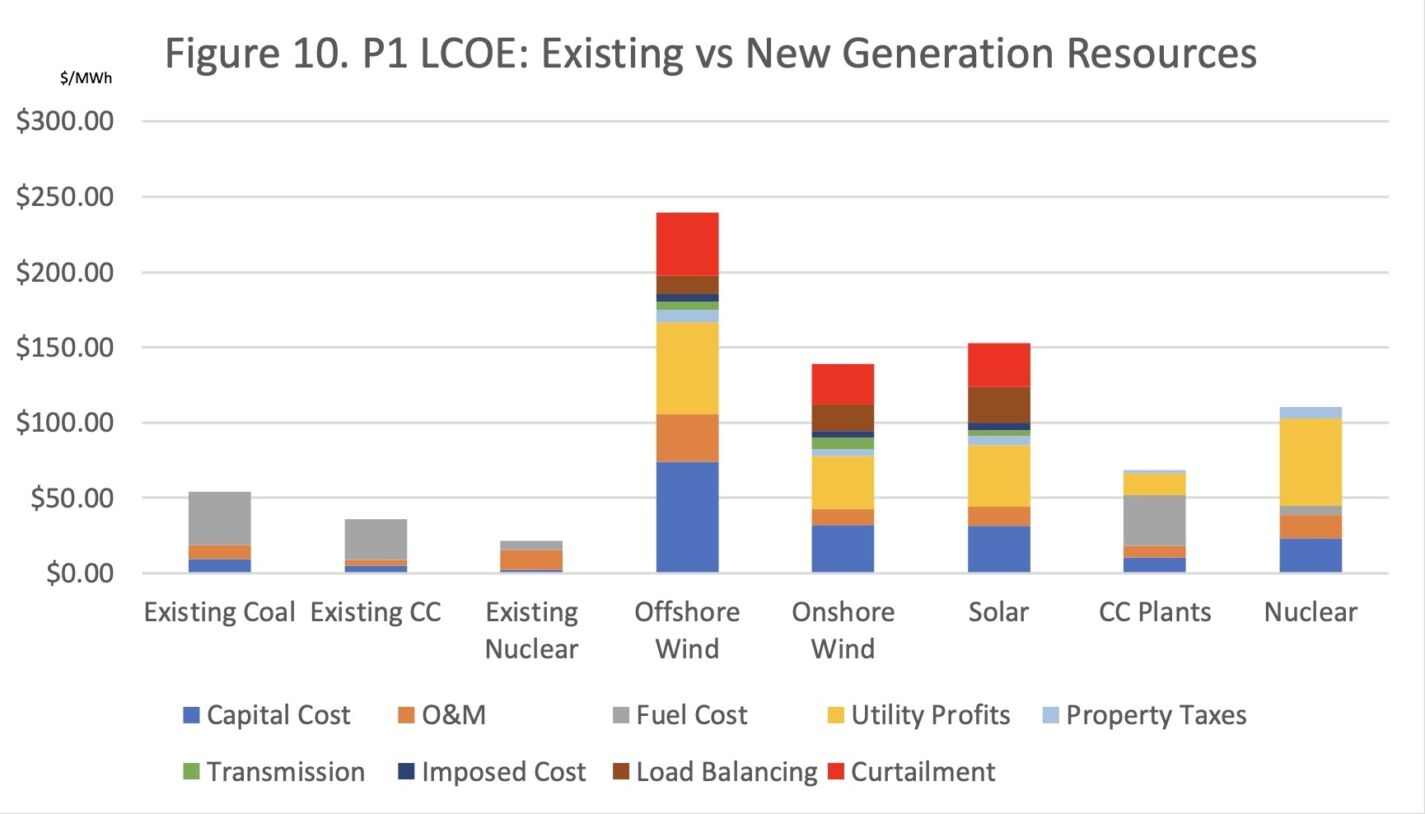
Source: Locke, “Analysis of Duke Energy’s Carolinas Carbon Plan and a Least Cost Decarbonization Alternative“
Those other costs aside, solar and wind facilities being provided free fuel is essential to advocates’ case for those sources being inexpensive. What happens when this free fuel is not provided, however, is a different matter.
MIT’s Climate Portal explained why wind and solar make our electricity more expensive, not less. A big reason is that they need storage to make up for when they can’t produce electricity, and “storage is not cheap.” So explained Richard Schmalensee, MIT’s Howard W. Johnson Professor of Management Emeritus, Professor of Economics Emeritus, and Dean Emeritus of the MIT Sloan School of Management:
Schmalensee says the main problem is the “intermittent” nature of wind and sunshine. We’re used to matching electricity supply and demand moment-to-moment by burning as much fossil fuel as we need. Renewable sources just don’t work that way. “You get what you get when nature gives it to you,” Schmalensee says. “That’s just a more complicated system, and it’s not going to be cheaper.”
Battery storage cannot be considered essential to wind and solar facilities if it can be discounted in discussing their costs.
When battery storage is essential
Intermittency being the hallmark of wind and solar power, however, those systems need some way of storing the power when it’s being generated. As MIT’s Schmalensee explained, there is no way to “costlessly store electricity.”
Someone else said it recently, as PolitiFact should have noticed. In the Washington Examiner article posted by the Energy Department in the post being checked, it included the following (emphasis added):
The secretary [Wright] claimed that without proper battery technology, wind and solar energy infrastructure is essentially “worthless” when it is dark and when the wind isn’t blowing.
So — essentially — Wright had made the same case that PolitiFact labored to make in suggesting that Wright’s department was telling a falsehood.
A simple reading of the source material in the post supposedly being fact-checked would have caught Wright’s quotation. Q.E.D.