Share this Story on Facebook, X, Text, LinkedIn, Gmail, Yahoo Mail, or Outlook
“Affordability” has become the most powerful word in modern politics – and nowhere more than here in Virginia. Candidates promised “affordable housing,” “affordable health care,” “affordable energy,” and “affordable child care,” often without defining what affordability means or acknowledging the tradeoffs required to achieve it. Now in office, the progressives in the General Assembly have even crafted a slick video to show their commitment to the “affordability agenda.” No doubt, Gov.-elect Abigail Spanberger will repeat the call for affordability frequently in her upcoming inaugural address.
What is lost in this discussion is that from an economic perspective, affordability is not a universal outcome that can be mandated by law. It is a relative condition that always raises a critical question: affordable for whom, at what cost, and paid for by whom?
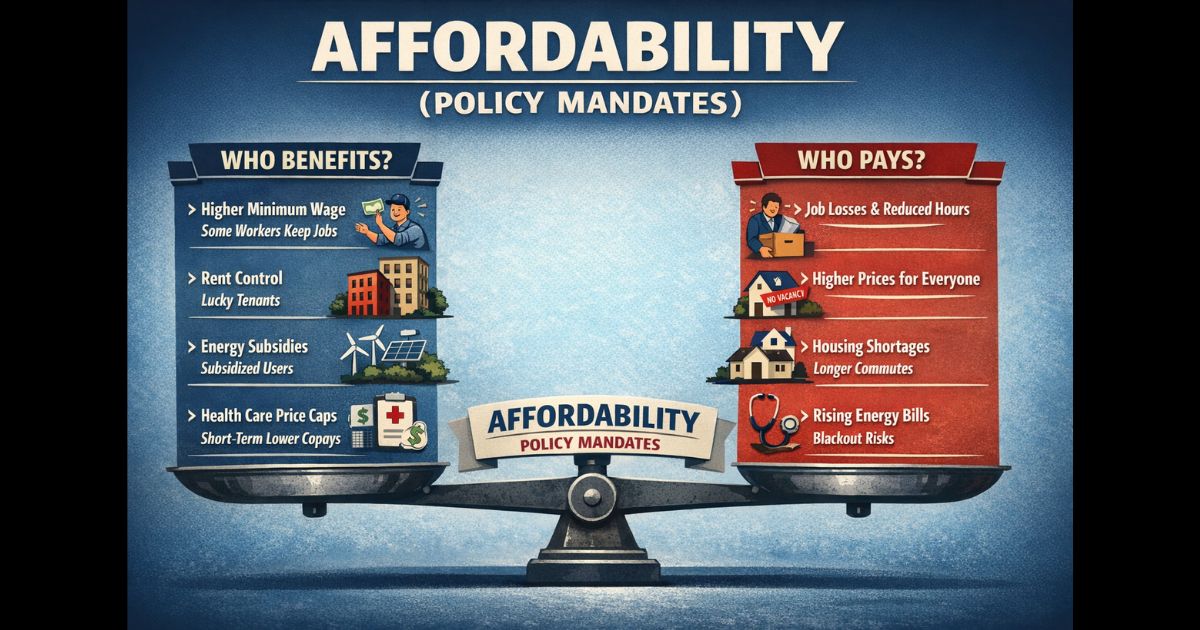
Consider the minimum wage. Raising it may increase take-home pay for some workers who keep their jobs, potentially making life more affordable for them. But economic reality does not allow higher wages to appear without consequence. Employers respond by cutting hours, reducing hiring, replacing workers with automation, or raising prices. For the worker who loses a job, affordability collapses entirely. For workers who get their hours cut back, affordability is cut. For low-income families facing higher prices at the grocery store, restaurant, or Walmart, affordability is reduced, not improved. The policy creates winners and losers, despite politicians speaking as if everyone wins. They don’t.
Housing provides another example. Rent control and aggressive price caps are often sold as “affordability” solutions. In practice, they reduce the incentive to build new housing, discourage maintenance of existing units, and shrink supply. The lucky tenant who secures a controlled apartment benefits. Everyone else faces higher rents, fewer options, and longer commutes. Affordability is improved for a narrow group while becoming worse for the broader population.
Energy policy shows the same pattern. Subsidizing renewable energy or restricting traditional energy sources is frequently justified in the name of “affordability” – buttressed with false claims of the economic and health “costs” of global warming. But when reliable baseload power is constrained, energy prices rise. Higher electricity bills hit working families, small businesses, and manufacturers the hardest. Data centers, hospitals, and schools pay more (as examples), but those higher costs are passed along to consumers. Affordability may improve for some – but at a risk of blackouts, brownouts and restraints on the use heating and air conditioning. In essence, affordability means more sweat or sweaters depending on the season for some, and higher prices elsewhere!
Health care is no different. Government price controls or expanded mandates can reduce out-of-pocket costs for some patients in the short term, but they also lead to higher insurance premiums, fewer provider choices, fewer providers, longer wait times, and reduced innovation. Someone may pay less at the doctor’s office but more every month in premiums — or lose access entirely. Affordability shifts; it does not magically expand.
The conservative approach recognizes, as demonstrated over the last four years by Governor Youngkin, that true affordability comes from abundance, competition, and growth, not price controls or mandates. Housing becomes more affordable when supply increases. Energy becomes more affordable when generation expands and markets are allowed to function. Wages rise sustainably when productivity increases, businesses grow, taxes go down and workers gain skills — not when politicians set prices by decree.
Most importantly, affordability must be measured across the entire economy, not just among politically visible beneficiaries. Every policy that claims to make life more affordable must answer hard questions about second-order effects, unintended consequences, and who ultimately pays.
Affordability is not a moral declaration. It is an economic outcome. And economics demands honesty about tradeoffs, not comforting slogans that ignore them. For the Commonwealth, it is important that Gov.-elect Spanberger move beyond slogans and explain the trade-offs inherent in her “affordability” agenda.
Share this Story on Facebook, X, Text, LinkedIn, Gmail, Yahoo Mail, or Outlook