Share this Story on Facebook, X, Text, LinkedIn, Gmail, Yahoo Mail, or Outlook
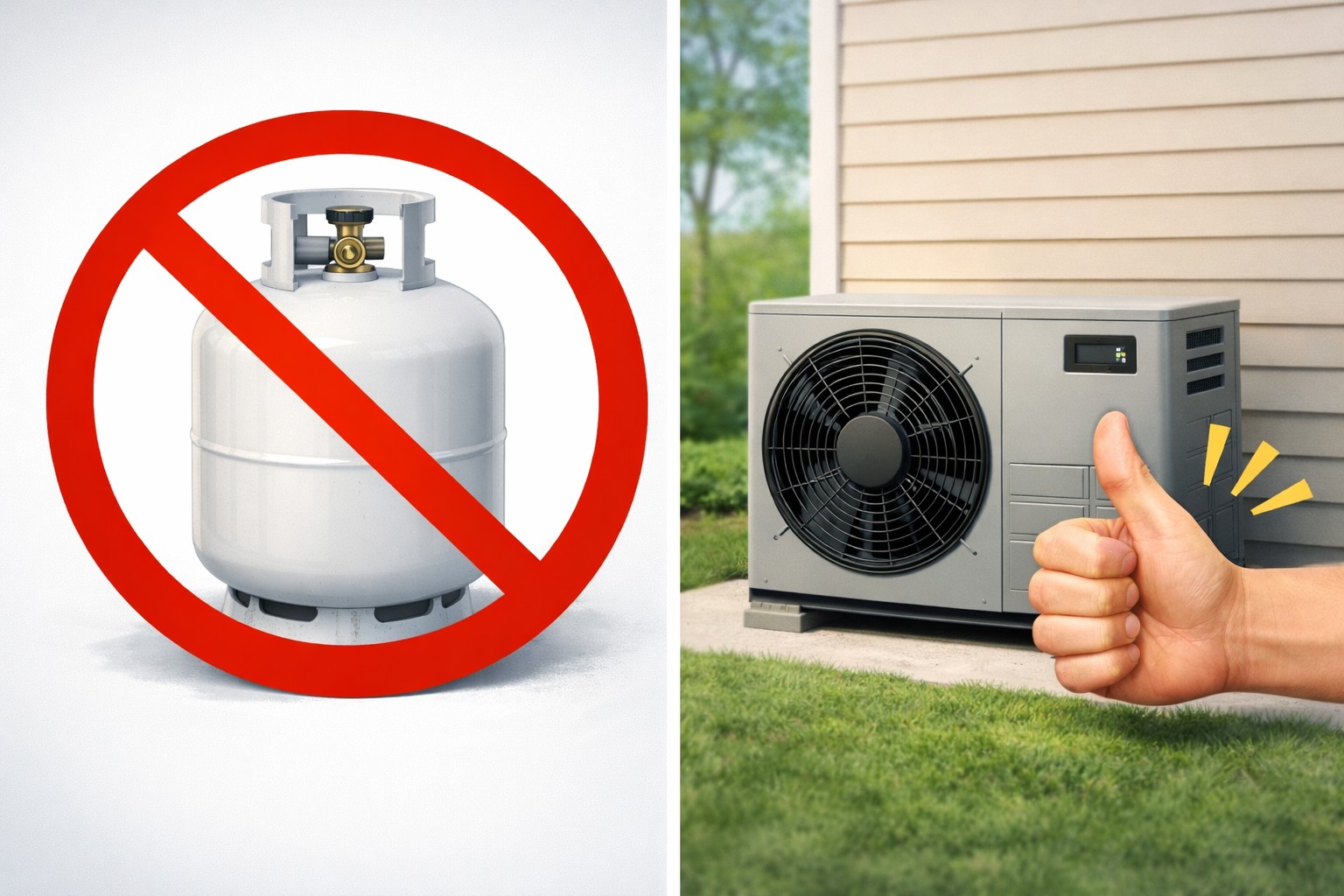
A free heat pump for thousands of Virginians who are now using oil or propane to heat their homes, paid for by Virginia’s general population of electricity ratepayers. That is the goal of legislation that passed its first hurdle in a House of Delegate subcommittee Tuesday on a bipartisan vote.
House Bill 2 is the same as legislation vetoed last year by former Governor Glenn Youngkin (R). The language linked is a substitute adopted Tuesday, and it will be in front of the full Labor and Commerce Committee on Thursday afternoon. (Contact information for members is on that committee link.) Next week, as the legislators are gathered on a snowy Capitol Hill, it will reach the full House of Delegates.
The bill applies to both Dominion Energy Virginia and Appalachian Power Company. Under it they will have the job of finding all the low-income households in their territories that are not using electricity for heat. Anybody still using wood or coal is certainly also covered by this, but it doesn’t seem to apply to natural gas heating customers – yet.
The proponents want 30 percent of those eligible Dominion customers, and 2,000 of Appalachian Power Company’s eligible households switched out to heat pumps within five years.
Nobody asked the platoon of utility lobbyists in the room or the delegation of State Corporation Commission staff just how many low-income households under that definition are in Dominion or Appalachian’s service zones. No legislator queried what is the average cost of ripping out somebody’s oil or propane equipment and tanks and replacing them with the high efficiency heat pumps.
But the line of advocates for the bill was long. Watch the video of the meeting, easy to find because this was the first bill. When a line of advocates for poverty programs, for the elimination of hydrocarbon energy, for renovation contractors and for the electric utilities themselves are all singing from the same hymnal, know that there is a huge bag of your money on the table.
The utilities are going to get thousands of new customers, and this is basically an extension of the existing (and less expensive or ambitious) energy efficiency programs we already pay for – programs that include utility profit margins. This may also earn utilities profit on the upgrade, not just the sales. All the details do still have to be presented to the State Corporation Commission, and it may not be until then until real cost estimates are produced.
The upgrade to their heating systems will be part of the overall energy efficiency upgrade, and while it wasn’t discussed in the meeting, it could extend to appliance replacements. Dominion ratepayers now pay about $1.34 on every 1,000 kilowatt-hours to cover conservation work on other people’s houses. Proceeds from Virginia’s coming return to the Regional Greenhouse Gas Initiative carbon tax may also be tapped for these heating conversions, and there are some (diminishing) federal funding sources.
This is the heart of new Governor Abigail Spanberger’s approach on “energy affordability,” lower costs for some paid for by others, and that was the argument put forward by the bill’s proponents. People who get one of these conversions will see their energy costs go down, as heating oil and propane are not cheap, especially with old equipment. The patron of this bill, Delegate Betsy Carr (D-Richmond) claimed it “pays for itself” because the utilities will get a bunch of new revenue from their new customers.
It doesn’t pay for itself. The general ratepayers – with most of the money coming from business customers – will pay for most if not all of it. The new revenue for Dominion or Appalachian will not cover these bills (although the SCC might like that idea.)
This was one of the “energy affordability” bills specifically endorsed by Spanberger before this session opened. The same subcommittee also blessed a second one, due to be in the full Labor and Commerce Committee Thursday. House Bill 3 was blessed by an even more bipartisan vote, with two Republicans in the aye column.
That bill (see also Senate Bill 5) merely creates a task force to further delve into expanding the scope of the utility provided (and thus ratepayer financed) efficiency and conservation upgrades. But the task force is directed to report by 2027 on:
…a plan, including estimated budget, prospective timeline, and potential funding sources, to ensure that weatherization-ready repairs and whole-home energy efficiency retrofits are provided to all eligible income-qualified individuals and households in the Commonwealth residing in multifamily buildings, single-family dwellings, and manufactured homes by December 31, 2034. The report shall also provide recommendations to grow and sustain the workforce needed to provide these services.
In case you missed the key line, it is “all eligible income qualified individuals and households in the Commonwealth.” This one is not limited to Dominion and Appalachian territories. What can all these folks hope for, paid for by the rest of us?
“Whole-home energy efficiency retrofit” means renovations or upgrades following a comprehensive energy assessment that are designed to increase housing quality, resident health, safety, resilience, and efficiency of a home while reducing energy costs, with such upgrades including but not limited to removing mold, lead, and asbestos, upgrading electrical panels, providing weatherization, improving energy efficiency, or conducting repairs necessary for electrification.”
The bill for this may be coming to your home or business electric bill before Spanberger’s term ends. A suggestion: everybody hold onto your electric bill for this month or next and save it to examine in four years – comparing it to your bill at that point. It is one campaign promise we can all track.

Steve Haner is a Senior Fellow for Environment and Energy Policy. Steve Haner can be reached at Steve@thomasjeffersoninst.org.
Share this Story on Facebook, X, Text, LinkedIn, Gmail, Yahoo Mail, or Outlook