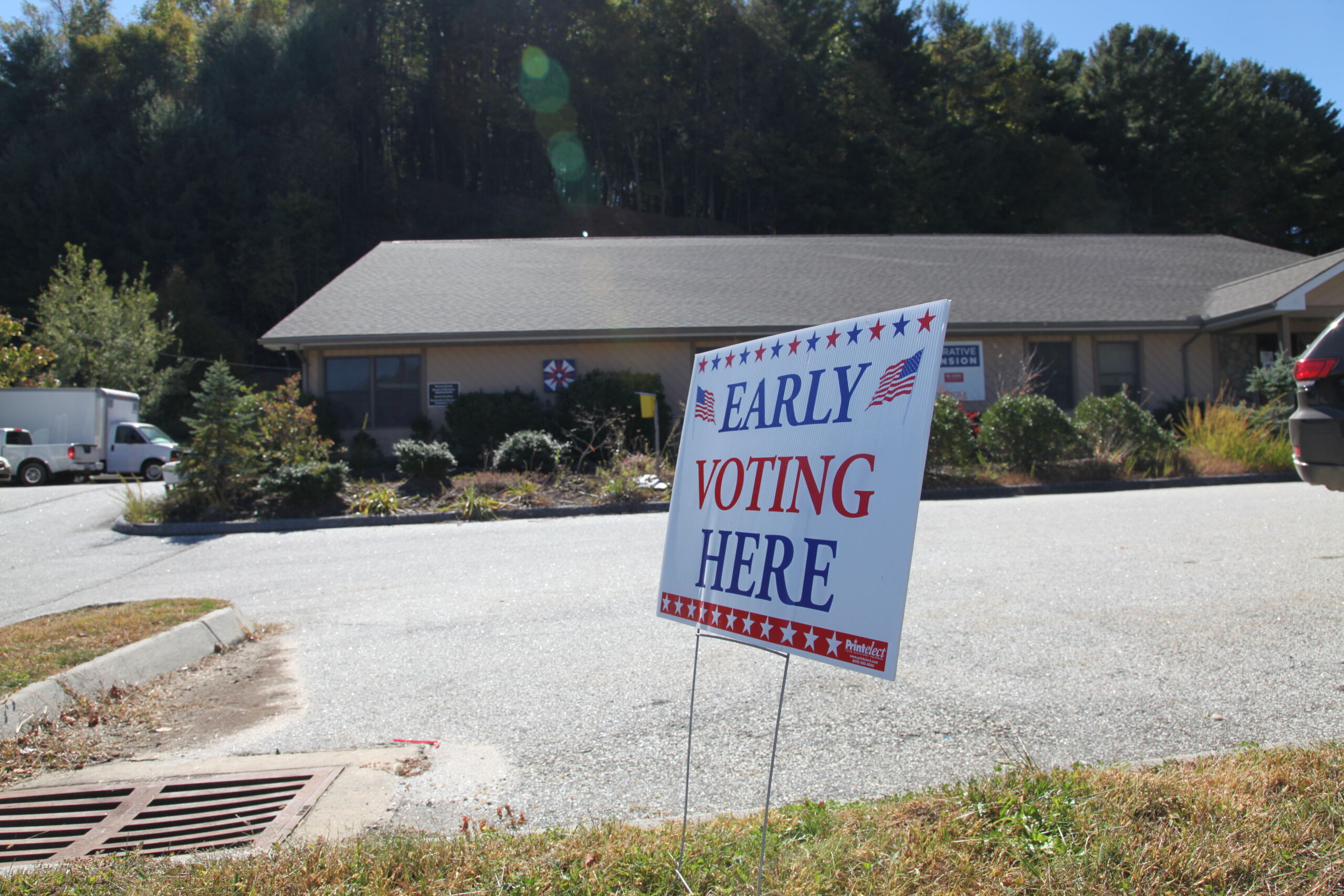
The board of the North Carolina State Board of Elections (SBE) met on January 13 to make final decisions on early voting plans for counties whose boards of elections could not come to a unanimous agreement. The nonunanimous counties and their competing plans are listed in the “Early Voting Information March 2026 Primary Nonunanimous Plans” file in the SBE January 13 meeting documents page.
There are 319 early voting sites scheduled for the 2026 primary, up from 301 in the 2022 primary, a net gain of 18.
Some of the plans were controversial, and board members were met with protests over them. Here are some of those controversies.
Closing the Western Carolina University campus site
Republicans on the Jackson County Board of Elections proposed using four of the five sites the county has traditionally used for early voting. The plan calls for consolidating the two sites in Cullowhee by not opening a site on the campus of Western Carolina University. All area residents, including WCU students, can vote at the Jackson County Recreation Center instead. (Voters may vote at any early voting site in their county, but most vote at the site closest to their home or work.) The county had early voting sites at both locations in Cullowhee in the 2018 and 2022 midterm primaries.
Democrats countered with two plans. The first would have maintained two sites in Cullowhee. The second would have closed the recreation center site in favor of keeping the campus site.
Countering claims that maintaining a single early voting site in Cullowhee would be a “disenfranchisement of student voters,” Jackson County Board Chair Bill Thompson said, “I’m confident that college students are capable of getting themselves six-tenths of a mile from the edge of campus to the Cullowhee Rec. Center to vote.”
Jackson County board members agreed that closing the WCU site would save county taxpayers’ money, but disagreed about how much. Republicans said it would save $20,000, while Democrats said it would save only $6,000. Counties pay for their own early voting sites.
Whether consolidating the Cullowhee early voting sites will result in fewer college-aged voters in Jackson County compared to previous midterm primaries is a testable question. We will know the answer to that question in March.
No midterm primary early voting site at North Carolina A&T State… as usual
While there were also disagreements about having early voting sites at UNC Greensboro and Elon University, perhaps the biggest fuss was over whether to have a site on the campus of North Carolina A&T State University. There is evidence that an outside organization bused in protesters from A&T to attend the SBE board meeting.
Democratic board member Siobhan Millen claimed that the moves made it appear as if “somebody is trying to crack down on college voting.” That sentiment was echoed by a protester outside the board meeting, who said that the vote was “simply them not wanting us to vote.”
To assess the legitimacy of the claims about the A&T State early voting site, I consulted the SBE’s polling place data page to compare this year with prior midterm primaries. The page has location listings going back to 2010. Here are the results:
- 2026: No North Carolina A&T State early voting site (Republican-controlled board)
- 2022: No North Carolina A&T State early voting site (Democratic-controlled board)
- 2018: No North Carolina A&T State early voting site (Republican-controlled board)
- 2014: No North Carolina A&T State early voting site (Democratic-controlled board)
- 2010: No North Carolina A&T State early voting site (Democratic-controlled board)
By way of comparison, “NC A&T” is listed as an early voting site in Guilford County for the 2024 presidential-year primary. Midterm elections tend to have lower turnout, so county boards can operate fewer sites without significantly decreasing voting opportunities. For example, Guilford County operated 14 early voting sites for the 2024 primary but only four for the runoff election just two months later. The A&T State campus was not one of those four sites.
The evidence is clear: no voting opportunity is being taken away from North Carolina A&T State students because the campus has never hosted an early voting site for midterm primaries.
Fewer counties with Sunday voting
The number of counties offering Sunday voting dropped from 29 in 2022 to 20 in 2022:
- Eight counties dropped the one Sunday of early voting they had.
- Two counties reduced Sunday voting from two days to one.
- One county, Harnett, dropped both Sundays of early voting.
Some of those reductions were unanimously approved by county boards, while others were decided at the January 13 SBE meeting.
No county added a Sunday of early voting.
Even though most counties have not offered Sunday voting, it is often a controversial subject. Marcus Bass, head of the North Carolina Black Alliance, called Sunday voting an “opportunity to go with your faith center, to go vote en masse, it helps to fight back against racist voter intimidation.”
However, while the per-hour rate of voters on Sundays is often higher than on Saturdays, Sundays typically have the lowest overall voter participation rate:
Sunday one-stop sites are typically open only on Sunday afternoons to accommodate church services for voters and election workers. There is little reason to believe that opening them on Sunday mornings would significantly increase turnout on those days, however. It is more likely that people would rather do other things with their Sundays. That contention is supported by the fact that Saturdays are the second least popular days to vote. [Until recently early voting was officially referred to as “one-stop absentee voting.”]
Covering that lower participation rate is not free in either time or money (previous link):
Money spent on keeping one-stop voting sites open on Sunday is money that cannot be spent on things such as training for election workers or servicing voting equipment. The question is whether the increased opportunity to cast ballots is worth the additional expenditures.
Opening one-stop voting hours beyond what is needed to serve voters adequately wastes taxpayers’ money and unnecessarily exhausts election workers. It also makes if harder for the major parties to cover all one-stop voting hours with election observers, the volunteers who watch over voting locations to help assure transparency and security in the voting process.
As noted in the same article, one possible solution to get the biennial fighting over Sunday voting behind us is to mandate four hours of early voting on the first Sunday of the early voting period and give all election workers the second Sunday of the early voting period off.