
The North Carolina Medicaid program is on an unsustainable fiscal path. Data from state and national budget reports show that Medicaid expenditures have risen sharply, with growth evident across federal receipts, state appropriations, and provider tax financing.
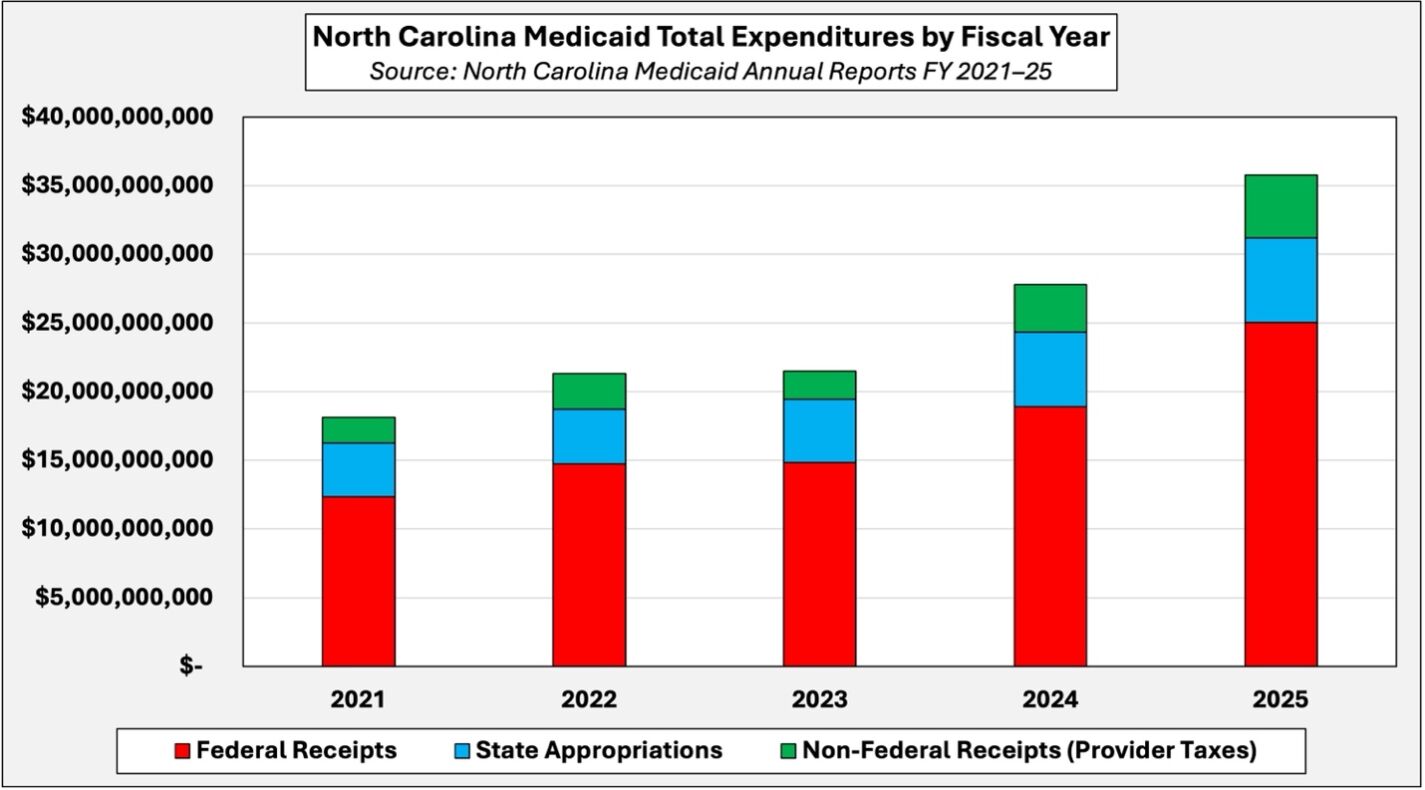
From FY 2021 to FY 2025, total Medicaid expenditures in North Carolina increased from $18.14 billion to $35.77 billion, or an incredible 97.2 percent
Each funding source carries distinct risks: increased federal funding deepens reliance on the fiscally unstable federal government; higher state appropriations create trade-offs with other General Fund spending priorities while providing upward pressure on taxes; and provider taxes will face new constraints as the federal cap on rates is reduced from 6 percent to 3.5 percent by 2032.
Together, these realities raise serious questions about the long-term sustainability of North Carolina’s Medicaid program.
North Carolina Medicaid expenditure trends
From FY 2021 to FY 2025, total Medicaid expenditures in North Carolina increased from $18.14 billion to $35.77 billion, or an incredible 97.2 percent. This growth reflects increases across federal receipts, state appropriations, and non-federal receipts, primarily provider taxes, rather than a surge within a single category.
Notably, of the 97.2 percent increase in total Medicaid spending, 66.4 percent occurred from FY 2023 to FY 2025 alone.
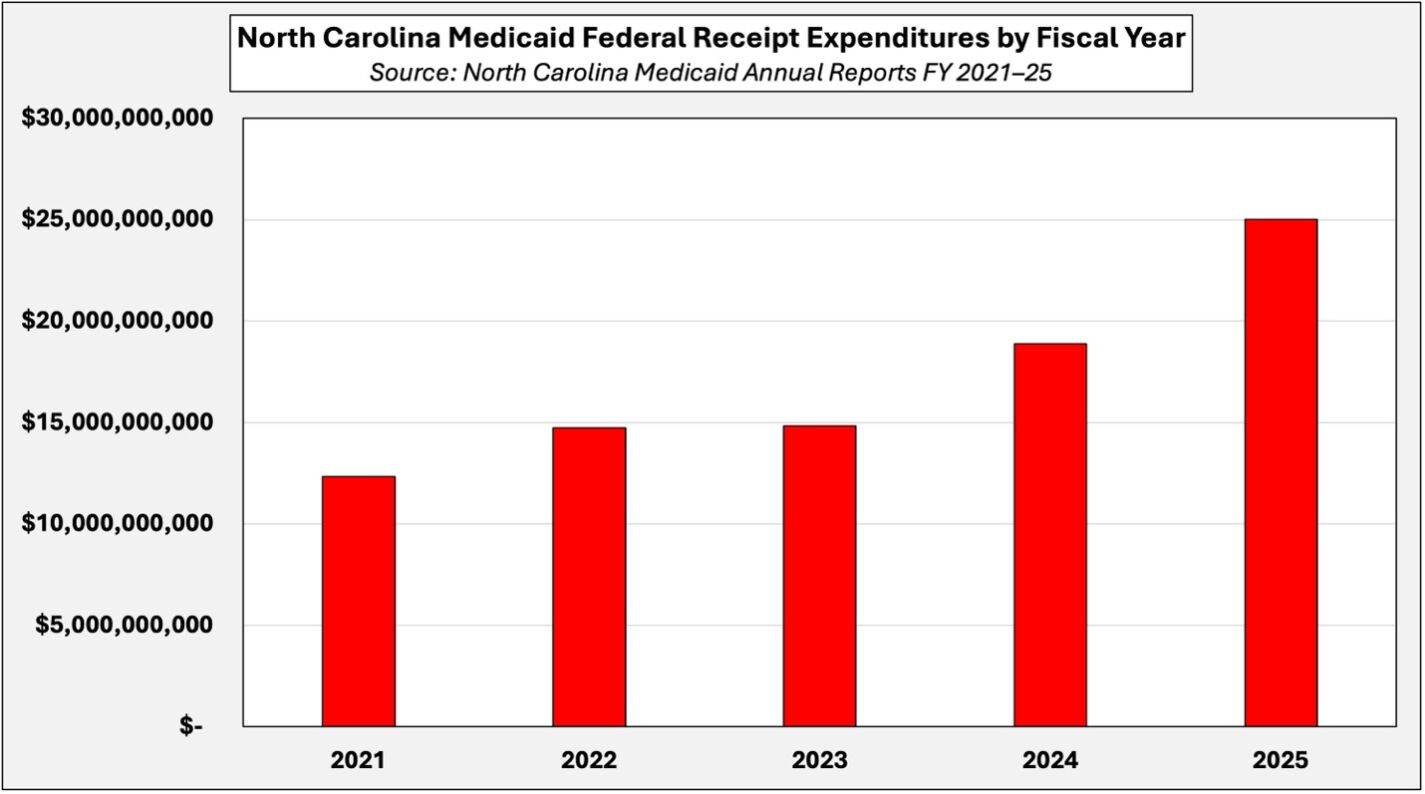
Federal receipts account for the largest share of Medicaid spending in North Carolina and have skyrocketed over the past several years. From FY 2021 to FY 2025, Medicaid expenditures sourced from federal receipts increased from $12.33 billion to $25.01 billion, or a staggering 102.8 percent.
This increased dependency on federal funds is particularly concerning, as the national debt as a percentage of Gross Domestic Product, similar to an individual’s debt-to-income ratio, is approaching an all-time high. As the federal fiscal crisis unfolds, states that depend most on federal funds will feel the sharpest impact.
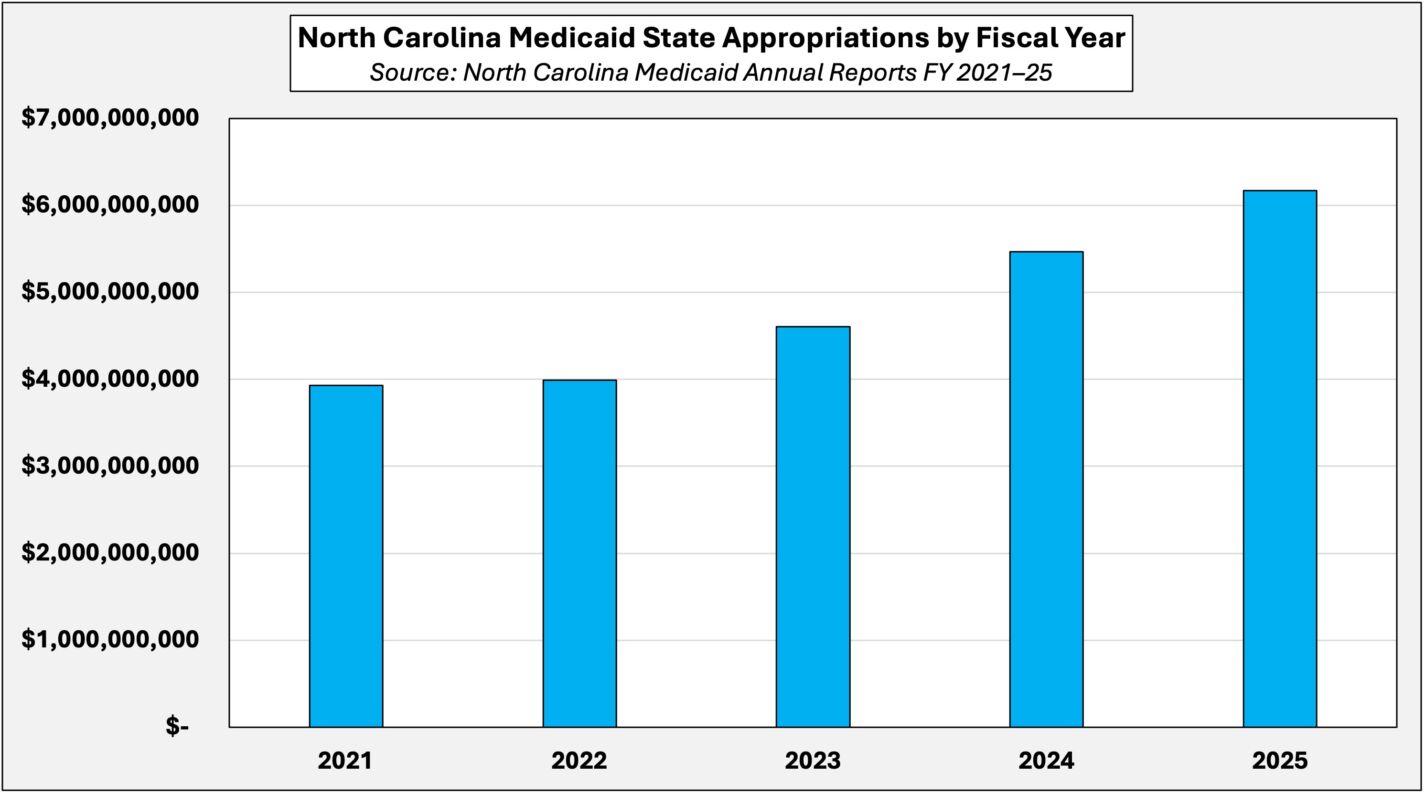
State spending on Medicaid has also risen dramatically. From FY 2021 to FY 2025, state appropriations for Medicaid increased by 57 percent, from $3.93 billion to $6.17 billion. Notably, 34 percent of this growth occurred from FY 2023 to FY 2025 alone.
While Medicaid expansion does not require state appropriations because provider taxes pay the state’s 10 percent share, its surge in enrollment has strained the overall system and contributed to rising costs. Since its launch in December 2023, more than 700,000 able-bodied adults have enrolled in Medicaid expansion. This accounts for 22.8 percent of all enrollees and now represents the single largest eligibility group.
It’s important to remember that as Medicaid consumes a greater share of state appropriations, fewer dollars will be available for other priorities such as education and public safety. This growing budgetary pressure underscores the real opportunity costs of Medicaid expansion.
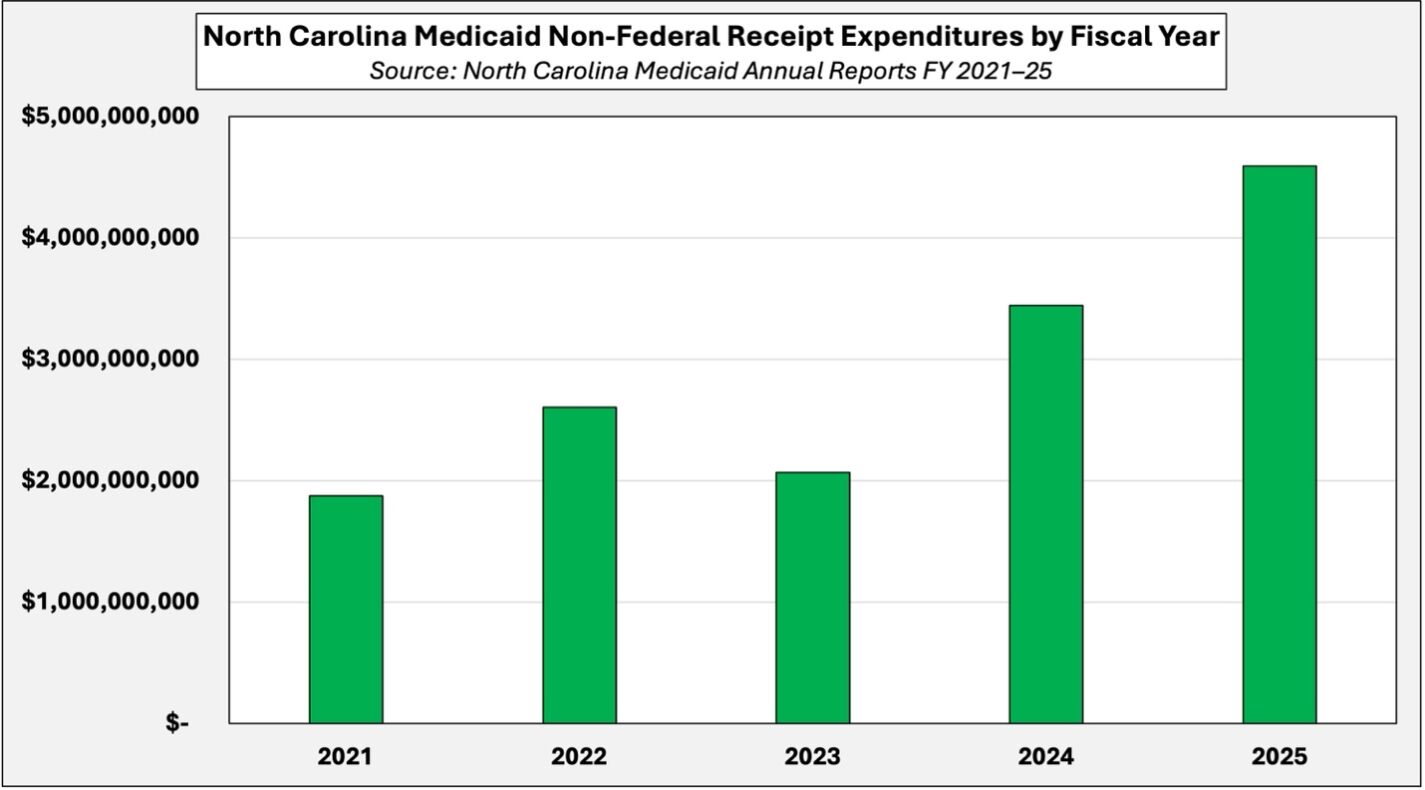
Non-federal receipts, primarily provider taxes, have experienced the most substantial growth in recent years. From FY 2021 to FY 2025, Medicaid spending sourced from provider taxes increased from $1.88 billion to $4.59 billion, or an unbelievable 144.8 percent.
North Carolina relies on these provider taxes to fund its 10 percent share of Medicaid expansion and to help fund its roughly 35 percent share of traditional Medicaid. With the provider tax rate limit set to drop from 6 percent to 3.5 percent by 2032, there will likely be insufficient revenue to fund the state’s share of Medicaid expansion, which, by law, would result in its repeal, unless prevented by further legislation.
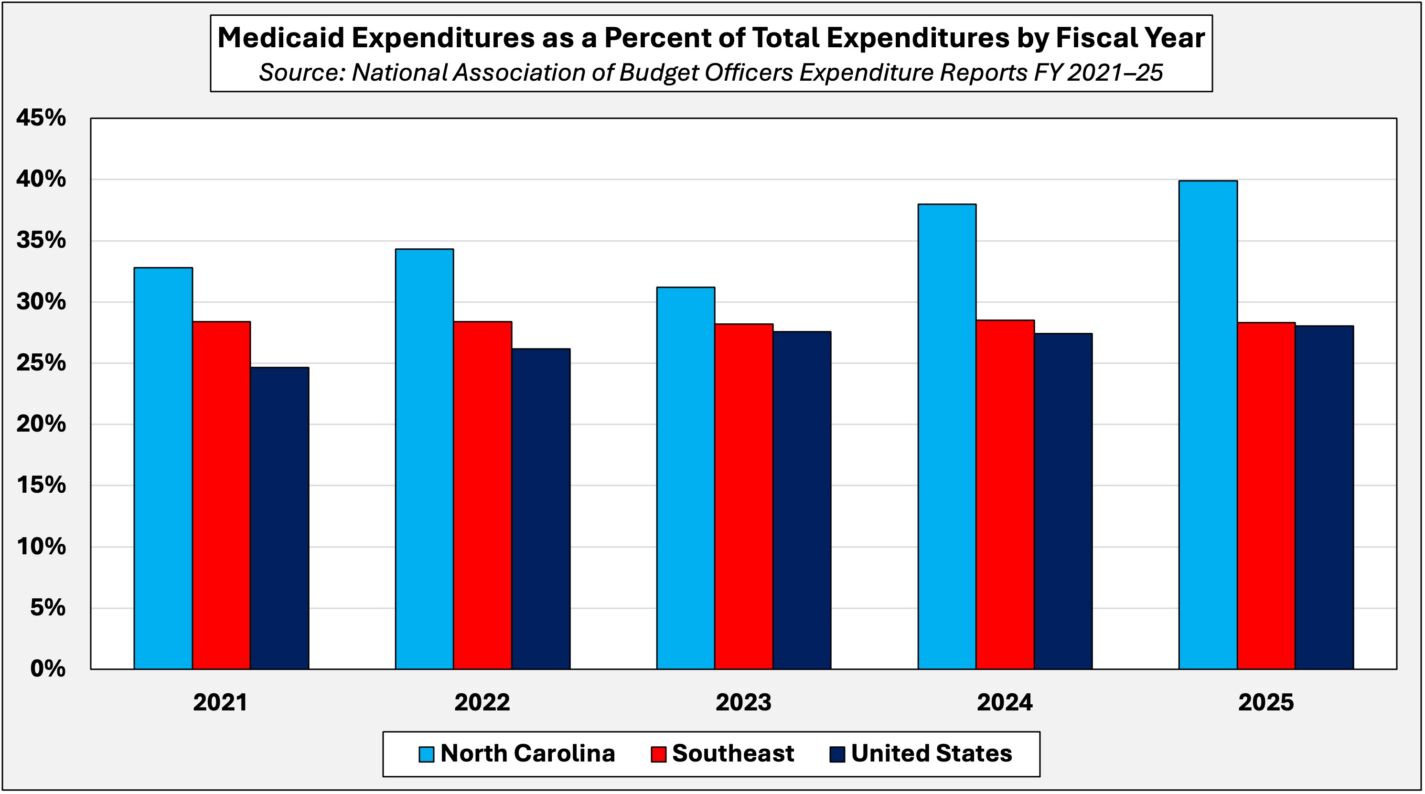
Some may argue that rising Medicaid spending is a national phenomenon and that North Carolina is simply following broader trends. However, the data show that North Carolina’s Medicaid program faces unique fiscal pressures that cannot be dismissed as merely part of a national pattern.
From FY 2021 to FY 2025, Medicaid expenditures from all revenue sources as a share of total expenditures in North Carolina increased from 32.8 percent to 39.9 percent. Over the same period, the average share across Southeastern states declined slightly from 28.4 percent to 28.3 percent, while the national average increased modestly from 24.7 percent to 28.1 percent.
In FY 2025, only three states devoted a larger share of total expenditures to Medicaid than North Carolina.
North Carolina Medicaid expenditures in FY 2025
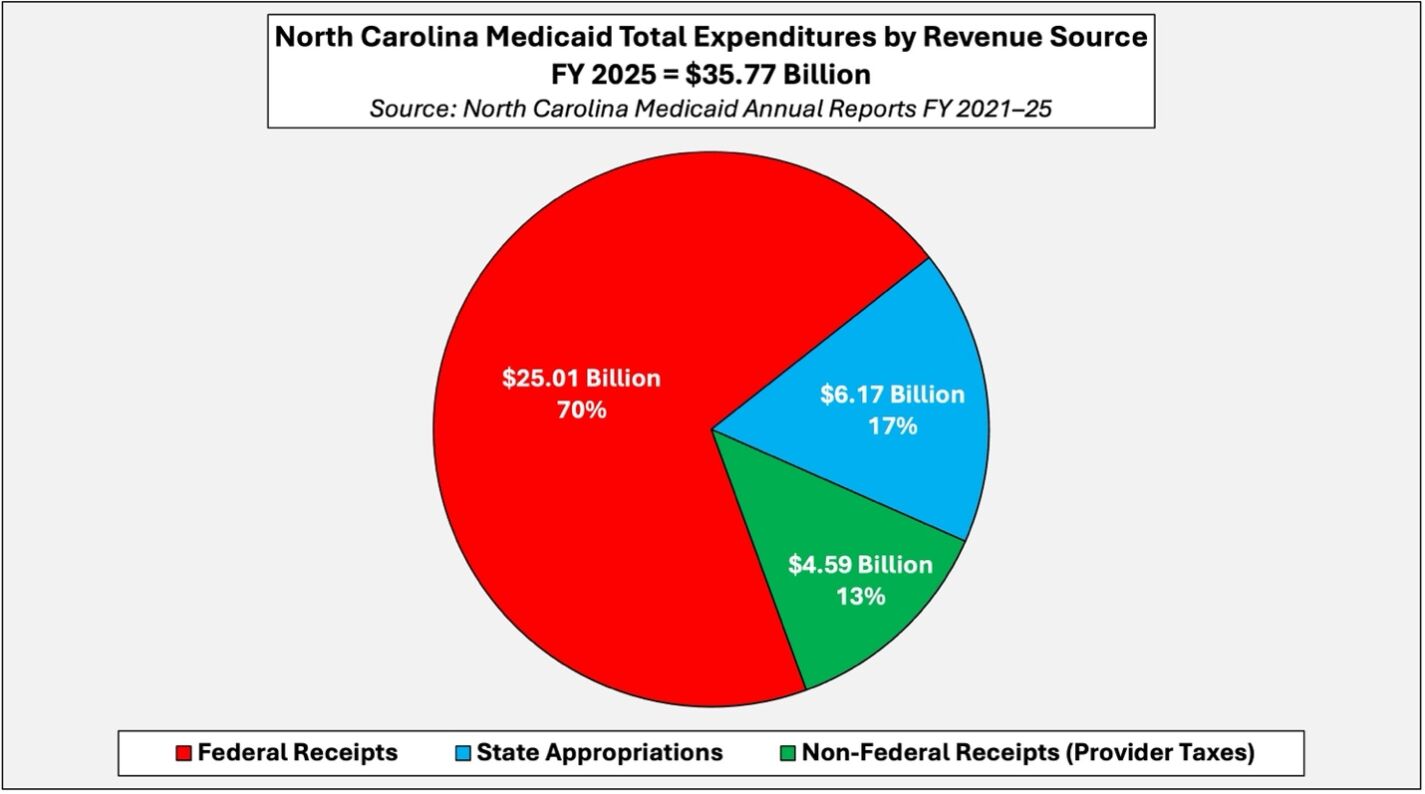
Looking more closely at FY 2025, 70 percent of the state’s total Medicaid expenditures were funded by federal receipts. Only 17 percent were sourced from state appropriations, while provider taxes accounted for the remaining 13 percent. This means that 83 percent of North Carolina’s Medicaid program relies either on federal funds or provider taxes, which the federal government has the authority to constrain.
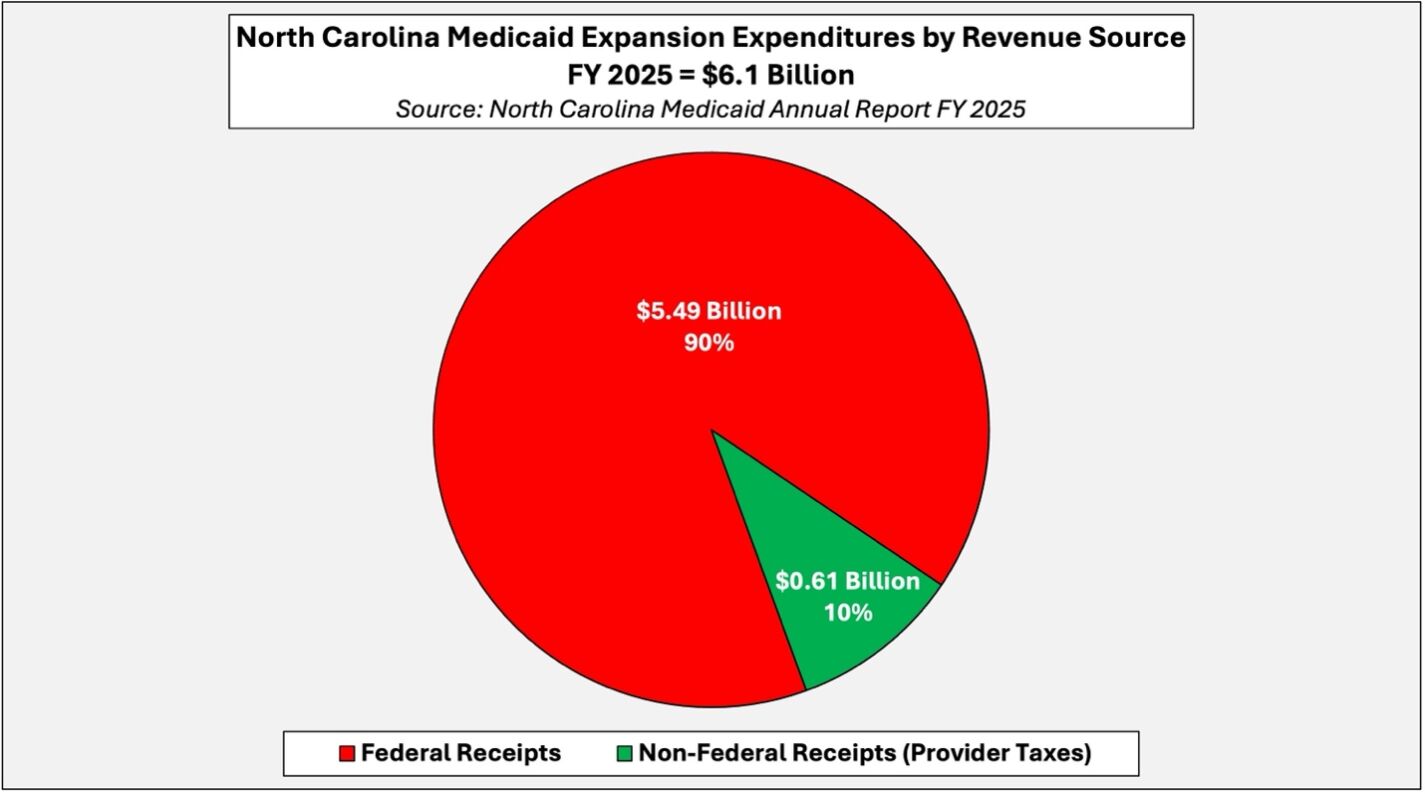
The decrease in the federal cap for provider taxes threatens to dismantle the state’s Medicaid expansion financing model. However, it is vital to recognize that of the $4.59 billion in provider tax revenue, only $610 million covered the state’s 10 percent share of the $6.1 billion cost of Medicaid expansion in FY 2025.
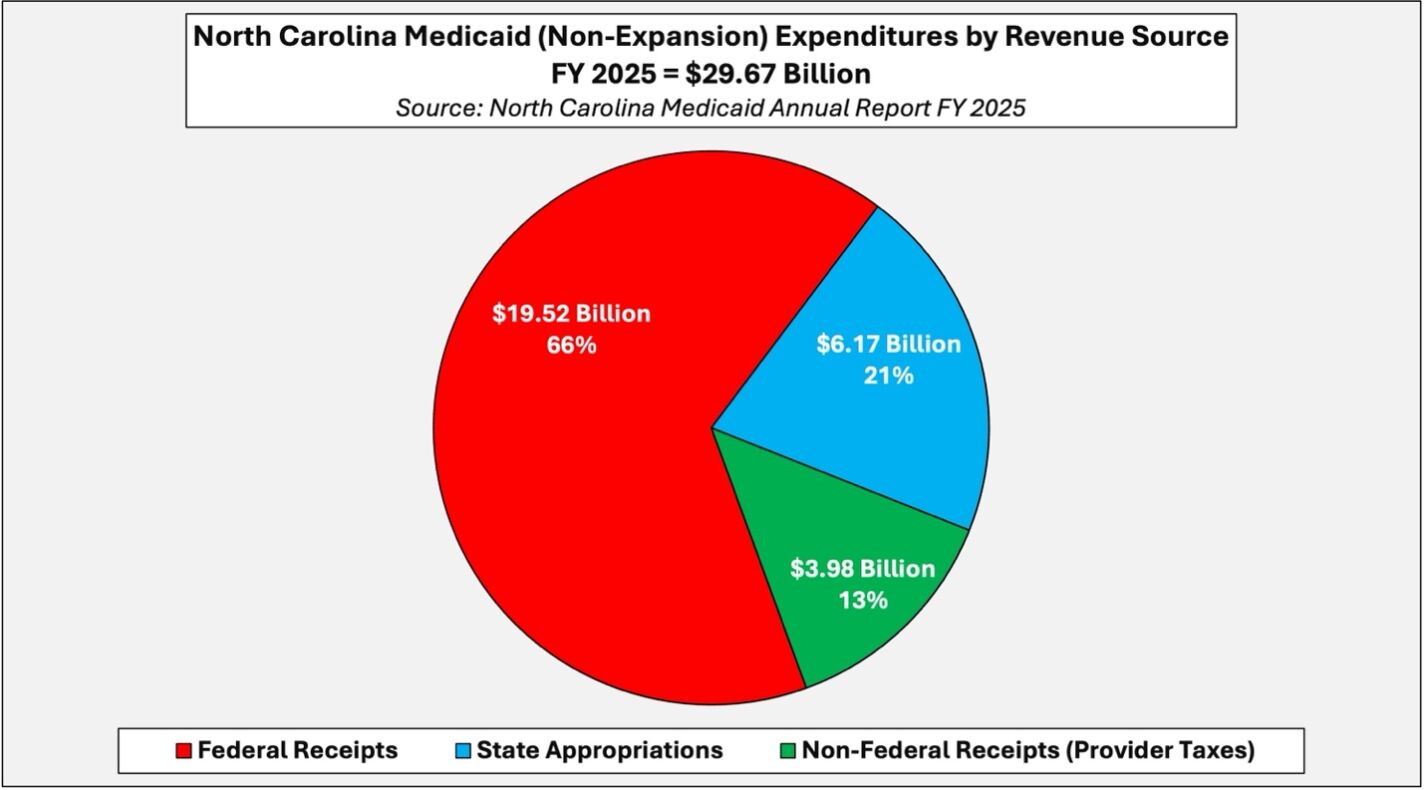
Of great concern is that the remaining $3.98 billion in provider tax revenue was used to prop up the state’s share of traditional (non-expansion) Medicaid. This means that as the provider tax rate cap is lowered, it not only puts Medicaid expansion in jeopardy but could also create a funding gap for traditional Medicaid that could reach the billions. This, of course, would be on top of the annual rebase, which has already proved increasingly expensive.
Closing thoughts
The data make clear that North Carolina’s Medicaid program is on an unsustainable trajectory. In just four years, total Medicaid spending nearly doubled, driven by rapid growth in federal funding, rising state appropriations, and an unprecedented reliance on provider taxes.
As the federal cap on provider tax rates is reduced, North Carolina’s financing structure faces a fundamental stress test. While much of the public debate has focused on preserving Medicaid expansion for able-bodied adults, the greater risk lies in the program’s heavy dependence on provider taxes to finance traditional Medicaid, which serves society’s most vulnerable.
In the coming weeks, this analysis will be followed by an examination of viable Medicaid policy reforms aimed at long-term fiscal sustainability.