
Votes have started coming in for the March 3 primary. The John Locke Foundation provides several election data products that will help you better understand what is happening in the primary and North Carolina politics more broadly.
Voter Tracker keeps you informed of absentee and early voting trends
Vote Tracker provides timely data on early and absentee voters. While it will not show you results (which are not made public until Election Night), you can use it to identify the party, geography (county or district), and demographics (race, sex, age) of absentee and early voters. We update that data daily during the 2026 primary and general elections (although Sunday updates can be spotty).
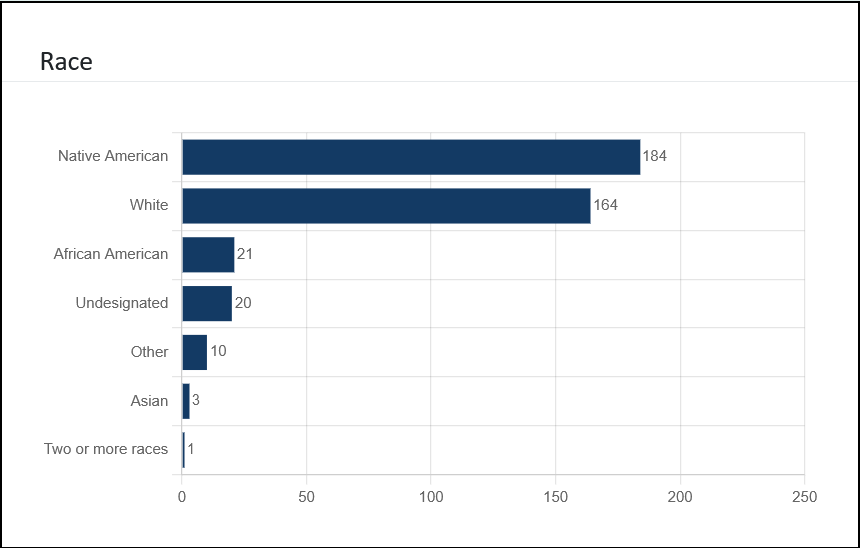
Vote Tracker’s filter feature allows you to examine subsets of absentee and early voters. For example, if you want to know the racial composition of Republican primary voters between the ages of 18 and 50 in Robeson County, you can get that with Vote Tracker. The example below is from the 2024 primary.
The Civitas Partisan Index
Locke’s 2026 Civitas Partisan Index (CPI) measures the tendency of voters in state legislative districts to vote for one of the two major parties. It does this by using data from the 2024 Council of State races in all of North Carolina’s roughly 2,700 precincts to compare how voters in each district vote relative to the state as a whole. We rate districts with a CPI of 0–1 percentage points in either direction as toss-ups, 2–5 as lean, 6–9 as likely, and 10 or more as safe seats for the respective parties.
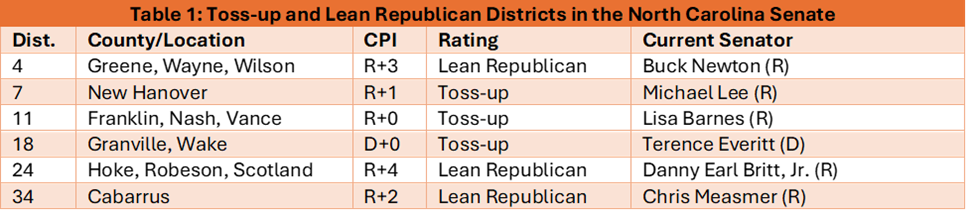
What are the General Assembly races to watch in 2026? In our experience, the districts most likely to be competitive in a midterm election with a Republican in the White House are toss-ups or lean Republican. There are six such districts in the North Carolina Senate:
The state House has 22 potentially competitive seats:
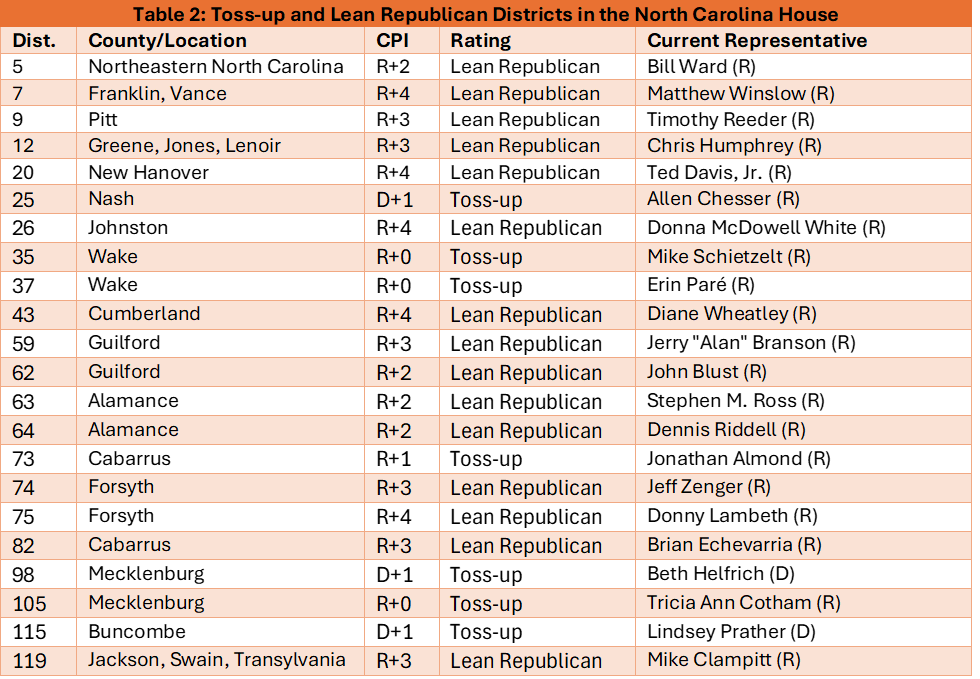
While the CPI does not account for factors such as candidate quality, it has proven to be highly reliable.
Voter Registration Changes
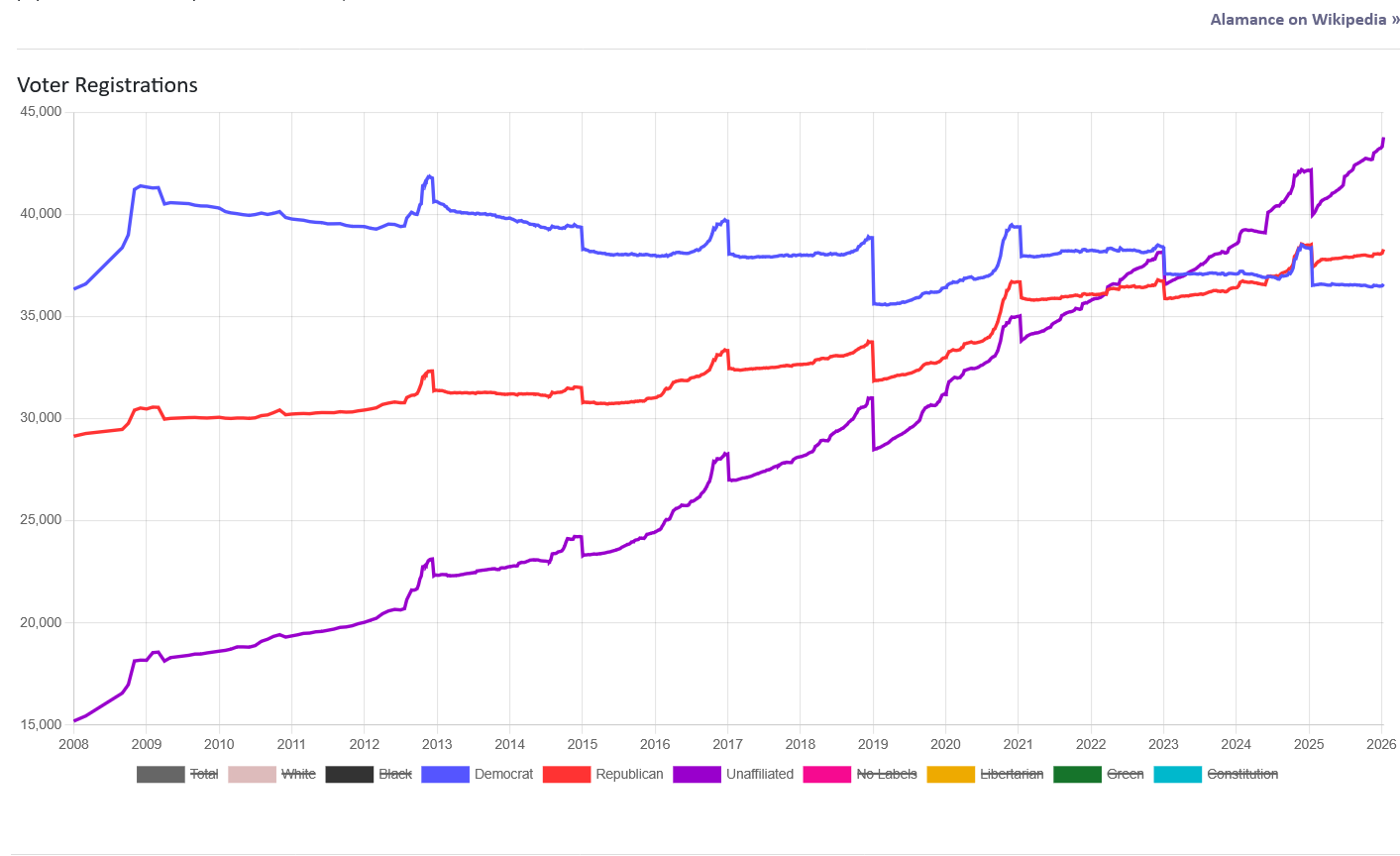
Finally, Locke’s Voter Registration Changes provides a weekly update on voter registration data in North Carolina. You can see how voter registration has changed in the state or in each of North Carolina’s 100 counties since 2008.
To get data for the county of interest, just click on the name of that county in the “County” column.
These data products will help you stay abreat of the latest development in North Carolina elections.