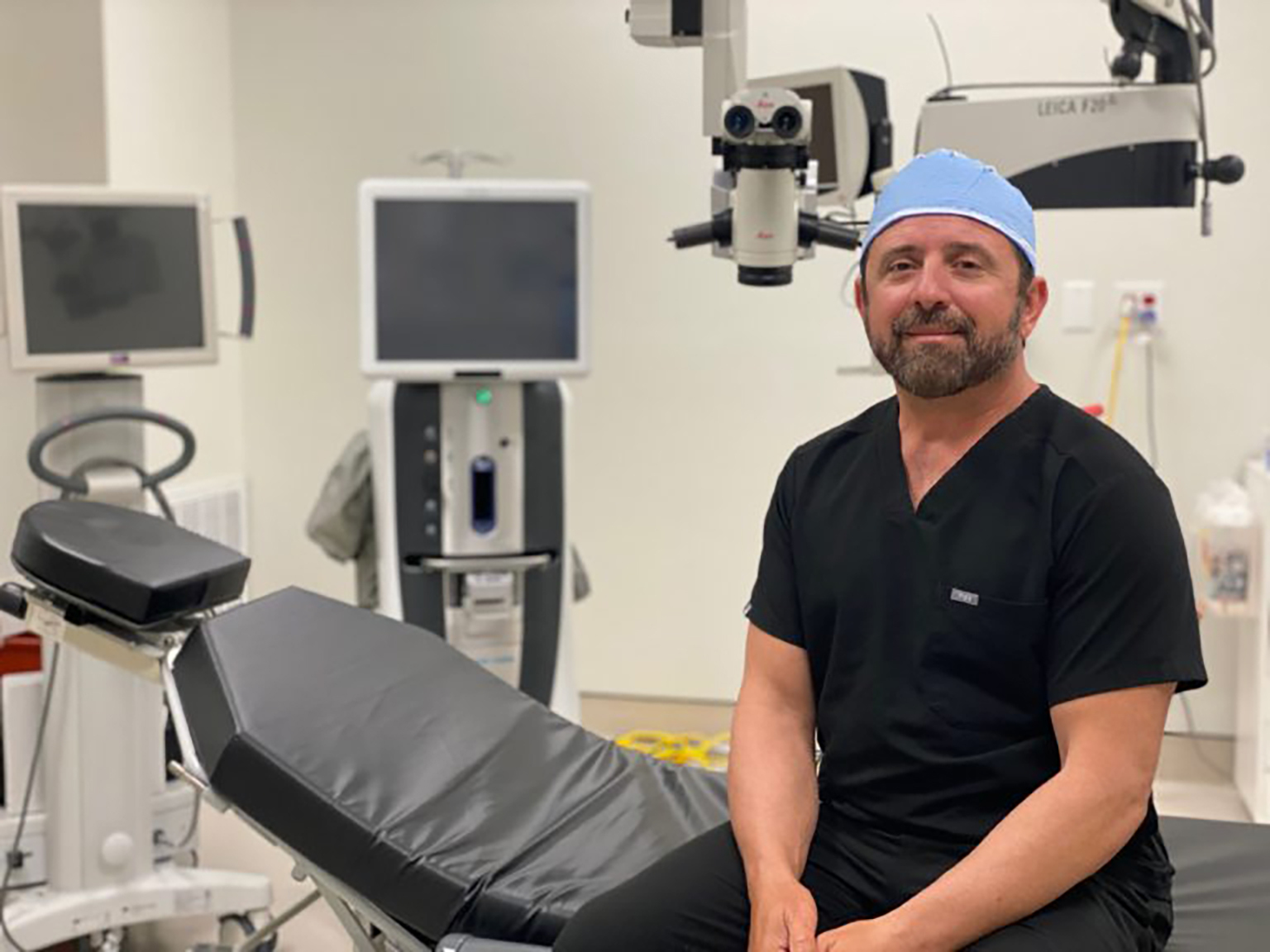
- For more than five years, New Bern eye surgeon Jay Singleton has been trying to get a North Carolina court to hear his claim that the state’s Certificate of Need law violates several provisions of the state constitution
- Instead of considering Dr. Singleton’s claim on its merits, North Carolina’s courts have repeatedly used a judicial doctrine called “rational basis review” to dismiss his complaint without a hearing
- Ironically, by refusing to hear his complaint, the courts have been violating another of Dr. Singleton’s constitutional rights: the right to a fair trial in open court
Note: This is the first in a series of research briefs discussing rational basis review, a judicial doctrine that is currently being used to shield state laws permanently from constitutional challenges.
North Carolina’s Certificate of Need law
Jay Singleton is a trained and licensed eye surgeon who has performed approximately 30,000 outpatient eye surgeries at his Vision Center in New Bern, North Carolina. The Vision Center is accredited by the American Association for Accreditation of Ambulatory Surgery Facilities, it meets all applicable licensing standards and follows the North Carolina Medical Board guidelines, and its operating and recovery rooms are fully equipped.
When Dr. Singleton performs outpatient surgeries at his center, the total cost is about $1,800. Despite his wishes, he is not allowed to offer this safe, economical, and convenient option to all his patients. Pursuant to a law enacted in 1977, the North Carolina Department of Health and Human Services has granted a “certificate of need” (CON) to CarolinaEast, a large, private hospital with billion-dollar annual budgets.
The CON makes CarolinaEast the one and only approved provider of ophthalmic operating room services in the region. It strictly limits the number of procedures Dr. Singleton can perform at the Vision Center and forces him to perform the rest at CarolinaEast. His patients receive the same treatment at the hospital that they would receive at the Vision Center, but they must pay the hospital an additional “facility fee” of $6,000.
Why does the law force patients, insurers, and taxpayers to pay thousands more for identical procedures? Not to protect public health and safety. If that were the object, the law wouldn’t allow Dr. Singleton to treat any patients at his center. North Carolina’s CON law serves one purpose and one purpose only: to protect large health care operators like CarolinaEast from competition.
It does so in the following way. First, it requires medical service providers to obtain a CON before opening new or expanded facilities, installing new or additional equipment, or even, as in Dr. Singleton’s case, treating more patients. Second, it makes CONs almost impossible to obtain. Finally, it permits the large hospitals, which already possess most of the existing CONs, to contest any decision to award a CON to one of their competitors. The inevitable results are more revenue for the big hospital chains and less affordable and less accessible medical care for everyone else.
Dr. Singleton’s lawsuit
In 2020, Dr. Singleton filed a complaint alleging that the CON law violates his rights under three provisions of Article I of the North Carolina State Constitution:
- § 19: “No person shall be … deprived of his life, liberty, or property, but by the law of the land.”
- § 32: “No person or set of persons is entitled to exclusive or separate emoluments or privileges … but in consideration of public services.”
- § 34: “Perpetuities and monopolies … shall not be allowed.”
Given that the CON law grants CarolinaEast an exclusive privilege to provide ophthalmic operating room services in the Craven/Jones/Pamlico region, given that the granting of such an exclusive privilege is the very definition of “monopoly,” and given that North Carolina’s constitution is the supreme law of the land and explicitly prohibits exclusive privileges and monopolies, one might have expected the courts at least to give Dr. Singleton an opportunity to present facts and arguments supporting his constitutional claims.
Instead, multiple North Carolina courts have summarily dismissed his case without a hearing. In every case, the courts did so by invoking a judicial doctrine called “rational basis review.” Under that doctrine, laws that regulate ordinary economic activity are presumed to be constitutional unless they are plainly irrational. Moreover, because legislatures are presumed to be in the best position to strike the right balance between individual liberty and the common good, courts are supposed to defer to legislative findings rather than make an independent determination about whether the “rational basis” test is satisfied.
The John Locke Foundation has filed four friend-of-the-court briefs on Dr. Singleton’s behalf (see below). In all four of them we warn against applying rational basis review in a way that allows the General Assembly permanently to shield state laws from constitutional challenges.
Future installments in this series will provide a brief history of rational basis review, explain why it is the wrong standard to apply to constitutional claims like the ones Dr. Singleton raises in his case, and suggest that dismissing such claims without a hearing on the basis of rational basis review violates another provision of Article I:
- § 18: All courts shall be open; every person for an injury done him in his lands, goods, person, or reputation shall have remedy by due course of law; and right and justice shall be administered without favor, denial, or delay.
Going forward
Dr. Singleton isn’t giving up. He will continue to pursue his constitutional claims, and the John Locke Foundation will continue to support him by filing briefs like the ones listed below. His hope is that the North Carolina Supreme Court will eventually hear his case on the merits and decide that the CON law does indeed violate the state constitution.
We hope so too, but we hope for something else as well. Rational basis review as currently practiced in North Carolina makes it much too hard for citizens to challenge state laws on constitutional grounds. The doctrine may have a legitimate role to play in North Carolina, but courts cannot be allowed to go on applying it the way they have been applying it to Dr. Singleton.
This case gives the Supreme Court an opportunity to instruct the lower courts on the proper application rational basis review and remind them that — even when they are challenging state laws — North Carolinians have a constitutional right to a fair trial in open court.
For more information about North Carolina’s CON law, Dr. Singleton’s case, and rational basis review, see: