Share this Story on Facebook, X, Text, LinkedIn, Gmail, Yahoo Mail, or Outlook
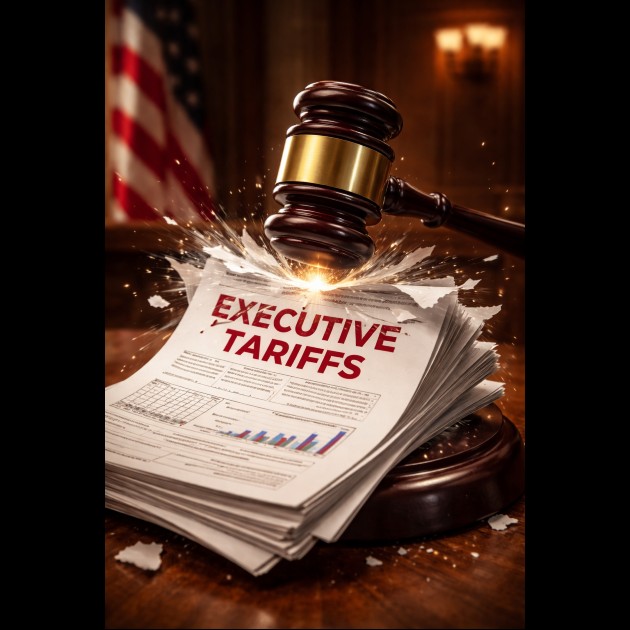
The Supreme Court’s decision in Learning Resources v. Trump is a landmark reaffirmation of one of the Constitution’s most fundamental principles: the power to tax belongs to Congress alone. Article I, Section 8 of the Constitution explicitly vests in the legislative branch the authority “to lay and collect Taxes, Duties, Imposts and Excises.” Tariffs are taxes, and the Court rightly held that the International Emergency Economic Powers Act (IEEPA) does not authorize the President to impose sweeping tariffs without clear congressional authorization.
Chief Justice Roberts’ opinion underscores what constitutional conservatives have long warned: permitting the Executive to wield such sweeping taxation authority erodes the separation of powers and undermines democratic accountability. Without this limit, revenue policy, the heart of governance, could be made unilaterally by a single individual rather than debated and enacted by the people’s elected representatives. We did not overthrow a tax and tariff Monarch to be replaced by a tax and tariff executive.
Yesterday’s Supreme Court decision vindicates the concerns voiced by the Thomas Jefferson Institute, and by former Virginia Governor George Allen who participated in this case. In earlier commentary, Governor Allen criticized these tariffs as “an unconstitutional seizure of taxation power,” a position rooted not in ideology but in constitutional textualism. The Framers deliberately placed fiscal authority in the legislative branch to prevent exactly the kind of executive overreach this case presented.
Governor Allen rightly warned about the risk of creating a unilateral emergency power, that when in the hands of a future President of the Left, could be used to declare a climate emergency to impose massive tariffs on all sorts of items and fuels in furtherance of the leftist’s hysterical green agenda.
But the constitutional argument is only half the story. Even on purely economic grounds, tariffs of this scope have proven harmful to the American economy.
Tariffs Hurt U.S. Households and Businesses
Contrary to some political narratives that foreign producers “pay” tariffs, independent research from the Federal Reserve Bank of New York shows that American businesses and households absorb nearly all of the economic burden of tariffs. According to the study, roughly 90% of the tariff costs fall on U.S. importers, firms, and consumers, not on foreign exporters. The results of this study are almost identical to those of the Kiel Institute in Germany that utilized actual shipment-level data covering 25 million transactions valued at nearly $4 trillion showing that only 4 percent of the 2025 US tariffs are absorbed by foreign exporters, leaving 96 percent passed through to US buyers. This means that the customs revenue of almost $200 billion were a tax paid almost entirely by Americans.
This finding aligns with decades of economic research showing that, in practice, protectionist measures raise input costs for domestic companies, disrupt supply chains, and ultimately result in higher prices for consumers. As Nobel prize winning economist Milton Friedman once quipped: tariffs “protect the consumer very well against one thing. It protects the consumer against low prices.”
In the Wall Street Journal editorial discussing this research, the evidence was clear: tariffs function like a tax on domestic economic activity, diminishing consumer welfare and imposing deadweight losses on the economy.
What does this ruling mean for Virginia?
Virginia’s prosperity is deeply tied to international trade. More than one in five jobs in the Commonwealth are supported by trade, and in 2023 alone Virginia exported $22.4 billion in goods to global markets. Over 7,000 Virginia companies export, while the Port of Virginia generates roughly $92 billion in annual economic output.
In 2025, Virginia’s international exports fell by 12.5 percent, the largest drop in a decade.Agriculture, advanced manufacturing, shipbuilding, logistics, and technology firms all depend on open access to global markets and affordable imported inputs. Trade is not peripheral to Virginia’s economy, it is foundational.
Sweeping tariffs therefore struck directly at the Commonwealth’s economic engine and it was having a direct impact on employment and economic growth. By raising costs on imported goods and materials, tariffs burdened manufacturers and consumers alike, while inviting retaliation that threatened Virginia exporters, particularly in agriculture.
At a time when Virginia is working to diversify away from federal employment dependence, a protracted trade war risked slowing port activity, reducing investment, and suppressing job growth. Yesterday’s Supreme Court decision limiting unilateral tariff authority is thus a welcome outcome for Virginia. It restores constitutional clarity, reduces economic uncertainty, and opens the door to policies that promote stability, competitiveness, and continued growth in one of America’s most globally connected states.
Refunds and Redistribution of Tariff Revenue
One of the more practical questions arising from the Supreme Court’s ruling is what happens to the $170 billion in tariffs the government has already collected. Businesses that paid tariffs and filed timely protests in the Court of International Trade are well-positioned to seek refunds. Under U.S. customs law, tariffs that were collected but later deemed unlawful generally must be refunded when proper procedures are followed. Uncontested tariff payments that are under final customs rules will be more difficult to reclaim.
Of course, Congress could vote to affirm the tariff regime and clarify how previously collected tariffs should be handled or they may be able to impose tariffs retroactively to capture those payments (further research on this would be needed). But, in a closely divided Congress, action is far from certain.
In other words, millions, if not billions, in tariff revenue that exceeded constitutional authority will likely be returned, which would normally provide a boost to the economy that would mimic the benefits of a tax cut.
A Short-Lived Victory
While yesterday’s ruling was a win for the Constitution and for free trade and for Virginia, within hours, the administration doubled down on tariffs and ordered a temporary 10 percent global tariff for the next 150 days. These Section 122 (of the Trade Act of 1974) duties would be placed on top of the tariffs that were in place prior to 2025. The administration is also initiating several Section 301 “unfair trade practice investigations” to replace the tariffs struck down by the Supreme Court.
So, while yesterday’s Supreme Court decision was a victory in the battle for sound economic policy and Constitutional limitations, the war for free trade and economic prosperity and the fight against protectionism rages on.

Derrick Max is the President & CEO of the Thomas Jefferson Institute for Public Policy and may be reached at dmax@thomasjeffersoninst.org.
Share this Story on Facebook, X, Text, LinkedIn, Gmail, Yahoo Mail, or Outlook
Source link