Share this Story on Facebook, X, Text, LinkedIn, Gmail, Yahoo Mail, or Outlook
In a dizzying display of power, the Democrats in the General Assembly voted this week to assign Virginia’s electoral college votes to the Presidential candidate who wins voter-dense urban and suburban areas in other states nationwide. They also voted to approve a gerrymandered congressional map that will give progressive and populous Northern Virginia control over five Virginia congressional districts, three more than it should based upon its population.
All Virginians will have their votes for President diluted and marginalized, and voters in many Virginia’s cities and counties outside Northern Virginia will have their choices for Congress decided by a handful of precincts far away. The brilliant Electoral College devised by the Founders and the Virginia Constitution’s brand-new amendment to prevent this kind of gerrymander will both be forgotten.
With both chambers of the General Assembly voting along party lines to enroll the Commonwealth in the National Popular Vote Interstate Compact (NPVIC), Virginia has agreed to award all of its presidential electors to the candidate who wins the national popular vote, even if that candidate was rejected by a majority of Virginia voters (imagine the irony: Donald Trump would have won Virginia’s electors in 2024 under this proposal).
While this compact will not go into effect until enough states have joined to account for 270 electoral votes, Virginia brings the total to 222.
The core problem with the NPVIC is straightforward: Instead of Virginians determining how Virginia’s electors are awarded, the decision would effectively be made by aggregated vote totals dominated by the largest population centers around the country. This is exactly what the drafters of the U.S. Constitution wanted to prevent.
Presidential campaigns would logically shift their attention and resources toward a handful of major metropolitan regions where large vote margins can be built, leaving states like Virginia, especially its rural and exurban regions, with less influence. These metropolitan areas, not surprisingly, vote overwhelmingly for the more extreme wing of the Democratic party, while the rural areas vote overwhelmingly for conservatives.
Proponents argue this compact is simply “one person, one vote.” But the United States is not a unitary national democracy; it is a federal constitutional republic made up of states. The Electoral College reflects that design. It balances population with statehood, ensuring presidents must build geographically broad support rather than simply maximizing turnout in dense urban corridors. That structure is not an accident or an anachronism; it is a guardrail against regional domination and factional capture.
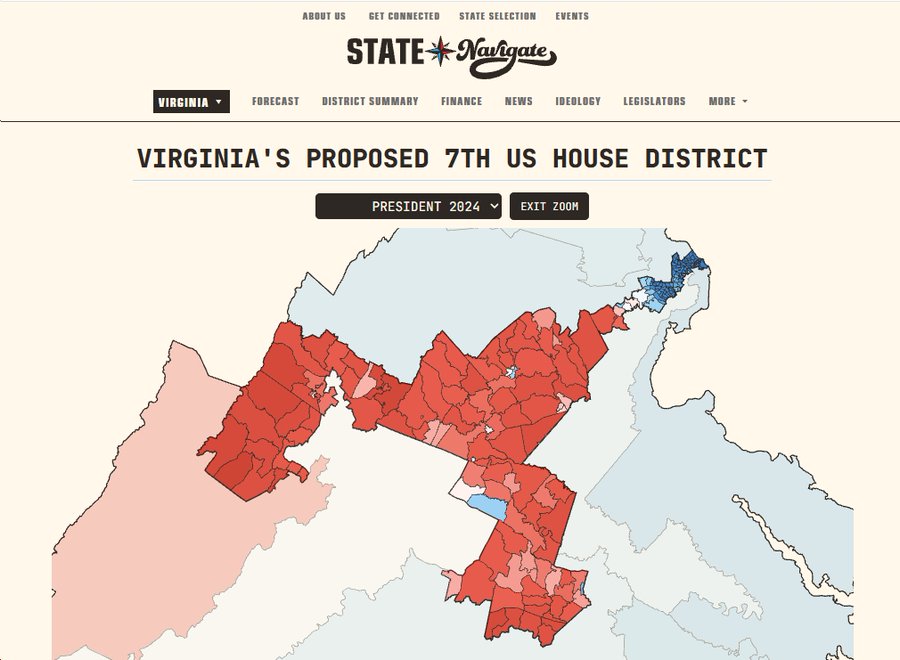
Of course, the Democrats in Richmond had already fully embraced regional domination and factional capture when they rushed to pass a redistricting map this week that dilutes rural votes by chopping up dense Northern Virginia into slivers split among multiple congressional districts. The map, seen by few Virginians yet, all but guarantees Democrats solid majorities in 10 of 11 districts.
So, while Democrats won 51 percent of the Presidential vote in Virginia in 2024, and currently hold 54 percent of Virginia’s congressional districts, the new map would give Democrats over 90 percent of Virginia’s congressional seats. You can almost feel the boots on the necks of rural conservative-leaning voters.
These two moves, which have to be viewed together, underscore a broader concern that should cross party lines: when foundational election rules are changed, one bypassing the clear language of the U.S. Constitution, and the other seeking to replace a popularly passed state constitutional Amendment, public trust erodes. Whether the issue is redistricting or presidential elector allocation, the core governance question is the same — should structural rules be stable and predictable, or adjustable whenever a governing majority has the votes to change them? Should a party in a dominating position be allowed to entrench that position through a blatant manipulation of election rules?
If progressives want to end the electoral college, do the hard work of passing a federal constitutional amendment. If they want to pass a Virginia constitutional amendment to do a mid-decade redistricting, don’t rush to bypass existing notice requirements, legislative rules, and election calendars – give voters time to digest and understand the changes being sought and to determine if the proposed maps conform to any reasonable sense of fairness.
The truth is, in our current troubled political climate, leaders in both parties are willing to explore changes that will further their political interests – under a false flag of fairness or seeking to respond to past wrongs, real or perceived. Virginia, the birthplace of our Republic, should stand against this tide. Virginia has a redistricting process that has allocated districts in a manner that closely aligns with voter preferences and promotes districts that have a real community of interest, and we have an electoral college process that rightly cast Virginia’s electoral votes for Kamala Harris.
If nothing else, we can hope that this blatant political power grab will wake up voters of all political persuasions who put constitutional principles first to what is really happening in Richmond.

Derrick Max is the President & CEO of the Thomas Jefferson Institute for Public Policy and may be reached at dmax@thomasjeffersoninst.org.
Share this Story on Facebook, X, Text, LinkedIn, Gmail, Yahoo Mail, or Outlook