Share this Story on Facebook, X, Text, LinkedIn, Gmail, Yahoo Mail, or Outlook
Unless Virginia voters reject the constitutional amendment on the ballot April 21, gerrymandering will return to Virginia.
Five years ago, 66% of Virginia voters — 2.8 million Virginians — approved a bipartisan redistricting constitutional amendment ending gerrymandering. The result was a map that is widely regarded as one of the fairest in the country. The new proposal, however, for which early voting is now taking place, restores gerrymandering, sending Virginia back down a slippery slope to the dark days of backroom deals.
The original “gerrymander,” after all, doesn’t look all that more contorted than the new Seventh Congressional District proposed for Virginia. The accusation fits.
Opposed by The Washington Post and a majority of Virginians, ridiculed by former Democratic Senator Chap Petersen as “Destroying Democracy in order to save it,” the new amendment was rushed into play, to be voted on in a special election when no one is paying attention, to replace something that works.
Although the Redistricting Commission’s 2021 launch was uneven, the amendment’s backup plan — a Special Master appointed by the courts — worked spectacularly … so much so that the Princeton Gerrymandering Project rated the final outcome an “A.”
It successfully created fair, compact, and competitive congressional districts. The Richmond Public Interest Law Review concluded: “The maps drawn by the special masters and approved by the Supreme Court of Virginia are free of extreme partisan bias and advance the goals of minority representation, competitiveness, and partisan neutrality.”
Now, the politicians in Richmond want to rip it apart to get what they want. Where Senate leaders like Louise Lucas once declared “We want a fair, nonpartisan commission to draw the lines,” she’s now redrawn the maps herself, aimed solely at electing 10 Democrats and flipping all but one Republican seat.
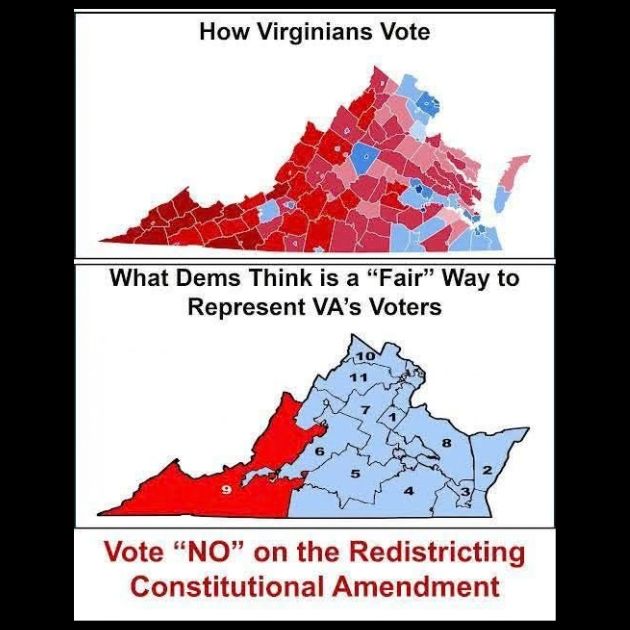
As Virginia Commonwealth University Associate Professor Alex Keena points out, “In order to give Democrats a 10-1 advantage, mapmakers must pack Republicans into one ‘safe’ district and ‘crack’ Republican support across the remaining districts to create Democratic majorities.”
Where once Northern Virginia’s population density meant districts were compact, now they’ll stretch hundreds of miles taking constituents hours to drive across. Those in NoVA will see less of their elected officials, who now will spend time a hundred miles away.
Under the plan, rural voters, lacking Members of Congress who will understand and fight to represent farmers, miners, blue-collar workers, and rural communities will have even less access to their representatives.
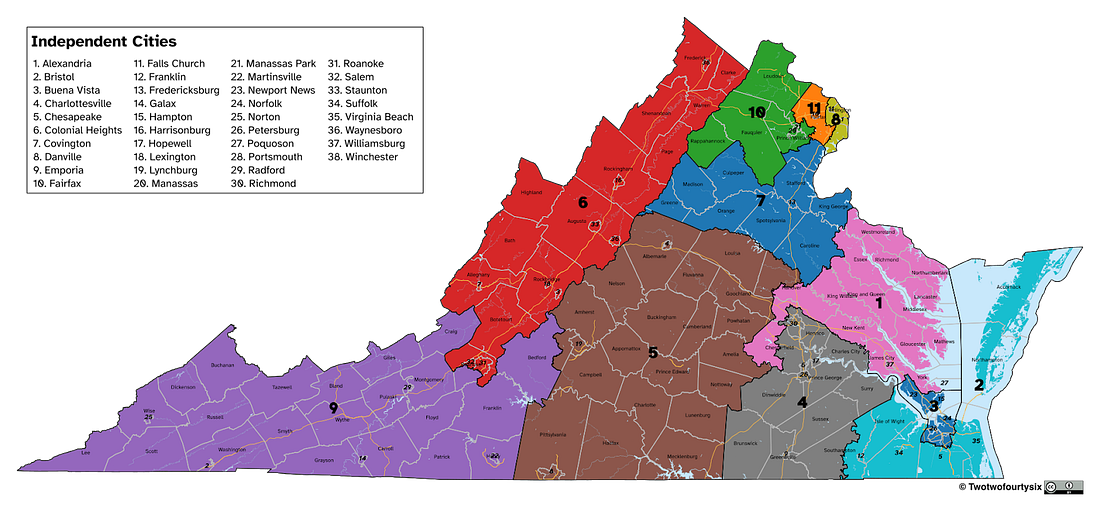
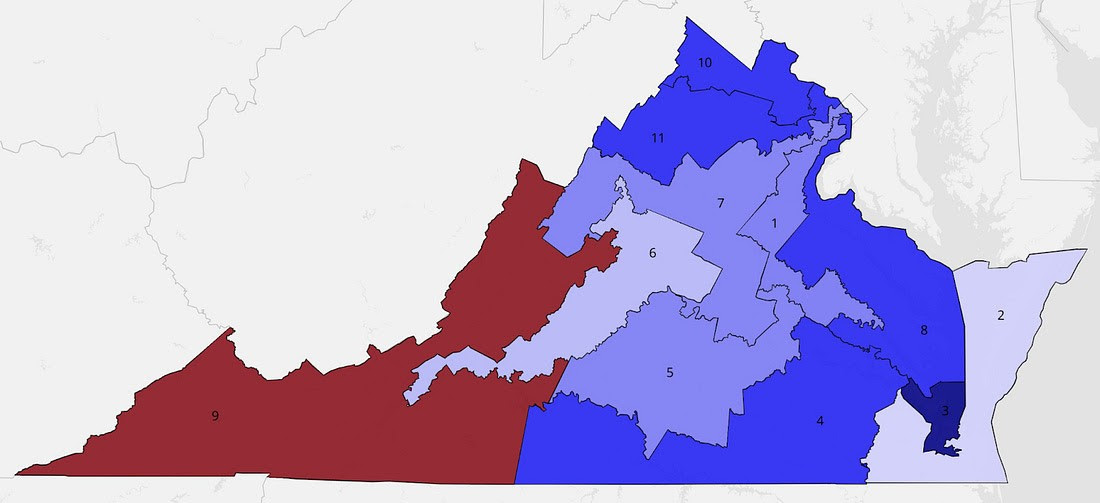
The new maps look like something drawn by Salvador Dali. The proposed First Congressional District is held together by a strip only a few miles wide. For nearly 50 miles, the Eighth District is a 1-4 mile-wide ribbon jammed between the First District and the Potomac River, before stretching to Hampton Roads. The Seventh District resembles a lobster, stretching around Charlottesville from Goochland to Augusta and throwing in 100,000 Arlingtonians to boot.
Arlington is ripped in half. Fairfax and Prince William Counties are split five ways. To craft partisan majorities, even tiny Buckingham County (population 16,736) gets slashed three ways – as are many other rural counties where “community” means something more than what is found on Facebook.
This is of little concern to dedicated Democrats of the Left like Majority Leader Scott Surovell, who makes a career out of aggressively ignoring his own constituents, nevermind those who can’t vote for or against him.
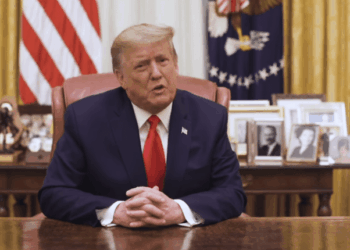
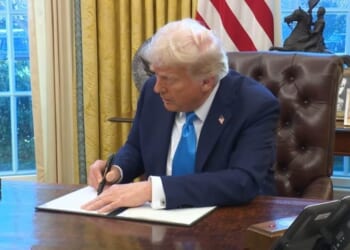
Even the new maps’ strongest supporters don’t deny the proposal is strictly partisan. Nor do they claim the existing maps are unfair. Instead, like schoolyard children, they need only point to Donald Trump and yell “He started it!”
Which, admittedly, he did … an effort seasoned strategists could have warned would lead to the current predictable result. The laws of politics are not that different from the laws of physics: Every action has an equal and opposite reaction.
But, as Brian Cannon, who led the campaign for 2020’s constitutional amendment and opposes the Trump effort for mid-decade redistricting, notes, “silencing voters is anti-democratic no matter who does it, and it sets a dangerous precedent for Virginia.”
“If the threat is democratic erosion nationally, the answer is not democratic erosion here in Virginia,” Cannon has written. “Gerrymandering disenfranchises voters. It is the deliberate engineering of political outcomes through map design. It replaces real voter accountability with prearranged results, and the principle does not change based on which party benefits.”
That only Democrats gain is evident from the $21.9 million donated from funders of Left-wing causes to the Virginians for Fair Elections committee spearheading a very public Vote Yes campaign, and using celebrity endorsers like former President Barack Obama.
Republicans, too, have now pivoted to a public campaign with new advertising, although the committee producing them still lags far behind the amount raised by the Left. While President Trump kicked off this competition, none of the $400 million in his PACs has found its way to Virginia.
Still, advocates of uprooting the constitution and restoring gerrymandering have shifted their message slightly to claim this is all only temporary and they can be trusted not to make another change sometime in the near future.
Whether they succeed will depend on who votes between now and April 21, and whether those voters believe that the career politicians now controlling the Governor’s Mansion and the General Assembly can be trusted to keep their word.
This time.
This commentary is an expanded version of one published in The Fairfax Times on March 13, 2026. Chris Braunlich is Senior Advisor and former President of the Thomas Jefferson Institute for Public Policy.
Share this Story on Facebook, X, Text, LinkedIn, Gmail, Yahoo Mail, or Outlook
Source link