Share this Story on Facebook, X, Text, LinkedIn, Gmail, Yahoo Mail, or Outlook
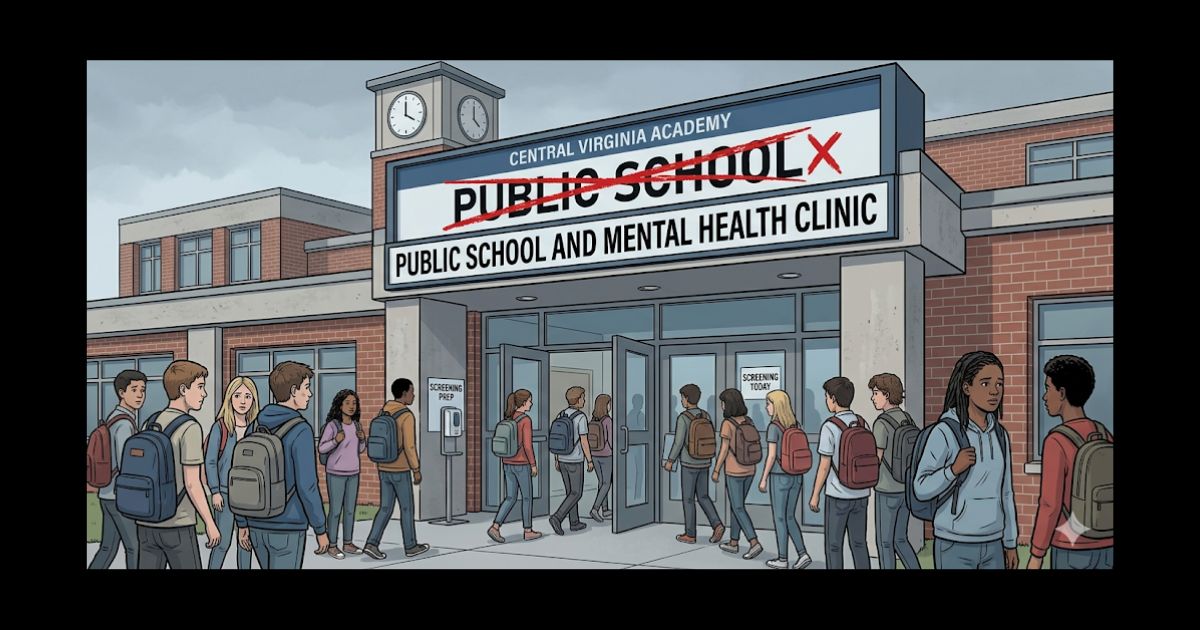
Virginia parents should be alarmed that the Virginia General Assembly just passed House Bill 355 which mandates annual mental health screenings for all public school students in grades 6 through 12. While framed as a compassionate response to a very real “mental health crisis,” it represents a fundamental shift in the mission of public education: from academic instruction to clinical surveillance.
By institutionalizing mandatory mental health screenings, HB 355 threatens to undermine parental authority, pathologize normal developmental issues experienced during difficult age ranges, and likely ignores the cultural and religious values of many Virginia families.
The primary objection to HB 355 is not clinical, but structural. The family is the foundational unit of a free society, yet this bill treats parents as secondary stakeholders. By utilizing a “passive consent” (opt-out) model, the state assumes the right to probe a child’s internal psyche unless a parent proactively intervenes. This, of course, assumes that parents fully understand or even receive critical opt-out notices that are sent home – notices that are likely crafted with “we are here to help” verbiage.
In a healthy society, the state must require explicit, informed “opt-in” consent before any psychological assessment. Make the schools convince parents that this is the right choice for their children and ensure they have their informed consent and partnership. When government screening is the “default,” it signals to parents that their role as the primary protector of their child’s well-being has been superseded by the state. Do nothing and the school will do it for you, and better (or so they believe).
This is not a safety net; it is a soft form of state overreach that erodes the parent-child bond.
From a mental health perspective, mandatory screenings are a blunt instrument in a field that requires a scalpel and significant training. Adolescence is a period of emotional volatility — especially at the ages being screened in this bill. A student struggling with a breakup or the stress of an exam or a tough morning at home will likely be “flagged” on these standardized, incredibly subjective surveys.
Once flagged, HB 355’s “same-day intervention” protocols kick in. This protocol creates a dangerous pipeline where a student becomes labeled in their permanent school record for what may be a temporary issue. This will then lead to students identifying with their “disorder” – potentially causing them to view themselves as fundamentally broken or unhealthy. Then, of course, the pipeline concludes in a likely referral for pharmacological interventions.
We are already seeing record rates of SSRI and stimulant prescriptions among minors — HB 355 will only accelerate the medicalization of normal teenage angst and the everyday struggles of normal adolescence.
Most importantly, psychology, like most social sciences, is not value-neutral. The “evidence-based tools” mandated by HB 355 are built on a secular, individualistic framework that often conflicts with the traditional values of Virginia’s diverse families and communities. Modern psychology often pathologizes virtue – traits that a religious family might view as “discipline,” “modesty,” “morality,” or “respect for authority” can be reframed by a secular screening tool as creating “social anxiety” or unhealthy “rigidity.”
The secular tools in modern psychology often prioritize “expressive individualism” over the communal and spiritual duties frequently taught in the home. By “grading” a child’s mental health through a secular lens, the school effectively sits in judgment of the family’s religious or cultural worldview.
Finally, we must view HB 355 in the context of recent actions by several Virginia school districts that took steps to “affirm” student gender transitions by changing student names and pronouns without parental consent or even notification. This is a sign that they are inclined towards high-stakes psychological assessments and the implementation of serious interventions – all done in secret.
Now, combined this history with mandatory mental health screenings, and HB 355 creates a system where the school identifies a “vulnerable” child, applies an ideological “treatment,” and intentionally or unintentionally sidelines the parents. This “clinician-first” approach treats the home as a potential obstacle to be managed or ignored rather than the sanctuary where a child truly belongs.
The solution to our children’s mental health struggles is not more government checklists or treatments; it is stronger, more empowered, and more informed families. If we turn our schools into clinical triage centers, we risk creating a generation of over-analyzed children and disempowered parents.
The mental and emotional development of a child is the sacred domain of the family. Schools can and should address mental health concerns by educating parents, offering screenings that parents can opt-in to at their discretion, and teacher training that helps educators understand age specific concerns to watch out for and share with the families of students if serious concerns are identified. This keeps parents as the primary and most important caretaker of their children’s mental health – in partnership with their schools.
Governor Abigail Spanberger should veto or amend HB 355 and return to a model where schools educate the mind, while parents — and the health professionals and faith communities they choose – handle their child’s mental and spiritual health.
Share this Story on Facebook, X, Text, LinkedIn, Gmail, Yahoo Mail, or Outlook