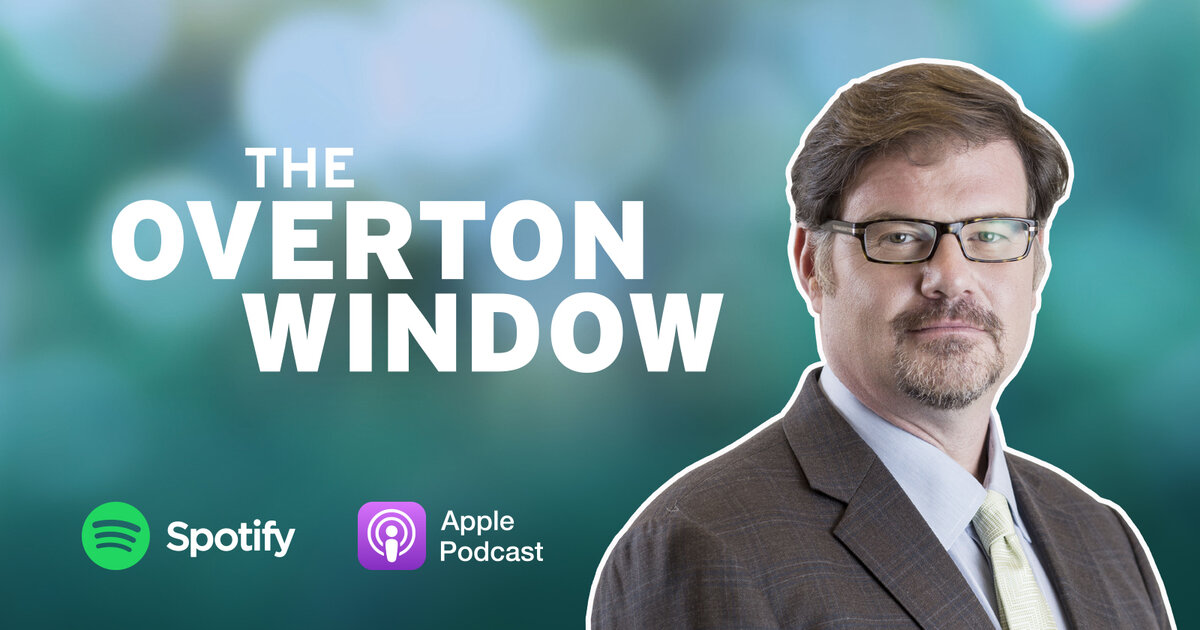
Jonah Goldberg has spent decades writing columns, authoring books, and appearing on television. But a few years ago, he decided the media landscape needed something different.
Goldberg joins The Overton Window Podcast to talk about where that led him: The Dispatch, a digital media company he co-founded with Steve Hayes that has quietly become one of the more interesting experiments in modern journalism.
Why should people subscribe to The Dispatch?
“First of all, because it’ll make all the right people angry,” Goldberg jokes, “because we are in a time and a place where a lot of people bemoan that they can’t trust the news.”
From the outset, the goal was modest. “If we could be a dollar in the black at the end of the year and accomplish the journalistic things that we wanted to accomplish, then we’d be happy.” Over time, that ambition expanded. The mission now includes proving that “non clickbaity, non-partisan-water-carrying journalism” can succeed as a business model.
“A lot of people think that part of their job is to craft arguments to help the Republican Party,” he says. “Steve and I wanted to come up with something else where we don’t carry water for Democrats or Republicans.” The result is backlash from both sides. Audiences often assume neutrality is disguised opposition. “I think that is the fault of the consumer, not of the provider in our case.”
Central to that mission is resisting the incentives that shape much of modern media. Goldberg describes an environment where being loud and provocative often matters more than being correct. At The Dispatch, the aim is different: to train journalists who avoid “rudeness for its own sake” and prioritize facts over performance.
For Goldberg, disagreement is not a flaw in democracy but its engine. “I just like arguments. And I think that politics is supposed to be about arguments.” He contrasts that with what he calls a “Popular Front mentality,” where ideological alignment overrides honest debate.
The publication’s editorial mix reflects its commitment to internal disagreement. “I can have a more meaningful, interesting conversation with somebody who’s fact-driven, policy-driven, who cares about the truth on the center left than I can with a lot of people who are ostensibly flying under the same flag as me,” Goldberg attests.
Underlying all of this is a principle Goldberg considers non-negotiable: honesty. “You shouldn’t lie. You just shouldn’t say things that you don’t believe to be true.” His frustration with the erosion of that standard during the mid-2010s was a major catalyst for founding the publication.
“What we don’t do — but a lot of media outlets do — is tell our audiences what they think they want to hear rather than what they need to hear,” says Goldberg. “If we’re not pissing off about 30% of our readership on any given day, we’re doing something wrong.”
In a media world built on telling people what they want to hear, The Dispatch is betting there’s an audience for something harder to swallow.
Listen to the full conversation on The Overton Window Podcast.