
Massachusetts lost an estimated 145,000 residents to New Hampshire over the last 20 years, a Josiah Bartlett Center analysis of U.S. Census migration data shows. For scale, that number of people living in one place would be Massachusetts’ fourth-largest city, larger than Cambridge and slightly smaller than Springfield.
The U.S. Census Bureau estimates that 369,368 Massachusetts residents moved to New Hampshire from 2005-2024, an amount equal to more than half (55%) of the 2024 population of Boston.
During that same period, an estimated 223,720 Granite Staters moved to Massachusetts, an amount roughly equal to the combined populations of Manchester, Nashua and Hooksett.
On net, 145,648 more people moved from Massachusetts to New Hampshire over those two decades, according to Census estimates. That’s roughly equal to the combined 2024 populations of Manchester, New Hampshire’s largest city, and Merrimack, the state’s eight-largest municipality.
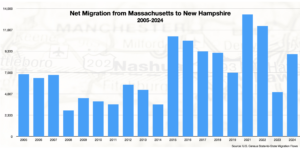
Plotted by year, New Hampshire’s net population gain from Massachusetts movers dropped during the 2008 financial crisis, rose again in 2012, and then surged by 212% in 2015.
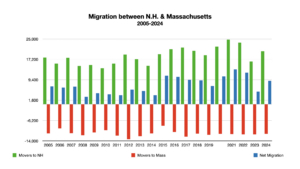
New Hampshire’s out-migration to Massachusetts has remained steady for 20 years, but in-migration from Massachusetts picked up a decade ago and has not fallen back to its 2014 levels.
From 2005-2014, New Hampshire’s out-migration to Massachusetts averaged 11,250 per year, while in-migration from Massachusetts averaged 16,117 per year.
Since 2015, New Hampshire’s out-migration to Massachusetts averaged 11,122 per year, while in-migration from Massachusetts averaged 20,820 per year.
“Nearly twice as many people move from Massachusetts to New Hampshire every year than go the other way, and that’s been true for a decade,” Josiah Bartlett Center President Andrew Cline said. “People move for a variety of reasons, but the steadiness of these numbers over time should be concerning for Massachusetts officials.”
As Boston’s Pioneer Institute showed in a new analysis, out-migration is costing Massachusetts billions in lost wealth, as measured by the adjusted gross income (AGI) of those who move out.
“Massachusetts’ net loss of AGI to other states grew from roughly $900 million in 2012 to $4.18 billion in 2023, representing a 467 percent increase over the past decade,” the Pioneer report found. “To Florida and New Hampshire alone, the state lost $2.75 billion in AGI, a 5-fold increase. The Bay State has lost a net total of $14.8 billion since 2020. The persistence and scale of these losses signal structural competitiveness challenges for the Commonwealth.”
Florida and New Hampshire are the top two destinations for Massachusetts residents who leave. Neither destination state has an income tax.
Though it does not cover the past two decades, a Massachusetts Opportunity Alliance survey last year of people who left the Bay State could shed some light on the motivations for movers. The top three stated reasons Massachusetts movers gave for closing their new state were:
- Lower cost of living
- Better quality of life
- Lower taxes
A note on the numbers: There are two primary measures of domestic migration in the United States. The IRS tracks migration from tax filings, and the Census Bureau tracks it through the bureau’s Annual Community Survey. The Pioneer Institute used IRS data, which include adjusted gross income, but don’t capture as many movers. Our analysis looked at Census data to try to capture more movers.
The Census figures are estimates based on the Census Bureau’s Annual Community Survey, with a 90% probability of representing the actual number of movers, according to the bureau’s methodology.