by Randal O’Toole
Bus rapid transit was originally supposed to provide light-rail-like services for a lot less money than the cost of building a new rail line. Yet TriMet has figured out a way to make bus rapid transit both expensive and painful.
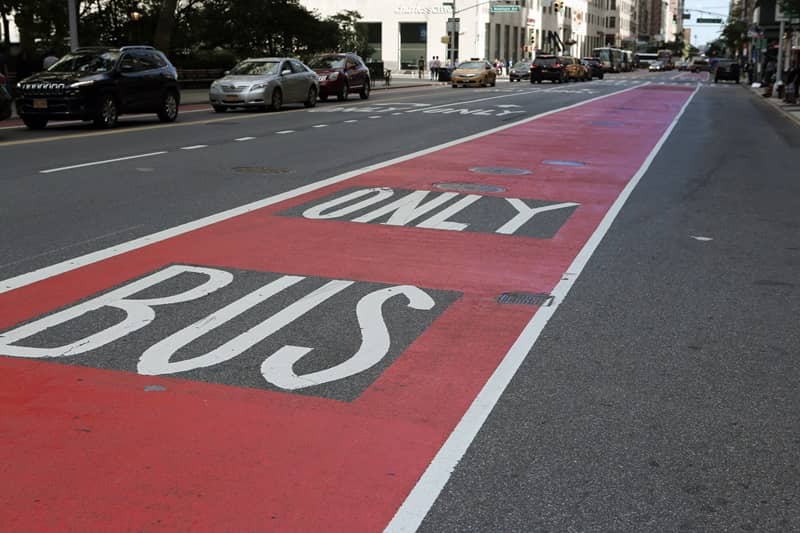
The agency wants to dedicate two lanes of 82nd Avenue for seven miles—from Cully Boulevard to Clackamas Town Center—to buses. Cars will be allowed to use those lanes only to turn right at the next intersection.
At heart, bus rapid transit consists of buses running more frequently and stopping less frequently than conventional bus service. Frequent buses mean that potential riders don’t need to consult schedules; they can just go to a transit stop knowing that a vehicle will pick them up in a few minutes. Stopping only once per mile instead of five or six times a mile increases average speeds, making buses more competitive with driving.
This kind of bus rapid transit, sometimes called BRT 1, has been known to attract significantly more riders than conventional buses. But this isn’t enough for many transit advocates, who demand that buses be given their own dedicated lanes, usually by taking existing lanes away from cars and other traffic. This is sometimes called BRT 2.
Dedicating lanes to buses makes sense when there are enough buses to fill those lanes. TriMet has scheduled as many as 160 buses per hour in the downtown bus mall. Istanbul has a busway that moves around 240 buses per hour. An exclusive bus lane through the Lincoln tunnel connecting New York City with New Jersey moves as many as 650 buses per hour.
TriMet’s use of 82nd Avenue won’t come close to those numbers. Instead, it expects to run just six buses an hour during peak periods, and as few as two buses an hour on weekends. That will leave the bus lanes about 95 percent empty. Yes, right-turning cars will be allowed to use those lanes, but only a tiny fraction of cars on 82nd turn right at any given intersection.
Why would TriMet demand half of the through-traffic lanes on 82nd for its buses? One possible answer was provided by the CEO of Los Angeles’ transit agency when it was trying to do the same thing on major streets throughout that city.
“It’s too easy to drive in this city,” said Los Angeles Metro chief executive Phillip Washington. Attracting new bus riders means “actually making driving harder.” Los Angeles is usually regarded as the most congested city in America, but LA Metro’s goal is to make it even more painful to drive in the region in order to get a few more bus riders.
To make matters worse, TriMet’s plan to close two lanes on 82nd Avenue to through auto traffic will cost at least $320 million. Even while TriMet was facing a $300 million gap in its budget, it felt flush enough to plan to spend more than that redesigning 82nd to favor its buses.
BRT 1 costs practically nothing except, perhaps, the cost of a few new buses. But TriMet’s version of BRT 2 will cost more than $45 million per mile.
All of this shows just how much TriMet and other Portland transportation agencies are detached from reality. U.S. Department of Transportation data show that transit carried less than 1.3 percent of passenger-miles in the Portland urban area in 2024, down from 1.9 percent in 2019.
Despite transit’s declining significance, TriMet acts as if it is the most important form of travel in the region and therefore deserves more dollars and nearly as much roadway space as automobiles that carry more than 95 percent of passenger travel.
TriMet should implement BRT 1 on 82nd Avenue just to see if it can attract any new riders. But the city should not allow TriMet to claim any lanes for its buses unless there is enough transit demand to run at least 100 or more buses per hour down those lanes.
Randal O’Toole is a transportation and land-use policy analyst and adjunct scholar for the Cascade Policy Institute. His most recent book is Romance of the Rails: Why the Passenger Trains We Love Are Not the Transportation We Need.