
In his annual message to shareholders, JP Morgan Chase’s chief executive, Jamie Dimon, offered a timely and pointed warning for New York policymakers.
It’s worth quoting in full, with emphasis added for a few key points:
Cities — like individuals, companies and countries — need to compete.
No matter who you are, you need to deal with reality and the truth. The truth is that while New York City has much going for it, particularly for financial companies (because of extraordinary local talent), it also has the highest city and state corporate taxes and the highest individual income and state taxes. People often make this a moral or loyalty issue, but it is not. Companies need to remain competitive in this very tough, fast-moving world. And higher taxes mean lower returns on capital and less competitiveness by their nature.
Additionally, individuals vote with their feet — you can already see a fairly large exodus of people and jobs out of some states with high taxes and high expenses (often due to high taxes and regulatory burdens). Sometimes you see companies leaving states, but migration also shows up in shifts of employees out of certain states. For example, while New York City is still our company’s global headquarters, we have shrunk our headcount in the city, from 30,000 a decade ago to 24,000 today, and increased our headcount in Texas, from 26,000 in 2015 to 32,000 today. This trend will likely continue.
Sometimes this can be a disaster for a city. I am reminded that in the 1970s, nearly half of the 125 Fortune 500 companies based in New York City left. While mergers accounted for some departures, the price of doing business in New York City accounted for most: cost of taxes, office rents, labor and so on. No city — or company or country — has a divine right to success.
Although Dimon didn’t get into specifics, he was clearly alluding to the “tax the rich” agenda of Mayor Zohran Mamdani and his allies in Albany – and tacitly making the case that New York lawmakers should be cutting taxes, not hiking them.
Dimon’s opinion deserves to be taken seriously. He’s a native New Yorker who heads the largest of the 43 companies in the Fortune 500 that are still headquartered in Manhattan. He oversaw construction of JP Morgan’s new 60-story headquarters building at 270 Park Ave. which opened last year, a $3 billion bet on the city’s continued viability.
Dimon makes his living by understanding how money works and keeping an eye on the big picture. His message to shareholders included disquisitions on artificial intelligence, cryptocurrency, the wars in Iran and Ukraine, the outlook for inflation and the nuances of financial regulation.
His choice to bring up New York’s tax code in that context is a sign that he sees it as a serious problem – both for his company and for the city and state where it makes its home.
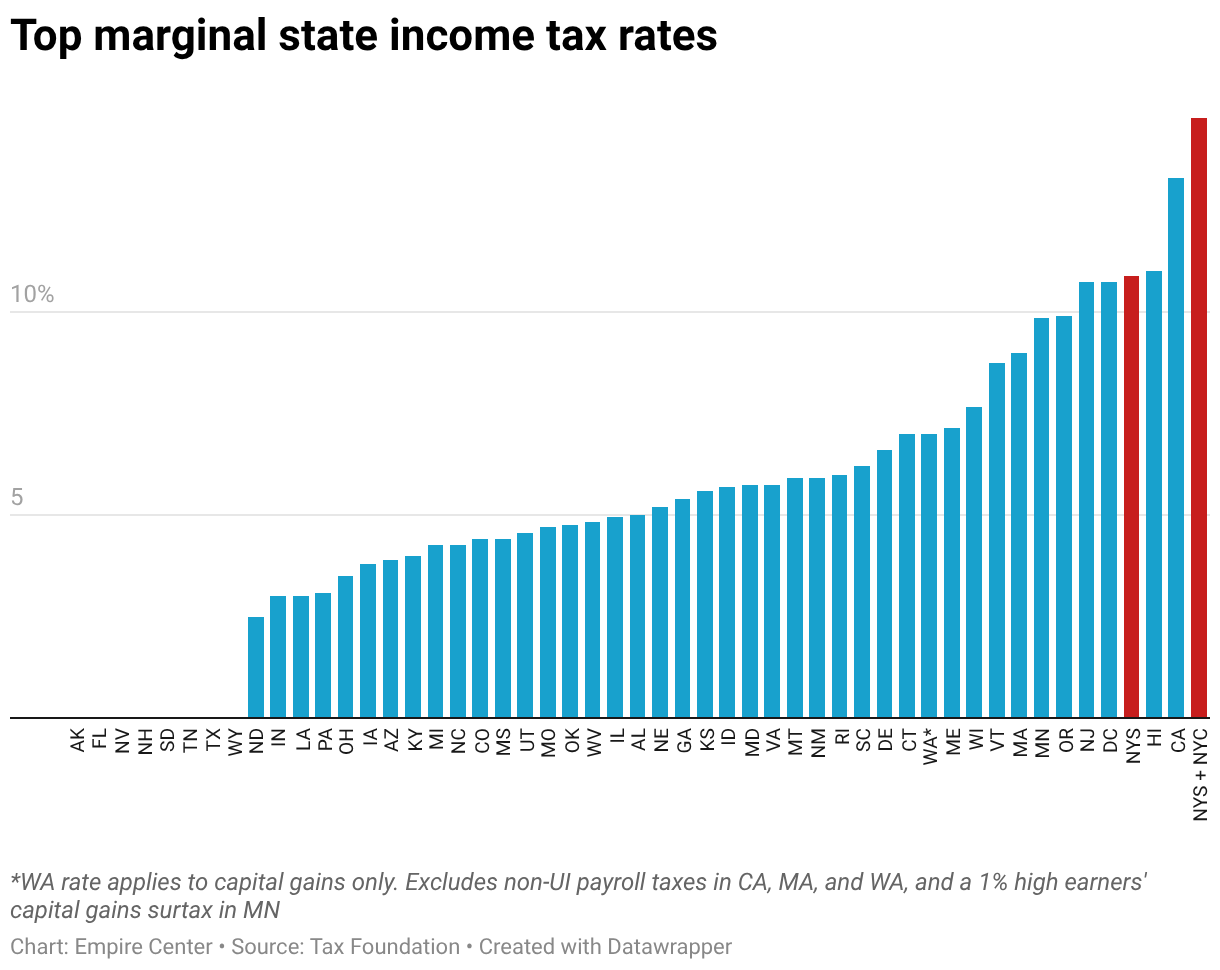
The shift of JP Morgan jobs from New York to Texas, as he described, is emblematic of larger trends. The state’s share of the nation’s millionaires is plunging, its population growth is stagnant, and its employment numbers are chronically weak. New York’s highest-in-the-nation tax rates (see chart) might not fully explain this long-term decline, but they are undeniably a contributing factor.
State lawmakers are currently debating Mamdani’s requested tax hikes as part of their overdue budget for the 2027 fiscal year, which began April 1. The Assembly and Senate are ready to say yes, at least in part, and Governor Hochul is trying to say no.
Dimon’s implied message is that raising taxes would make a bad situation worse – and possibly invite a 1970s-style fiscal disaster. Here’s hoping that people in Albany were paying attention.
About the Author