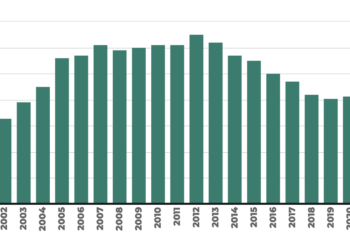
In 1969, nearly nine out of 10 American children lived in households with two married parents. By 2023, that figure had fallen to roughly six in 10 — with stark differences across racial groups. According to data from the U.S. Census Bureau’s American Community Survey, about 82 percent of Asian children live with married birth parents, compared with 62 percent of White children, 43 percent of Hispanic children, and 23 percent of Black children.
Over the same half-century, results from the National Assessment of Educational Progress, or NAEP, have shown persistent achievement gaps. On long-term trends and main NAEP assessments, Asian students score highest on average, followed by White students, then Hispanic students, with Black students trailing.

These patterns are widely discussed in terms of race and income. Far less attention is given to family structure — even though peer-reviewed research consistently finds that children raised in traditional two-parent households, on average, demonstrate stronger academic performance and lower grade retention rates than peers in single-parent or non-traditional homes.
This does not mean race is irrelevant. Nor does it imply that family structure alone determines outcomes.
But it does suggest that family context is one of the most consistent correlates of achievement. And yet Wisconsin, like all states, does not systematically report it in its K–12 education dashboards.
Students spend roughly 10 percent of their formative waking hours in school. The remaining 90 percent — particularly in early childhood — is shaped by family routines, supervision, expectations, and time use.
The Brookings Institution has documented meaningful differences in daily homework time across racial groups: Asian American students report roughly 115 minutes per day, White students about 60 minutes, Hispanic students about 40–45 minutes, and African American students about 30–35 minutes. Time spent engaged in academic practice is strongly associated with skill development and higher test performance.
Schools alone cannot equalize disparities in supervised learning time outside the classroom. If we are serious about closing gaps, we must measure the environments in which children are growing up.
Discipline patterns tell a similar story
Family structure also correlates with discipline outcomes — an area where racial disparities dominate public debate. National longitudinal research using datasets such as Add Health and ECLS-K finds that students from single-parent households experience significantly higher suspension rates than peers from married two-parent homes, even after controlling for income and prior academic performance. The gap does not disappear when socioeconomic variables are included.
That does not erase racial disparities. But it raises additional empirical questions that policymakers rarely examine because household composition is not routinely reported:
- If there are racial differences in suspension rates, what proportion of suspended students are from two-parent vs. single-parent homes — within and across racial groups?
- Within racial categories, do students from two-parent homes experience lower suspension rates than peers from single-parent homes?
- Do boys from single-parent households experience higher suspension rates than girls from single-parent households?
These are measurable, researchable questions. Without collecting and reporting household composition data, policymakers — and, critically, local school boards and community leaders who partner with intervention organizations — cannot determine whether observed discipline gaps are more closely associated with school climate factors, with differing enforcement practices, or with statistically correlated differences in out-of-school supervision, structure, and adult availability. Without this information, communities are left to debate disparities without fully understanding what contributes to them.
Ignoring family context does not eliminate inequities; it constrains our capacity to diagnose them with precision and to design interventions that are proportionate, targeted and evidence-based.
What Wisconsin can do
First, Wisconsin should begin tracking and reporting family structure in its education dashboards. This would mirror changes in health care integrating “social determinants of health” into data systems to recognize that outcomes are shaped by more than clinical treatment alone. Education policy can apply similar logic.
Household composition data would allow schools to intervene earlier and more precisely. The goal is not to stigmatize families but to align support with need.
Second, Wisconsin should consider teaching the “Success Sequence” in its K–12 curriculum: graduate from high school, work full-time, and delay childbearing until marriage or economic stability. Research from the American Enterprise Institute finds that young adults who follow this sequence are substantially more likely to avoid poverty and enter the middle class.
Educators cannot control the circumstances into which children are born. But they can equip students with knowledge about the life decisions statistically associated with upward mobility.
Third, local leaders can develop community frameworks to support children in single-parent homes. Economist Melissa Kearney, author of “The Two-Parent Privilege,” describes how two-parent households tend to confer several measurable advantages — more adult supervision, greater economic resources, and greater parental emotional bandwidth — which together support children’s cognitive, emotional, and educational development. These mechanisms do not imply that single parents are less committed, but they do describe structural differences in adult capacity and time allocation that influence outcomes.
Schools can help compensate where structural gaps exist. Districts could collaborate with community-based organizations, mentoring groups, faith-based institutions, after-school providers, and mental health agencies to increase supervised time, tutoring availability, and enrichment for students from single-parent homes.
The goal is not to replace parents but to supplement adult bandwidth. If two-parent households on average provide more supervision and stability, schools and community agencies can coordinate to replicate those supports for students who need them most.
By measuring family structure alongside academic and discipline outcomes, Wisconsin would gain clearer insight into which disparities are primarily school-based, context-based, or amenable to coordinated intervention.
Data does not assign blame. It clarifies reality. If we want better outcomes, we must measure what matters — and design policy accordingly.
Goldy Brown III is a native of Beloit and a professor of education at Whitworth University in Spokane, Wash. He has 25 years of experience in education, including five years as an award-winning principal in Beloit. Brown is also a member of the Conservative Education Reform Network, affiliated with the American Enterprise Institute.
Viewpoints reflect the opinion of the author and not necessarily the position of the Badger Institute.
Submit a comment