Next month, independent school districts (ISDs) will, again, ask voters to approve massive new borrowing schemes that threaten to unleash a wave of tax hikes and bigger bureaucracies.
These fiscal excesses appear widespread too.
Taxpayers in nearly 60 different counties will decide on one or more of the 109 individual propositions up for a vote this election cycle, according to the Texas Bond Review Board’s (BRB’s) bond election database. If these measures are entirely successful, then school districts will take on a staggering $11.6 billion of new principal debt. Importantly, that figure does not include interest costs.
Any additional debt approved will be added to the amount school districts already owe, which was estimated at $234.2 billion in FY 2025. That figure—which includes principal and interest costs—represents approximately 42% of Texas’ total local debt (i.e., $552 billion in FY 2025).
Given the stakes, it’s worth asking: Which school districts are chasing after the largest, most expensive bond propositions this cycle? And what is the actual cost of those measures, not just the principal amount being advertised?
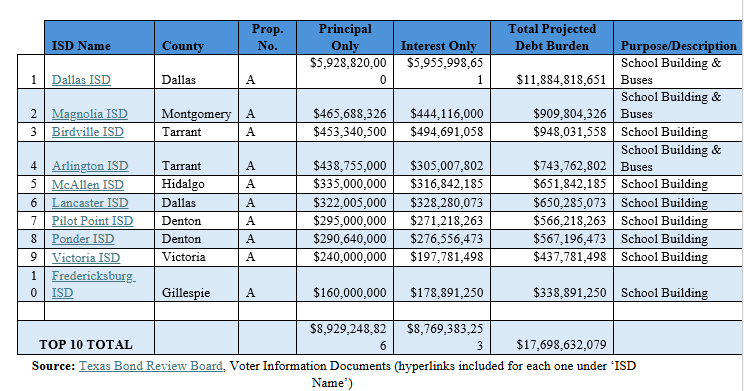
To answer those questions, we can use the BRB’s bond election database (link above) and the Voter Information Document (VID) required to be posted online for each item. Using these 2 sources, we can identify which ISD bonds are the most expensive, which have the highest interest costs, and what each measure will actually cost taxpayers, assuming passage and full repayment.
The data gathered is revealing. For instance, Dallas ISD’s $5.93 billion Proposition A is expected to cost almost $12 billion when interest is accounted for. Dallas, Birdville, Lancaster, and Fredericksburg ISDs all expect to pay back more in interest costs than the principal borrowed. And the top 10 largest propositions are projected to cost taxpayers $8.9 billion initially and almost $18 billion upon total repayment.
So, is your district on the most expensive school bond list?