- Judicial elections are important, and voters need information to make correct decisions
- North Carolina Supreme Court Justice Anita Earls has faced attempts to silence her speech on public issues
- There can be a balance between judicial free speech and protecting the right to due process
State Rep. Sarah Stevens (R-Surry, Wilkes) is challenging Justice Anita Earls for her seat on the North Carolina Supreme Court. Although the race will not determine control of the court (Republicans have a 5–2 majority), we can still expect a vigorous campaign with record-breaking spending. One thing we should not have to expect is that candidates will have to curtail their speech excessively out of fear of censure or worse from judicial authorities.
The importance of informed voters in judicial elections
Like many states, North Carolina elects its judges. Those elections are just as important as legislative and executive elections and can have as much, or even more, impact on our daily lives. But how do voters know which judicial candidates to vote for?
In his seminal book, “An Economic Theory of Democracy,” Anthony Downs wrote, “political information is useful to voters because it enables them to have specific preferences [for example, between candidates], which in turn influence government policies that affect them.”
Voters need information to help them select the candidates that best represent their views on policy and have the right experience and temperament for the office. When they lack that information, they make incorrect decisions or even refuse to vote.
North Carolina had a natural experiment in the impact of denying voters information when the General Assembly switched from partisan to nonpartisan elections for North Carolina’s Supreme Court.
As seen in the table below, the result, in the form of a greater drop-off from voting in presidential races to voting in North Carolina Supreme Court races, was immediate and dramatic:
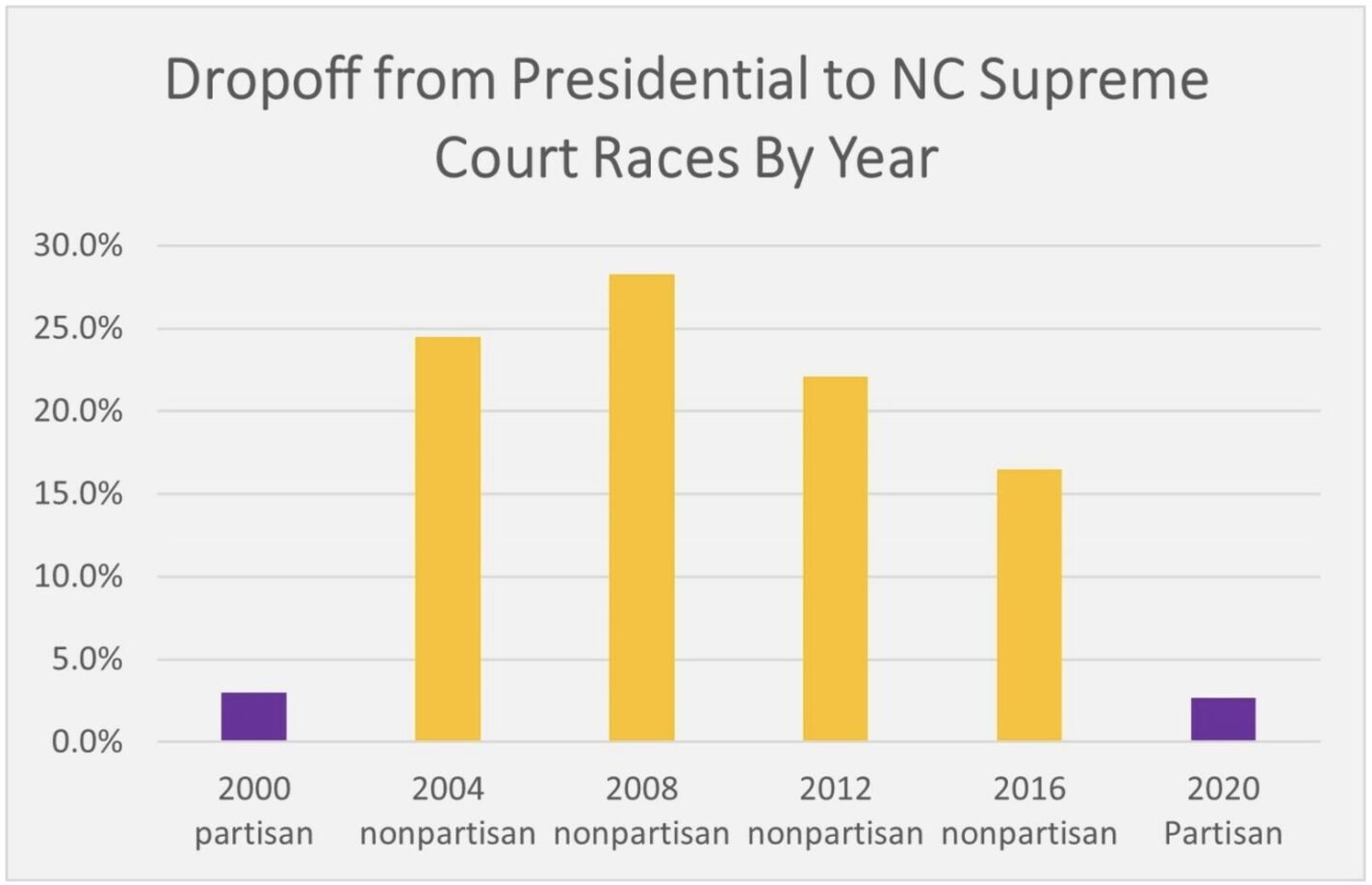
The difference in drop-off between partisan and nonpartisan Supreme Court races is dramatic. The average decrease in partisan Supreme Court races is 2.8 percent. For nonpartisan races, the average was 22.8 percent.
When voters lost access to one piece of information, the party affiliation of the candidates, more than one-fifth of them did not vote.
Another source of information is candidates’ statements. Voters are more likely to support candidates who “signal proximity to their own attitudinal position.” Judicial candidates cannot do that, however, without stating their general views on public issues.
The problem is that those candidates and sitting judges can find themselves in trouble for making such general statements.
A Supreme Court candidate has faced limits on her speech
North Carolina Supreme Court Justice Anita Earls is running for a second eight-year term. Her challenger is State Rep. Sarah Stevens, who chairs one of the House judiciary committees. If past conduct is any indication, Earls will say things on the campaign trail that nearly cross the line of what is acceptable for judicial candidates.
In June 2023, Earls made several statements in an interview published in the legal news service Law360 that appeared to disparage the court on which she served. Among other things, she accused her colleagues on the Supreme Court of “unfairly cutting off a female advocate.” She further stated that white male advocates before the court “are treated better” due to the “implicit bias” of other justices.
That August, the North Carolina Judicial Standards Commission (JSC) sent Earls a letter stating that she was under investigation because “you appear to allege that your Supreme Court colleagues are acting out of racial, gender, and/or political bias in some of their decision making.” The JSC saw that as a potential violation of Canon 2A of the North Carolina Code of Judicial Conduct, which states, in part, that a judge “should conduct himself/herself at all times in a manner that promotes public confidence in the integrity and impartiality of the judiciary.”
Earls responded by suing the JSC, claiming that such investigations, along with the threat of disciplinary action, were a “blatant attempt to chill her First Amendment rights.” People across the political spectrum, including the John Locke Foundation, backed Earls’ position. A central theme of that support is that voters have a right to know Earls’ views so they can choose for themselves if they are unacceptable.
Earls lost her case in federal district court and eventually dropped the lawsuit after the JSC dismissed the complaint against her, leaving the constitutional question unresolved.
Finding the right balance on judicial candidate speech
Admittedly, trying to find the right balance between judicial candidates’ freedom to speak about public issues (and thus provide voters with useful information) and the risk of prejudicing judges on cases that may come before them is hardly new.
The United States Supreme Court ruled 5–4 in Republican Party of Minnesota v. White (2002) that a state ban on judicial candidates speaking on disputed legal or political issues, “both prohibits speech based on its content and burdens a category of speech that is at the core of First Amendment freedoms—speech about the qualifications of candidates for public office.”
A Minnesota ban on campaign “pledges or promises” was not challenged in that lawsuit.
Stephen Gillers, a vice dean at the New York University School of Law, proposed a rule for judicial candidate speech:
A candidate for judicial office may state his or her general views on legal issues, but must make it clear that these views are tentative and subject to arguments of counsel and deliberation.
A related standard would be that a candidate for judicial office may state his or her general views on legal or political issues, but may not take positions on particular laws or cases and then sit in judgment of them in court. Anything less would raise serious due process concerns in those cases.
Under that standard, Earls would not, for example, have to recuse herself from a redistricting case because of her past statements against gerrymandering (indeed, she resisted calls to recuse herself on those grounds in 2022). If she declared her opposition to the current North Carolina congressional map, however, she should recuse herself from any future cases involving that map.
That is perhaps a tortured distinction, but it balances our due process rights with our rights to free speech and to know the qualifications of judicial candidates.