Harrisburg, Pa., May 4, 2026 — Last fall, Pennsylvania lawmakers removed the Keystone State from the Regional Greenhouse Gas Initiative (RGGI) after six years of legal battles. According to new analysis from the Commonwealth Foundation, the commonwealth’s flirtation with RGGI resulted in decreased electricity generation, an exodus of energy projects, and billions of dollars in lost revenue.
Pennsylvania entered RGGI in 2019, under executive overreach by former Gov. Tom Wolf. However, the Commonwealth Court ruled Wolf’s executive action unconstitutional. Gov. Josh Shapiro appealed the decision, prolonging the commonwealth’s problematic relationship with RGGI. This yearslong legal limbo lasted until November 2025 when the state legislature forced the governor to drop his litigation and freed the commonwealth from threat of RGGI, as part of last year’s state budget deal.
The report compares Pennsylvania’s pre-RGGI success to the state during the RGGI years. Additionally, the report compares the energy success of Pennsylvania (a RGGI state) to Ohio (a non-RGGI state) between 2019 and 2025.
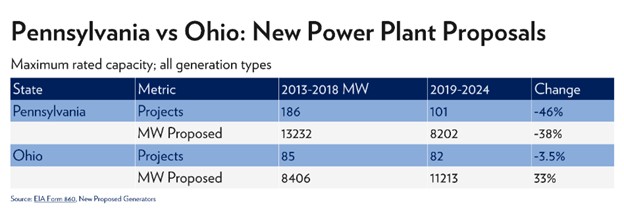
While obstacles like falling natural gas prices plagued both states, the driving difference between Ohio’s consistency and Pennsylvania’s stagnation was clear: RGGI.
Elizabeth Stelle, vice president of policy for the Commonwealth Foundation, issued the following statement in response:
“The Keystone State’s six-year on-again, off-again relationship with RGGI is a cautionary tale for other states, such as Virginia. RGGI is a tax on every user of electricity, toppling the energy future of every state it touches.
“In the six years under RGGI, Pennsylvania lost between $5 billion and $8 billion dollars in investment in our energy sector. The commonwealth lost enough electricity to power the entire Pittsburgh metro area.
“Unfortunately, that loss is not shocking. While Pennsylvania debated, litigated, and delayed over carbon tax policy, Ohio provided developers with a predictable regulatory environment to commit billions in capital. Projects in Pennsylvania were cancelled as the project pipeline in Ohio boomed.
“This loss was not unique to Pennsylvania. RGGI members like Maryland and New Jersey lost affordable, baseload power, while non-RGGI states like Ohio and West Virginia gained capacity.
“Pennsylvania’s investment drought under RGGI should be a warning to other states as electricity demand surges. Virginia’s re-entry to the program under newly elected Gov. Abigail Spanberger boggles the mind as electricity demand in data center row soars.
“Despite Pennsylvania’s RGGI exit, Gov. Josh Shapiro continues to champion an even more extreme taxing scheme through the Lightning Plan. Elements of this plan including the Pennsylvania Climate Emissions Reduction Act (PACER) and Pennsylvania Reliable Energy Sustainability Standard (PRESS) programs, would cost Pennsylvania $157.2 billion and more than double residential electricity bills.
“Affordable, reliable energy is not achieved through Green New Deal-style mandates and burdensome regulation. The pre-RGGI years show a stable regulatory environment can attract the investment Pennsylvania needs to bring down electricity costs and unleash our energy assets.
“Pennsylvania is uniquely positioned to dominate American energy independence, but only if lawmakers focus on bolstering—not undermining—our energy sector.”
Read the full report here.
The post Pennsylvania Lost $5 Billion in Energy Investment and Power Supply Under RGGI appeared first on Commonwealth Foundation.