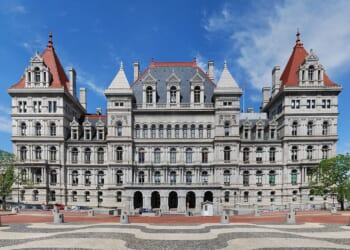
- Starting soon after Independence, and continuing for a century and a half thereafter, America’s courts recognized that they had a duty to review and invalidate unconstitutional acts by the other branches of government
- The progressive elite that rose to power in the early 20th century opposed that kind of judicial review because it impeded their efforts to create an omnipotent regulatory state
- They eventually persuaded first the federal courts and then the state courts to adopt a doctrine that placed laws regulating economic activity beyond the reach of judicial review
Note: This is the second in a series of research briefs discussing rational basis review, a judicial doctrine that effectively shields most laws and regulations from constitutional challenge.
How should a court respond when someone complains that a government agency has violated his or her constitutional rights? As the discussion of Singleton v. NC DHHS in part one of this series illustrates, nowadays courts often respond to such complaints by dismissing them without a hearing. It wasn’t always that way, however.
For the first century and a half of our nation’s history, most courts recognized that under the American system of government they had an implicit duty to review such complaints impartially, and — if they found that the act in question was indeed unconstitutional — they had the power to declare that act to be invalid and unenforceable.
The story of how and why the courts first asserted and then surrendered the power of judicial review begins in North Carolina with another lawsuit involving a party named Singleton. The case was Bayard v. Singleton, and the Superior Court of Law and Equity’s reasoning in the case set a pattern that courts throughout the country would follow for 150 years.
The plaintiff, Elizabeth Cornell Bayard, was the daughter of a wealthy New Bern loyalist whose property had been confiscated during the revolution. When she sued to recover the property after the war, the state asked the court to dismiss the case under a 1785 statute that barred such lawsuits. The state constitution, however, explicitly guaranteed the right to a jury trial in “controversies at law respecting property.” The court, therefore, had to decide which law should prevail: the 1785 statute, or the 1776 constitution?
The Bayard court began its deliberations by observing that:
[A]t the time of our separation from Great Britain … the people of this country … formed that system of those fundamental principles comprised in the Constitution, dividing the powers of government into separate and distinct branches, to wit: the legislative, the judicial, and executive, and assigning to each several and distinct powers, and prescribing their several limits and boundaries.
The rest of the decision followed inexorably from that institutional context. “[N]otwithstanding the great reluctance they might feel against involving themselves in a dispute with the Legislature of the State,” the judges nevertheless found that “no object of concern or respect could … authorize them to dispense with the duty they owed the public … under the solemnity of their oaths.” And because “by the Constitution every citizen had undoubtedly a right to a decision on his property by a trial by jury,” and because “no act [the state legislature] could pass could by any means repeal or alter the Constitution,” they held unanimously that:
[T]he Constitution … standing in full force as the fundamental law of the land …, the act on which the present motion was grounded … must … stand as abrogated and without any effect.
Sixteen years later, in Marbury v. Madison, Chief Justice John Marshall of the United States Supreme Court followed a similar line of reasoning to a similar conclusion regarding the federal courts:
[T]he constitution of the United States confirms and strengthens the principle, supposed to be essential to all written Constitutions, that a law repugnant to the constitution is void, and that courts … are bound by that instrument.
Being mindful of their limited role within the constitutional framework, the courts tended to be cautious about second-guessing the other branches of government, and many jurists, theorists, and politicians worried about the practical and theoretical implications of giving the judicial branch the power to strike down duly enacted laws. Nevertheless, the logic of Bayard and Marbury was compelling, and the precedents established by those cases governed for well over a century. Moreover, when those precedents were eventually overturned in the middle of the 20th century, it wasn’t because the logic had become less compelling. It was because the courts had been browbeaten into accepting a doctrine under which they could avoid having to apply that logic at all.
The progressive elite that rose to power in the early 20th century wanted to replace the American system of limited, constitutional government with a unified administrative state in which ostensibly wise and beneficent technocrats wielded unlimited power. They resented the constitutional checks and balances that stood in their way. The honorable and aboveboard way to have dealt with that situation would have been to try to amend the state and federal constitutions, but that would have been difficult. Much easier, they decided, was to persuade the courts to stop applying the constitutional limits that were getting in their way.
It took several decades, and a threat by President Franklin D. Roosevelt to pack the court, but the progressives eventually got what they wanted. In 1937, in United States v. Carolene Products, the United States Supreme Court declared:
Regulatory legislation affecting ordinary commercial transactions is not to be pronounced unconstitutional unless … it is of such a character as to preclude the assumption that it rests upon some rational basis.
The Court left open the possibility of “more exacting judicial scrutiny” for other kinds of laws, and in the decades that followed it adopted a complex “tiers of scrutiny” system with multiple levels. “Rational basis review,” however, continued to be the standard for economic regulations, and it rapidly evolved into an irrebuttable presumption of constitutionality that could be invoked to bypass judicial review altogether. Jurists who had sworn an oath to uphold the constitution no longer felt honor bound to act as impartial arbiters in cases involving constitutional challenges to duly enacted laws. Instead they could say, “Sorry. Supreme Court precedent precludes us from considering your claim on the merits. You lose as a matter of law.”
As a way of justifying this dereliction of duty, rational basis review made a spurious kind of sense at the federal level because the U.S. Constitution provides very little explicit protection for economic rights. It made much less sense when state courts started applying it to claims under their own constitutions. And as I will explain in the next installment in this series, given the text and history of our state constitution, it made no sense at all in North Carolina.
For more information see: