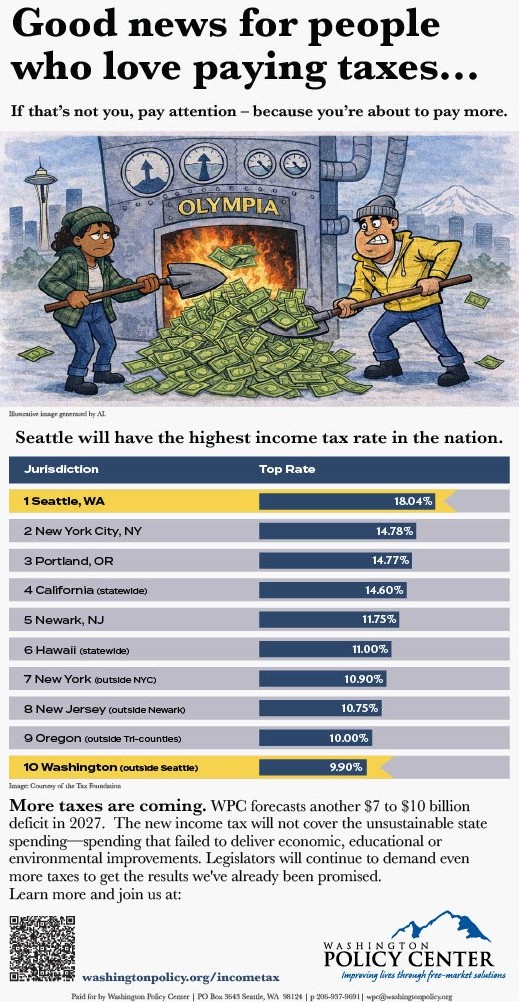
You may have seen our full-page ad in Sunday’s Seattle Times showing Seattle’s top income tax rate climbing to 18.04% once the new state income tax takes effect in 2028, the highest of any jurisdiction in the country. A piece on Washington Observer’s Substack this week dismissed that figure as “fun with numbers” and presented with “no caveats.” It also argued that two of the four taxes in that stack are paid by businesses, rather than individuals, and therefore don’t belong in the calculation. Both claims are wrong.
The 18.04% figure comes from a January analysis by Tax Foundation Senior Fellow Jared Walczak. It combines 9.9% from the new state income tax, 5% from Seattle’s Social Housing Tax on compensation over $1 million, 2.557% from the JumpStart Payroll Expense Tax on high-earner wages, and 0.58% from WA Cares. The ad presents these as “Top Rate” figures, caveated as such in the column header, and ranks Seattle alongside the top rates in New York City, Portland, California, and other high-tax jurisdictions.
The JumpStart and the Social Housing taxes are calculated as a percentage of an individual employee’s compensation above set thresholds. They are not flat fees per worker, nor are they levied on revenue or profits. The tax base is the worker’s wages, which is the defining feature of an income tax. The fact that the employer writes the check rather than the employee doesn’t change who actually pays. Walczak addresses this directly in his analysis:
“These payroll taxes are remitted by employers, not employees, but they are priced into wages. As new taxes are imposed, employers may initially bear some of the burden because wages are “sticky” and the adjustment is largely through smaller raises or lower starting salaries. Ultimately, however, the economic incidence of payroll taxes is on employees, just like the individual income tax. They increase the cost of employing workers in Seattle and reduce the wages of those employed there.”
This treatment of payroll taxes aligns with the working assumption of nearly every federal scorekeeper.
The Congressional Budget Office, in its methodology for distributing federal taxes across households, states that “CBO also allocates the employer’s share of payroll taxes to employees because employers appear to pass on their share of payroll taxes to employees by paying lower wages than they otherwise would.”
The Treasury Department’s Office of Tax Analysis is even more direct in its distribution methodology: “Payroll taxes (employer and employee shares) are assumed to be borne by labor.”
And the Joint Committee on Taxation includes the employer share of FICA in its measure of individual “expanded income,” reflecting what it describes as “the consensus in the economic literature that workers’ wages would be higher in the absence of the payroll taxes paid by their employers on their behalf.”
Combine the JumpStart and the Social Housing Tax with the new 9.9% state tax, and WA Cares, and Seattle’s high earners face an all-in rate of 18.04% on their wages. That’s exactly what Walczak documented, and exactly what the ad reflects. No fun with numbers required.
All that said, if you do want some fun with numbers, look at state spending growth. Despite the 2023 capital gains tax, the WA Cares payroll tax, billions in new Climate Commitment Act revenue, the largest tax increase in state history in 2025, a one-year estate tax increase, expanded B&O surcharges, raids on the LEOFF 1 pension fund and the Public Works Assistance Account, accounting gimmicks in the 2026 supplemental budget, and now an income tax on top of all of it, Washington is still on track for another multi-billion-dollar deficit in the coming biennium. That deficit will compel the Legislature to again seek tax increases.
Those are the kinds of number games that are of consequence in Washington.