- Two hundred fifty years ago, the Founding Fathers set about forming a new government
- They drew inspiration from John Locke’s thoughts on what legitimizes government
- Preserving life, liberty, and property are the foundational reasons to form a government
As our nation celebrates its 250th anniversary, much discussion surrounds the people, actions, and motivations that made America’s founding possible.
Once the Revolutionary War was won, our Founders had to go about the business of establishing a new government for this newly independent land.
To frame what this government should look like required reliance on a philosophical belief in the legitimate purpose of forming a government, so that this government could be restricted to morally justified functions.
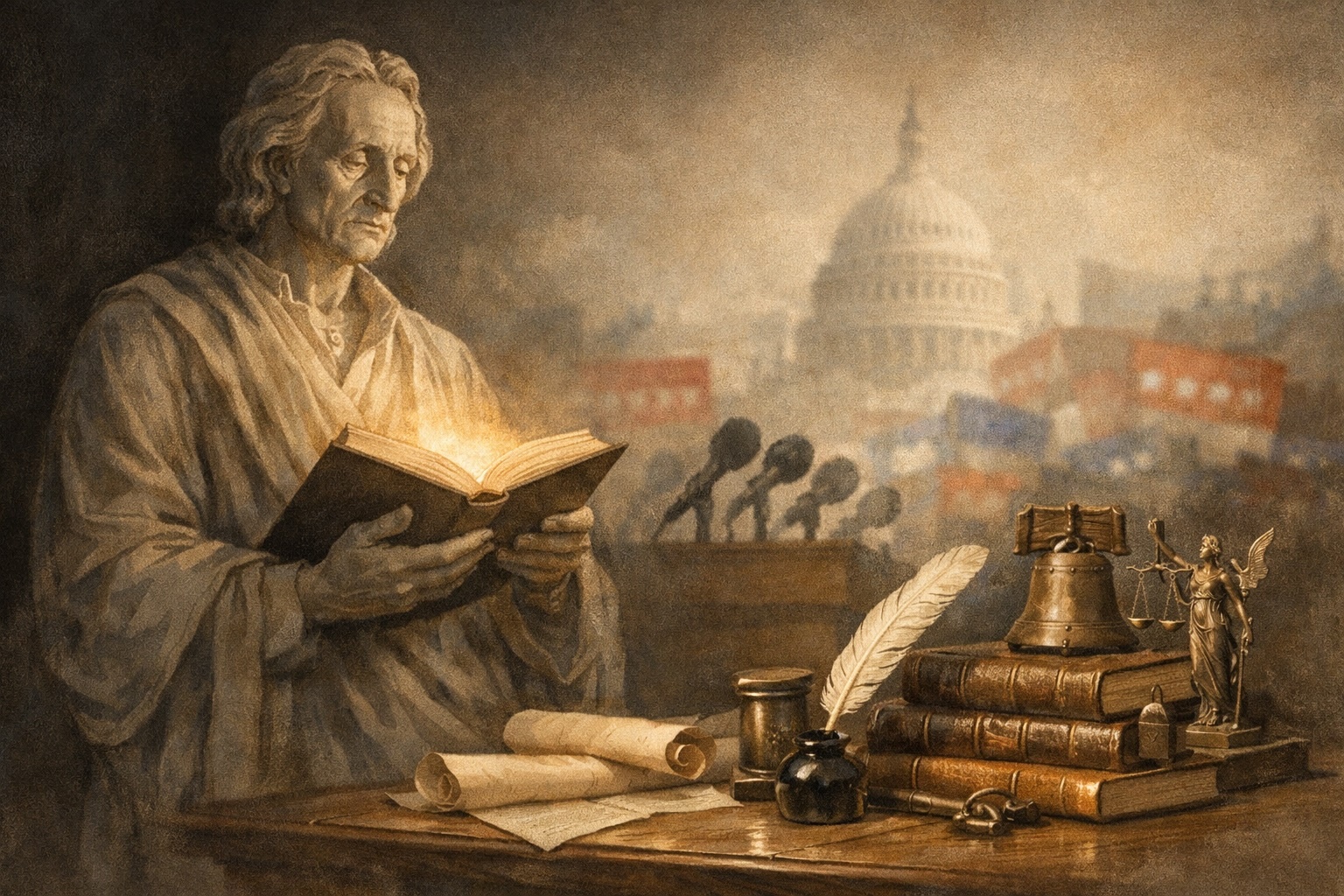
There’s no doubt that many of the Founders — especially Thomas Jefferson — looked to 17th century British philosopher John Locke as inspiration.
It therefore benefits those wishing to celebrate this nation’s founding, which goes hand in hand with the formation of our government, to understand Locke’s thoughts on why “Governments are instituted among Men.”
Locke begins his thought process with a conception of man in a “state of nature.” This state predates the creation of governments. In this state, there are God-given rules of conduct and rights each person is born into.
These rules are quite basic: no person has any intrinsic authority over others; all people possess an equal right to life, liberty, and property; and those who do aggress against others to violate these rights should be treated as though they have quit this voluntary arrangement and forfeited their rights.
According to Locke, these rights live outside of history, meaning that they are not confined to any historical epoch, but ring true regardless of time or societal organization.
It’s worth noting that Locke centered property rights among these rules. As he observed, the human condition is characterized by scarcity, which means that there are not enough resources available to satisfy all human desires, and crucially, that resources being used for one purpose are therefore not available for alternative uses.
As a result, disputes over the usage of resources are inevitable, and Locke maintained that property rights serve as a peaceful means to settle such disputes.
With these rules of social interaction established for the state of nature, Locke could then articulate the legitimate purpose for forming a government. Put simply, the purpose of political society (i.e., forming a government) is to live together in peace and security — something unobtainable without political society.
As Locke wrote, in a state of nature without a government to settle disputes, each individual would take it upon themselves to determine when they’ve been wronged and to exact punishment. This could devolve into chaos, as each individual would serve as their own judge and jury.
A political society, by contrast, should have a government that serves as a neutral arbiter of disputes, enforcing violations against those rights of life, liberty, and property. This government, according to Locke, would serve as a means to enforce internal order among society’s members.
Crucial to legitimizing these basic functions of government, however, is the consent of the governed to this government. On this front, Locke did not believe formalized consent was necessary, such as an oath or pledge. Rather, tacit consent would suffice.
Forms of tacit consent, according to Locke, include owning or using land, residing within a territory, and receiving protection of laws. As he wrote in his Second Treatise of Government: “Every man, that hath any possessions, or enjoyment, of any part of the dominions of any government, doth thereby give his tacit consent.”
Any obligation created by this tacit consent, however, is conditional and can be withdrawn by leaving that political society. That is why Locke emphasized the right of exit.
The legitimacy of a government is undercut when it uses force without right (that is, legitimacy under the law) to disrupt the peace. Government should serve merely as an umpire between citizens, not favoring some versus others using special protections or benefits.
In such circumstances where the government exceeds this role, it is just (morally appropriate) for men to rebel against it, concluded Locke. This notion was on display when the Founders wrote their grievances in the Declaration of Independence.
John Locke had a profound influence on the founding of this nation. As we celebrate its 250th year of existence, we can all benefit from a better understanding of his views on the legitimate reasons for the creation of government. Our Founders pledged their lives, fortunes, and sacred honor in pursuit of this vision. It’s up to us to keep it alive.