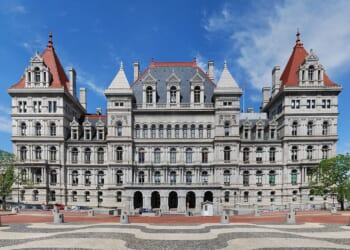
As Governor Hochul and legislative leaders rush to finalize the overdue state budget, outlines of some healthcare-related deals have begun to emerge from the closed-door negotiations.
Those deals reportedly include subsidizing a benefit fund affiliated with 1199 SEIU and extending a modified version of the so-called MCO tax on health insurance.
Although details remain murky, these agreements would tend to make health insurance less affordable for millions of New Yorkers while potentially running afoul of the Trump administration’s crackdown on misuse of Medicaid dollars.
Here is a summary of some of what the governor and legislative leaders are contemplating, as explained by sources closely following their negotiations.
Subsidizing union benefits
The budget will reportedly earmark $100 million from the state’s Medicaid program to subsidize a benefit fund for members of 1199 SEIU, the state’s largest union for healthcare workers.
It’s not clear which fund will receive the money, but the one covering home health workers is a likely candidate. Known as the 1199 SEIU National Benefit Fund for Home Care Employees, it has been losing members and running deficits in recent years.
Since 2024, the home care benefit fund has also been saving money by shifting lower-income workers into the state-run Essential Plan – an option that will no longer be available after July 1 as the state restructures the plan in response to the loss of federal funding.
Over the past decade, at least three 1199-affiliated benefit funds have indirectly received money through various Medicaid-funded programs. The programs have paid enhanced reimbursements to health care providers, such as nursing homes and home health agencies, and those providers in turn have passed the money to union-affiliated benefit funds.
Programs known as the Advanced Training Initiative and the Enhanced Advanced Training Initiative subsidized two funds that provide benefits for nursing home workers. The home care fund has received money through the Quality Incentive Vital Access Provider Pool, or QIVAPP.
These transactions have been documented in annual disclosure reports filed by the benefit funds.
According to filings from 2015 through 2024, the three funds have reported receiving $446 million in Medicaid subsidies. That included $82 million in QIVAPP subsidies for the home care fund from 2022 to 2024.
In the past, federal officials at the Centers for Medicare & Medicaid Services have given New York approval for these subsidy programs. However, it’s not clear that cooperation will continue given the Trump administration’s focus on eliminating waste, fraud and abuse in the Medicaid program.
The role of 1199 in influencing the state’s Medicaid program has caught the attention of the CMS administrator, Dr. Mehmet Oz. In a recent CNBC interview, Oz suggested that the reorganization of the New York’s Consumer Directed Personal Assistance Program, which paved the way for unionizing hundreds of thousands of caregivers, was a form of “political patronage” for 1199.
Extending the MCO tax
In a second deal, state leaders are reportedly planning to continue a tax on managed care organizations, or MCOs, even though the loophole that made such taxes lucrative for states has been shut down by Washington.
Although details have not been disclosed, the extended MCO levy is expected to cost about one-half of 1 percent of premiums, which would be roughly $50 per insured person per year.
That would compound what are already some of the highest health insurance taxes in the U.S., which industry officials say add between 7 percent and 14 percent to premiums for employers and consumers. These taxes are one reason why New York’s premiums are among the highest in the U.S. and 13 percent above the national average, a gap that has gradually gotten wider over the past 30 years.
State lawmakers initially approved the MCO tax in 2024 as a way of extracting extra federal Medicaid money out of Washington. Inspired by a similar maneuver in California, the New York officials tailored the details of the tax to exploit a glitch in federal regulations. That included setting rates for Medicaid MCOs that were far higher than the rates for commercial MCOs.
Although the Biden administration allowed the maneuver, it made clear that its approval was temporary – and that it would close the loophole in a matter of a few years. The Trump administration followed through on that threat, allowing the MCO tax to continue in its current form only through the end of 2026.
New York officials have reportedly decided to continue the tax in a modified form that would comply with the updated federal rules. That entails levying the same or similar rates for all health plans, both government-funded and commercial. The exact structure – and how much it adds to costs for consumers – remains to be seen.