- Entrenched leadership in the North Carolina General Assembly creates a stranglehold on power and limits how well other legislators can serve their constituencies
- Other states have imposed leadership term limits through various means
- North Carolina should, at a minimum, impose leadership term limits by statute
North Carolina’s General Assembly is unusually strong compared with the legislatures of other states. So, it is especially damaging when entrenched legislative leaders stymie legislation, including state budgets, as part of inter-chamber power struggles.
Imposing reasonable limits on the length of time legislators can serve as speaker of the House or president pro tempore of the Senate would help make the General Assembly run more effectively and be more responsive to the people.
Struggle between House and Senate leaders slows the General Assembly
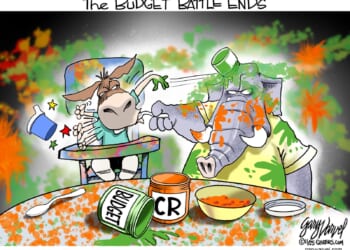
One of the basic functions of a legislature is to enact a budget. The North Carolina General Assembly failed to do that last year. Much of the reason for that impasse was a “disagreement between Republican Speaker of the House Destin Hall and Republican Senate leader Phil Berger” over what to prioritize in the budget. The legislature passed several “mini budgets,” but the state is mostly on fiscal cruise control.
Before then, the “diminished relationship” between Berger and the previous long-serving speaker, Tim Moore, was to blame for much of the lack of progress on multiple issues. One legislator told researchers how their personal relationship had become a political problem:
I think [passing legislation] becomes more difficult when you have leadership that’s been around like Tim and Phil in those roles for a decade. There’s a lot of old battle scars to deal with between those two[,] and [it] catches up in other people’s issues.
The stranglehold on power by legislative leaders can not only lead to impasses between the House and Senate. It can also stymie the agendas of legislators who find themselves outside of leadership, regardless of their party affiliation.
A legislator interviewed for the John Locke Foundation’s report, “Reforming North Carolina’s General Assembly,” said that the stranglehold leadership had over the legislature made it so that “a few people … decide what bills are ever going to get heard.” A survey of legislators found a similar result: Two-thirds agreed that having the same members in leadership for long periods gives them too much influence over the General Assembly (see below).
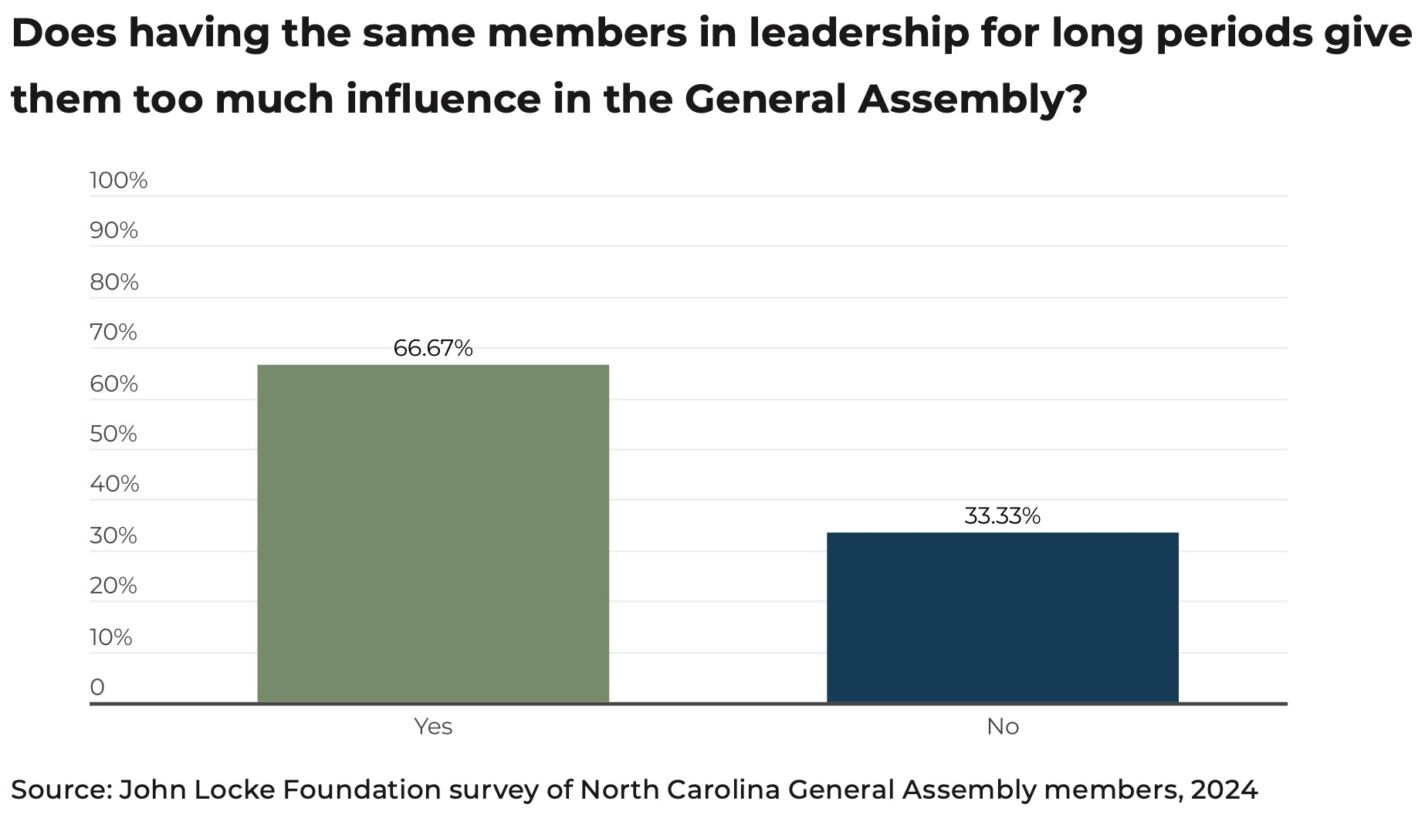
Source: The John Locke Foundation’s report “Reforming North Carolina’s General Assembly”
A further complicating factor is that North Carolina’s legislative leaders are uniquely powerful, with appointment authority that is often reserved for the executive branch. That power has grown dramatically since Republicans took control of the General Assembly in 2011.
Balancing legislative power through leadership term limits
There are ways states can rebalance power within their legislatures. One way is to impose term limits. Sixteen states currently impose term limits of eight or 12 years on state legislators. That would have the effect of making the terms for leaders at least somewhat shorter, since it is unlikely that a legislator would begin his or her career leading the chamber.
There are problems with term limits, however. Perhaps the biggest is that they limit voters’ ability to choose the candidates they want. Research has shown that term limits also weaken the legislative branch relative to the executive and increase lobbyists’ and bureaucrats’ influence by eroding institutional knowledge in the legislature.
Another approach is to limit only the length of time legislators may serve in leadership. As shown in the chart below, 19 chambers in 12 states impose some limit on the length of time legislators can serve in leadership roles. The most common source of leadership term limits is simply by tradition. Other states limit leadership terms through formal chamber rules, while Republicans in the Oklahoma House limit leadership through their party caucus rules. Only Maine sets term limits for leadership by law. (The Wyoming Senate limits the terms of legislative leaders through a combination of tradition and chamber rules.)
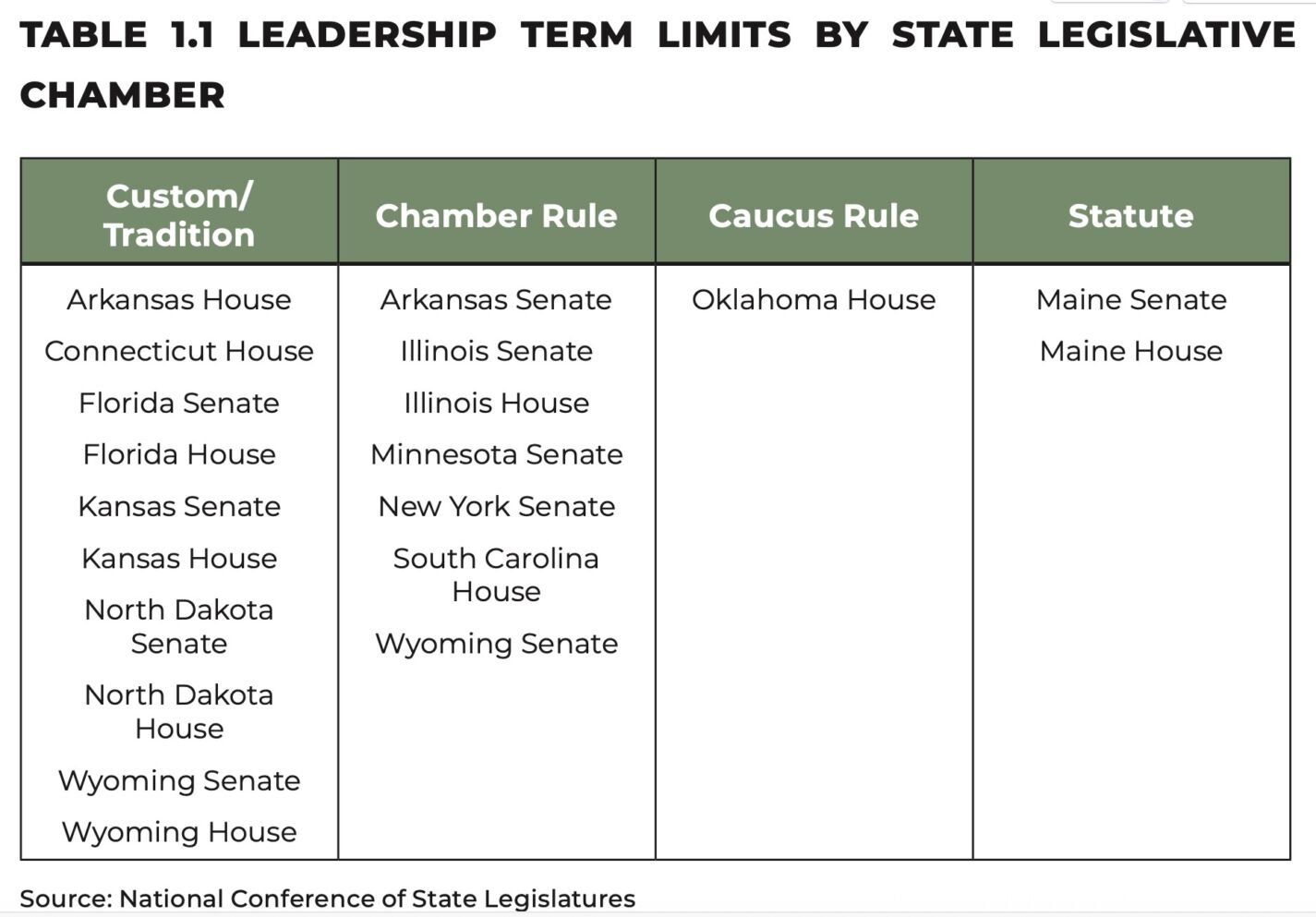
Source: “Reforming North Carolina’s General Assembly”
Bringing legislative leadership term limits back to North Carolina
North Carolina used to be one of the states that imposed term limits on leadership by tradition. Except for Liston B. Ramsey in the 1980s, every speaker in the 19th and 20th centuries served for between one and four years in the role. Most Senate leaders similarly served one or two terms over the course of those centuries. That has changed over the past few decades, however, with the most extreme example being Marc Basnight, who served as president pro tempore of the Senate from 1992 to 2011.
Both the general public and most legislators would like to restore the legislative balance of power and reverse the stagnation brought about by entrenched leadership by reimposing term limits on leadership. In a September 2023 poll conducted for the John Locke Foundation by Cygnal, 85 percent of respondents favored term limits for the leaders of the North Carolina General Assembly, while only five percent were opposed. As seen in the figure below, two-thirds of legislators polled in a 2024 survey for a John Locke Foundation report on legislative reform also supported term limits.
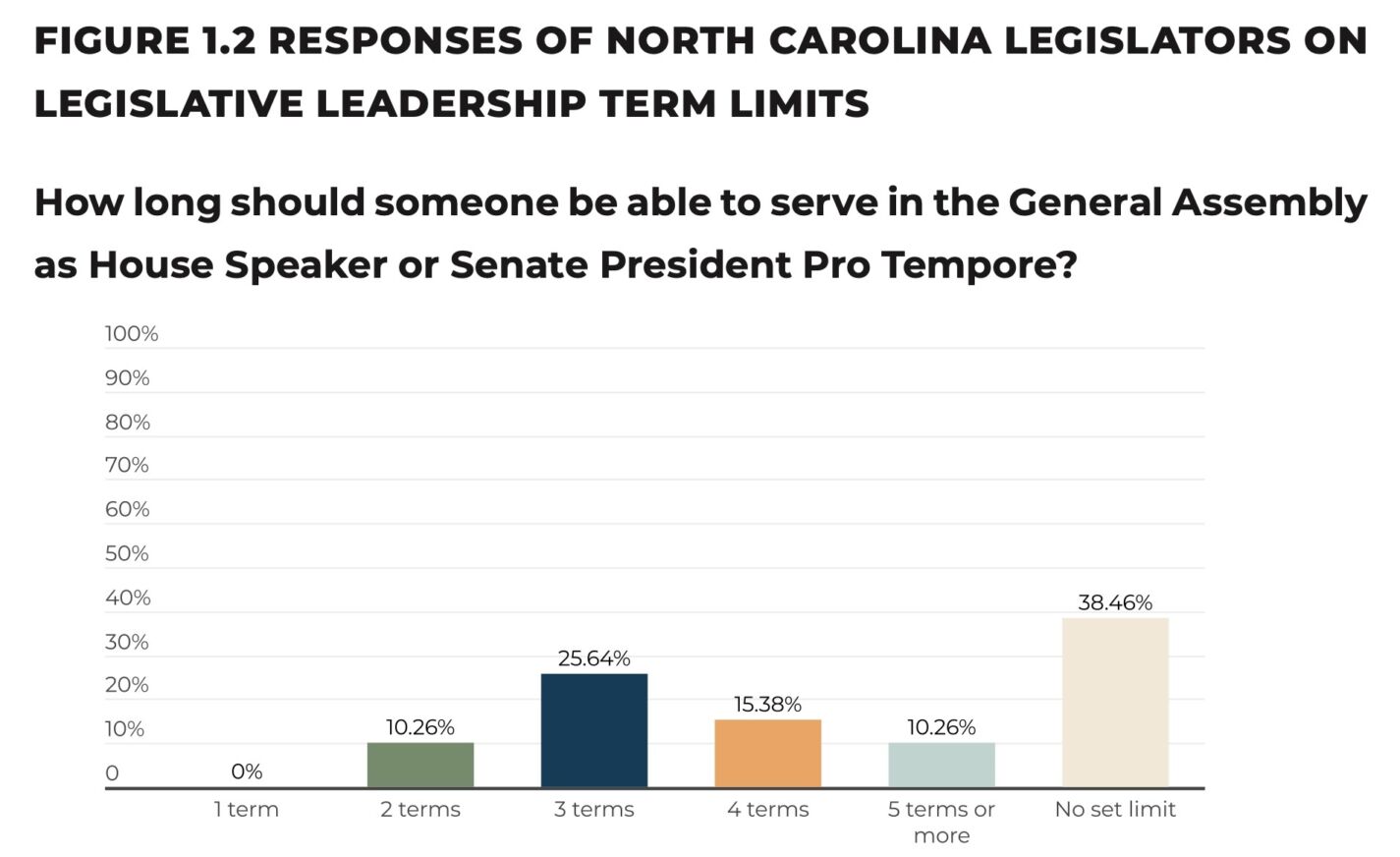
Source: “Reforming North Carolina’s General Assembly”
North Carolina is unlikely to reimpose legislative leadership term limits by returning to tradition, however. Chamber rules, which legislators impose on themselves, are highly malleable and so can be changed if a leader gains enough power to sway the chamber.
That leaves statute as the best means of imposing term limits on legislative leadership. An advantage of legislation is that repealing it would require the agreement of both chambers and would be subject to a gubernatorial veto, a much higher barrier than relying on either tradition or chamber rules.
Reimposing term limits on General Assembly leaders would restore a better balance of power between leaders and rank-and-file legislators and reduce the chances that personal conflicts between leaders would morph into legislative stagnation. That would make the state legislature more responsive to the residents of North Carolina. Those gains would certainly be worth the inconvenience to two people.