At the request of Gov. Kelly Ayotte, the New Hampshire Fish & Game Department has paused a proposed increase in fishing and hunting license fees.
Department officials say the increases are needed to shore up the budget. The last fee increase took effect in 2016.
A decade’s worth of inflation has eroded the value of those fees significantly. The small increases proposed this April would not make up for the effects of a decade’s worth of inflation, but would bring in some additional revenue.
A Josiah Bartlett Center analysis of the department’s current fees reveals two seemingly contradictory findings.
- Inflation has eroded the value of the primary hunting and fishing license fees by about 40%.
- Still, New Hampshire’s fees are among the highest in New England.
Current fee rates vs. other New England states
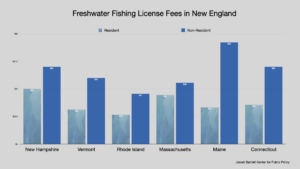
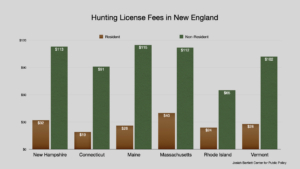
New Hampshire’s primary fishing and hunting license fees are among the highest in New England.
The resident fishing license fee is 36% higher than the regional average, and the non-resident fee is 7% higher.
The resident hunting license fee is 14% higher than the regional average, and the non-resident fee is 13% higher.
New Hampshire anglers have by far the most expensive license in the region. Granite Staters pay by $12 more than the average New England resident to fish in their own home state.
The prices in other states range from $24 in Rhode Island to $40 in Massachusetts.
 Stable fees, lower value
Since the department last increased fees in 2016, inflation as measured by the U.S. Consumer Price Index has soared.
If resident hunting and freshwater fishing license fees had been adjusted annually for inflation, each fee would be 39.5% higher today.
The $45 freshwater fishing license would be $62.78.
The $32 hunting license would be $44.64.
Because they were not adjusted, the fees have much lower purchasing power for the department than they did a decade ago.
Looking only at these fee levels, the department is effectively being asked to fund the same services as in 2016 on 60% of the fee revenue it received that year. (The department receives 25% of its budget from license fees, according to its annual report.)
But fee revenue is not the only variable. The number of licenses sold matters too.
According to department data, the number of resident fishing permit holders increased by 10,155 from 2016-2024, and the number non-resident fishing permit holders increased by 2,570.
The number of resident hunting license holders increased by 1,464 increased by 1,201.
The percentage increases are:
- Resident anglers: 9.5%
- Non-resident anglers: 5.2%
- Resident hunters: 3.1%
- Non-resident hunters: 11.3%
These higher license sales equal real revenue gains for the department.
The department’s list of total licenses sold doesn’t specify whether someone bought a single-season fishing license, a lifetime license, a combined hunting-fishing license, or a one-day, three-day or seven-day license. Because of this, we can’t calculate the exact revenue from each year’s sales.
But we can create a ballpark figure by counting each license as a full season license. Doing that, we get the following revenue increases from 2016-2024:
- Resident fishing: $456,975
- Non-resident fishing: $161,910
- Resident hunting: $46,848
- Non-resident hunting: $135,713
That comes to $801,446, which doesn’t come close to making up for the loss from inflation, but does help to offset some of that loss, probably less than 20%.
The department budget picture
From the department’s point of view, increasing license fees after a decade is important for stabilizing the budget.
License fees accounted for 25% of the department’s Fiscal Year 2025 budget vs. 32% in FY 2016.
But the department’s total budget—including American Rescue Plan Act (ARPA) money and other federal funds—has grown well above the rate of inflation in the last decade.
The department spent $27.9 million in 2016 vs. $49.2 million in 2025. That’s an increase of $21.3 million, or 76%. (ARPA money is important here.)
Adjusted for inflation, the 2016 budget of $27.9 million would come to $38.9 million today—$10.3 million less than the department’s total budget last year.
According to the department’s annual reports, 17% of the 2025 budget comes from the American Rescue Plan Act, the 2021 federal stimulus legislation. That 17% amounts to about $8.37 million.
Subtracting ARPA funds, the department’s budget remains roughly $2 million higher than what level-funded budget would be after adjusting for inflation since 2016.
Fees in a broader context
Hunting and fishing licenses are essentially user fees. They’re supposed to pay for as much of the state services related to those activities as reasonably feasible.
New Hampshire has a long tradition of funding state services with user fees when possible.
The state also has a pattern when it comes to user fees. The fees tend to remain stable for many years until department heads (sometimes frantically) propose increases to make up for the effects of inflation.
There are three overall effects of this pattern.
- It puts departments under financial pressure as a means of encouraging them to trim expenses.
- It keeps fees under the control of elected officials.
- It tends to keep fees from growing rapidly.
That pattern is on full display here, with the exception that the 2016 license fee increases established a high baseline relative to the region, and those fees remain high today.
Going forward, when this proposal is brought back for consideration next year, some scrutiny should be given to the department’s budget growth over the last decade. Because these fees are already high relative to the rest of New England, placing a higher burden on New Hampshire hunters and anglers, any proposed increase should be given increased scrutiny.