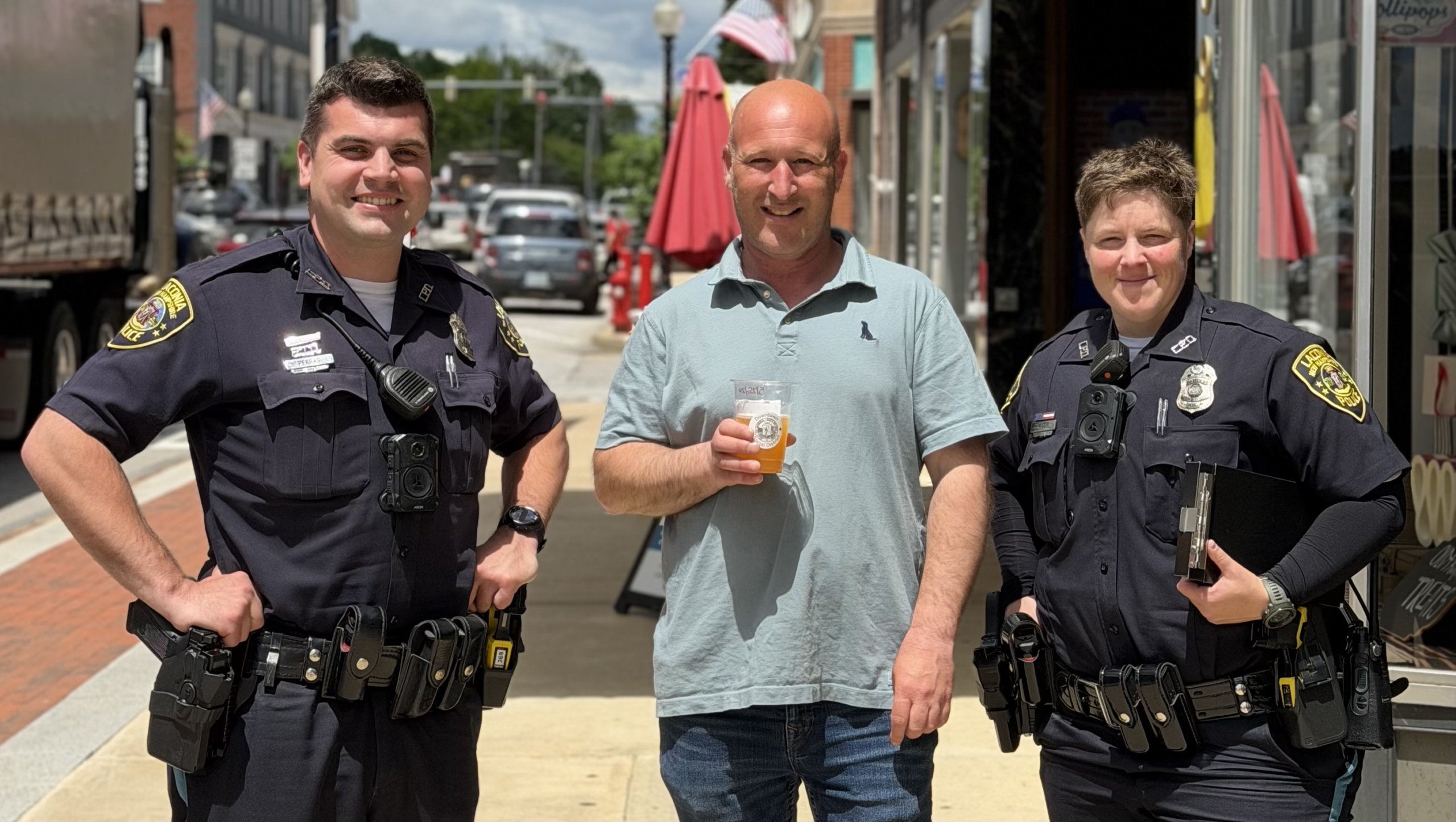
On March 21, Laconia launched New England’s first social district, a designated area where drinking is allowed in public under tightly regulated conditions.
With Motorcycle Week looming, critics on social media mockingly predicted disaster.
A week later, Joia Hughes, Laconia’s economic development and housing director, summed up the damage.
“No problems,” she said.
Mayor Mike Bordes, a state representative who voted for the bill allowing social districts, said he’d also heard “no complaints.”
The City Council intentionally set Laconia’s social district downtown, about a 15 minute drive from Weirs Beach, where Motorcycle Week is held.
“There was a little confusion because some people thought you could walk around with open containers down in the Weirs,” Bordes said. But that was quickly sorted out and the city had no issues in the social district.
Downtown, the social district is working as intended, Hughes said.
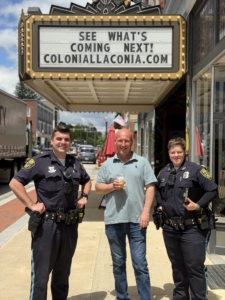
Laconia Mayor Mike Bordes poses with a beer and two city police officers in Laconia’s downtown social district.
“We’ve had two Concerts on Canal since we’ve had social districts, on June fifth and June 19th. It was incredible attendance. There were tons of people. We’ve had six downtown participating businesses who are licensed to sell. They’re all doing well.”
There were “definitely more people” downtown during this year’s concerts than before the creation of the social district, Hughes said. “Last year you could find a place to put your camp chair. This year it was standing room only.
“Before when we had Concerts on Canal, we had one vendor and you had to stay confined to that area. Now you can go everywhere. It will attract people to those businesses. When you’re hungry, you’re going to go to those businesses and you can hear the music all over downtown.”
Hickory, N.C., one of the inspirations for New Hampshire’s social district law, had a similar experience. As we reported last year, the city created a concert series to draw visitors to downtown businesses. But state law required the city to corral concert-goers with drinks inside a small alcohol containment zone.
Because visitors would stay inside the zone to finish their drinks, the concerts didn’t do much to help local businesses. After the creation of the social district, business picked up in local shops as concert-goers were free to stroll the downtown with one drink in hand.
Like municipalities in North Carolina, Laconia printed signs for businesses to place in their windows if they don’t want people coming in with drinks. They’re all still sitting in the economic development director’s office.
“I had my opt-out signs all ready to go,” Hughes said, “and nobody asked for one.”
The social district launched on May 21, and that weekend “worked really well,” said Kayla Bastille, director of operations at Defiant Records & Craft Beer, a pub/vinyl record store on Main Street. “It wasn’t like any crazy things happened. People just wanted to walk around. There was a draw because people were excited to just walk across the street.”
Colleen Henrick, a bartender at Defiant, said she worked that first Friday night. “I think a lot of people bought cups to stand on the sidewalk right outside the fence.” (Defiant has a decorative fence out front, at the edge of the sidewalk.)
“That’s really what people did. People were just outside the fence. But then they’d take a lap and walk.”
Bastille said the social district makes life a little easier for her staff. During the Concerts on Canal, they don’t have to police the front door to make sure patrons keep their feet off the sidewalk.
“For us, we usually have to put the borders around for the alcohol. And now we don’t. It’s stuff like that that it’s really meant for.”
For the city, there’ve been no issues, Hughes said.
“People are staying in the boundaries. They’re disposing of their cups in the right way. No problems to speak of.”
Before approving the social district, Laconia’s City Council spent months holding meetings and discussions about it. They solicited feedback from businesses and citizens, looked at districts in North Carolina and carefully laid out the district boundaries.
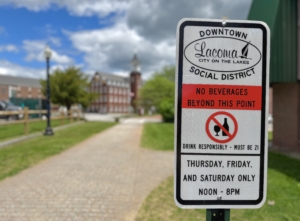
Signs are posted at the district’s edges. The city assigns a police detail to the area during social district hours, which run noon-9 p.m. Thursdays-Saturdays. (The city extended the ending time from 8-9 p.m. earlier this month.)
“We had a lot of meetings on this because we really wanted to try to check off all the boxes correctly,” City Manager Kirk Beattie said. “It went really smoothly. It had full council support from day one. They want to see economic development. They want to see growth. They want to see things that draw people into town.”
The council votes were all unanimous, Beattie said. Council members, and downtown merchants, got right away what ill-informed social media critics did not, Bordes said.
“It’s a social district, not a drunken district. There’s a difference between social drinking and stumbling drunk.”
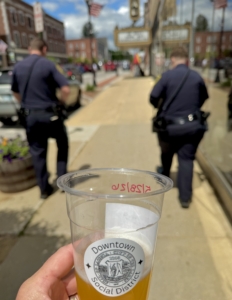
To-go drinks in the district must be purchased from an approved seller located in the district and contained in a marked plastic cup. Patrons can possess only a single drink.
It’s only been a few weeks, but the mayor sees promise in the district’s early success. As it draws more visitors to downtown , Bordes hopes the increased attention and foot traffic encourage would-be entrepreneurs to take a chance on his city.
“My goal is, I want to bring more businesses downtown. Let’s get another restaurant. Let’s get a brewery. Let’s get more shops,” he said.
Bordes doesn’t expect the social district to transform Laconia overnight, he said. But launching New England’s first social district has put Laconia in a region-wide economic development conversation.
Last week, Massachusetts Gov. Maura Healey signed a law allowing municipalities to create social districts, a year after New Hampshire adopted its law. This week, Boston followed Laconia’s lead and approved two social districts to help keep the city hopping during the World Cup and Sail Boston.
Unlike Laconia’s district, Boston’s districts expire July 31.
Bill Boyd, primary sponsor of New Hampshire’s social district bill, was at least partially motivated to get the bill in last year because of news reports that Massachusetts officials were considering a social district law.
Now, Laconia has the distinction of beating the rest of New England to the adoption of a cutting-edge policy to improve economic development and quality of life.
“It’s been great,” Hughes said.