
- North Carolina faced an extreme heat event on June 11–12
- Duke Energy obtained an emergency order from the U.S. Department of Energy waiving environmental emissions restrictions in order to secure the power grid
- Once again, nuclear, natural gas, and coal power kept the power on without incident, underscoring the importance of affordable, reliable electricity
The forecast in North Carolina for June 11–12, 2026, called for extreme heat. A heat advisory was issued for most of the state. WNCN reported that in Raleigh on June 12, the high was “103 degrees with a heat index over 106.”
As during last year’s extreme heat wave and earlier this year during a deep freeze, Duke Energy obtained an emergency order from the U.S. Department of Energy to keep the power on. The order set aside emissions limits that artificially constrain Duke from operating reliable, efficient power plants to their fullest during the emergency.
The waivers are explicit acknowledgments that avoiding blackouts, especially during temperature extremes, keep people alive and safe and keep the economy running. As with the earlier grants of emergency waivers, blackouts were avoided on June 12, and the power stayed on.
Emergencies underscore the importance of securing affordable, reliable electricity
U.S. Secretary of Energy Chris Wright spoke of the importance of “using every available tool ensuring Americans in the Carolinas have continued access to affordable, reliable, and secure energy to power and cool their homes.” The order involved several power generation units in the combined fleets of Duke Energy Carolinas and Duke Energy Progress: natural gas combined cycle plants, natural gas combustion turbine plants, and coal power plants.
These generation sources are reliable, dispatchable power plants whose operations also result in some carbon dioxide (CO2) emissions. Incidentally, North Carolina’s CO2 emissions from electricity have been essentially cut in half since 2005, right in line with the United States having cut more CO2 emissions from electricity than other country in the world.
The order notes that “Duke Energy has indicated that it anticipates unusually high load forecasts totaling approximately 34,589 MW from 4:00 PM ET on June 11, 2026, until 10:00 PM ET on June 12, 2026, due to customer demand as a result of a period of hot weather.” It further notes that “some generating units are limited in providing needed generation because of conditions and limitations in their environmental permits,” which would leave the system possibly without sufficient power generation available to meet the expected high demand and require Duke to curtail the load (i.e., institute rolling blackouts). It therefore allows Duke to exceed the environmental constraints applied to those coal or natural gas units if “their generation is necessary to meet the electricity demand” during the time indicated above (from 4 p.m. on June 11 to 10 p.m. on June 12).
What powered the state during that time? A look at the U.S. Energy Information Administration’s Hourly Electric Grid Monitor gives the answer. The following table shows the hourly generation by the different sources for Duke Energy Carolinas, Duke Energy Progress–East, and Duke Energy Progress–West (collectively, Duke Energy).
Hour-by-hour electricity generation for Duke Energy during the heat emergency of June 11–12, 2026, in MW
| Hour | Coal | Natural Gas |
Nuclear | Solar | Battery | Hydro | Pumped Storage Hydro |
Other |
|---|---|---|---|---|---|---|---|---|
| 4:00 PM | 5,984 | 9,309 | 10,855 | 2,769 | -3 | 188 | 1,686 | 978 |
| 5:00 PM | 6,012 | 9,446 | 10,853 | 2,360 | 45 | 262 | 1,828 | 1,023 |
| 6:00 PM | 6,021 | 9,308 | 10,856 | 1,815 | 47 | 568 | 1,770 | 1,007 |
| 7:00 PM | 6,062 | 9,803 | 10,859 | 1,069 | 124 | 592 | 1,789 | 1,030 |
| 8:00 PM | 6,229 | 9,967 | 10,863 | 371 | 149 | 312 | 1,762 | 1,055 |
| 9:00 PM | 6,236 | 9,392 | 10,855 | 24 | 54 | 227 | 1,751 | 1,078 |
| 10:00 PM | 6,153 | 8,354 | 10,860 | 1 | 0 | 162 | 1,722 | 1,015 |
| 11:00 PM | 6,056 | 7,600 | 10,869 | -5 | -2 | 101 | 393 | 932 |
| 12:00 AM | 6,208 | 6,590 | 10,872 | -3 | -2 | 54 | -3 | 926 |
| 1:00 AM | 6,150 | 5,395 | 10,868 | -6 | -2 | 44 | -3 | 921 |
| 2:00 AM | 5,861 | 4,926 | 10,867 | -2 | -49 | 45 | -577 | 932 |
| 3:00 AM | 5,755 | 4,255 | 10,867 | -2 | -51 | 56 | -898 | 954 |
| 4:00 AM | 5,272 | 3,905 | 10,868 | -4 | -51 | 44 | -1,302 | 953 |
| 5:00 AM | 5,079 | 3,788 | 10,879 | -4 | -51 | 43 | -1,550 | 857 |
| 6:00 AM | 5,248 | 3,645 | 10,882 | -6 | -52 | 48 | -1,553 | 796 |
| 7:00 AM | 5,273 | 3,849 | 10,880 | 74 | -37 | 60 | -1,545 | 787 |
| 8:00 AM | 5,166 | 3,825 | 10,885 | 719 | -95 | 56 | -1,543 | 807 |
| 9:00 AM | 5,543 | 3,999 | 10,877 | 1,746 | -101 | 75 | -1,541 | 835 |
| 10:00 AM | 5,668 | 5,246 | 10,840 | 2,531 | -18 | 88 | -1,427 | 846 |
| 11:00 AM | 5,733 | 6,688 | 10,867 | 3,035 | -2 | 63 | -995 | 872 |
| 12:00 PM | 5,838 | 7,391 | 10,862 | 3,304 | -2 | 64 | 41 | 943 |
| 1:00 PM | 5,835 | 8,239 | 10,855 | 3,404 | -2 | 63 | 602 | 964 |
| 2:00 PM | 5,848 | 8,764 | 10,849 | 3,278 | -3 | 66 | 1,521 | 1,007 |
| 3:00 PM | 5,842 | 9,102 | 10,850 | 3,143 | -1 | 64 | 1,910 | 995 |
| 4:00 PM | 6,020 | 9,656 | 10,850 | 2,905 | -3 | 81 | 1,802 | 982 |
| 5:00 PM | 5,960 | 9,846 | 10,844 | 2,591 | 45 | 165 | 1,758 | 996 |
| 6:00 PM | 5,949 | 10,030 | 10,836 | 2,000 | 47 | 278 | 1,763 | 1,009 |
| 7:00 PM | 6,050 | 10,287 | 10,840 | 1,125 | 124 | 503 | 1,788 | 1,026 |
| 8:00 PM | 6,008 | 10,111 | 10,853 | 308 | 148 | 494 | 1,648 | 1,035 |
| 9:00 PM | 5,866 | 10,351 | 10,831 | 36 | 54 | 195 | 1,000 | 1,082 |
| 10:00 PM | 6,084 | 9,328 | 10,846 | 15 | 0 | 100 | 804 | 946 |
Data source: U.S. Energy Information Administration, Hourly Electric Grid Monitor
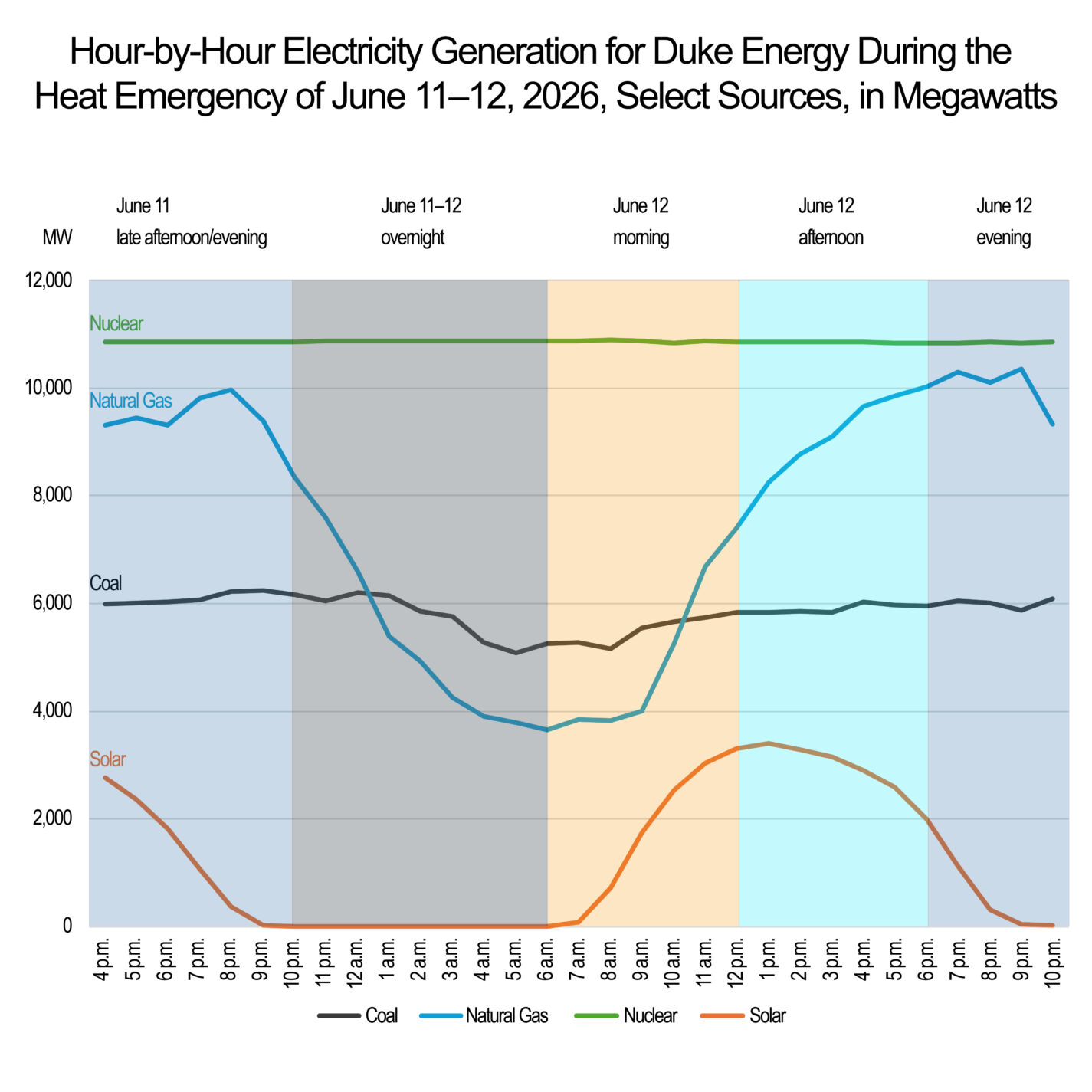
The following chart shows the hourly generation for Duke during the emergency by nuclear, natural gas, coal, and solar.
Hour-by-hour electricity generation for Duke Energy during the heat emergency of June 11–12, 2026, select sources
Here are some things one can observe from the chart:
- Coal: As befitting a baseline generation source, coal power was fairly steady throughout the emergency period, decreasing some during the overnight hours when demand was lower
- Natural gas: Being a dispatchable generation source, especially with respect to the combustion turbine plants (typically peaker plants, so named because they can bring power online quickly during periods of peak demand), natural gas provided the second-highest amount of electricity during the periods of heaviest demand
- Nuclear: As seen during the previous two emergencies and the Christmas Eve blackouts of 2022, baseload nuclear power plants provided the most power and the steadiest generation during this emergency as well
- Solar: Also as seen during the previous two emergencies and the Christmas Eve blackouts, solar “performed as expected,” meaning that it was productive during the daylight hours (since the skies were clear) but absent for nearly half the 24-hour day — and only nearly half because June 11–12 is very close to the summer solstice (June 21, the year’s longest day)
A contrast in approach to affordability and reliability
Former Gov. Roy Cooper warred against North Carolina’s legal requirements of affordability and reliability in order to craft his “Clean Energy Plan.” He had 166 environmental and other “stakeholder” groups plan North Carolina’s electricity future despite only 7 percent of them saying that they regarded affordability and reliability to be “[v]alues to prioritize going forward.” No, affordable, reliable power was not important to Cooper and his allies.
Cooper’s plan was enacted in the Carbon Plan law, though with some guardrails on affordability and reliability. Even so, a law that requires closing working power plants and necessitates building new ones and overbuilding solar facilities is still a law that results in more expensive, less reliable electricity overall.
Fortunately, with his “every available tool” approach to secure electricity provision during an emergency, Secretary Wright shows that he understands better: Affordable, reliable power is critically important to the people of North Carolina.
Policymakers interested in protecting affordability and reliability in electricity provision can find several ways to help in a new report from the John Locke Foundation. The report, “Energy Poverty in North Carolina: Securing Affordable, Reliable Electricity,” develops a county-by-county energy poverty index for North Carolina and discusses several policies and outcomes affecting affordability and reliability of electricity provision in this state. The report concludes with several recommendations for keeping the lights on and power bills as affordable as possible for North Carolinians, especially those most in need.