In today’s economy, over 20 percent of workers navigate the complex landscape of occupational licensing—a scenario with its contours varying
drastically across state lines. In West Virginia, the average license for low- and moderate-income jobs takes 214 days of education and experience. What does this mean for our economy and, more importantly, for individual workers?
The Licensing Landscape
Occupational licensing is a process where entry into the occupation requires permission from the government. It requires some minimum- degree demonstration of competence from applicants. Many states impose some “good character” requirement that can make it more difficult, if not impossible, for individuals with criminal records to obtain a given license. Working without a permit in such professions brings severe repercussions, including fines and imprisonment—a further layer of complexity.
On its face, licenses aim to improve the quality and safety of consumer services. It reduces consumers’ uncertainty when choosing a professional to perform the skilled services they need, as the government has done the vetting for them. Hiring any licensed professional ensures that the customer will receive assistance from someone who has completed a minimum level of education and experience and, in most cases, passed at least one exam.
The Economic Impacts of Licensing
However, this protective shield has some predictable economic effects. By restricting the labor supply in a specific field, licensing inflates higher wages for those professionals in licensed occupations and drives up consumer prices.
This can best be shown in a classic supply and demand diagram.
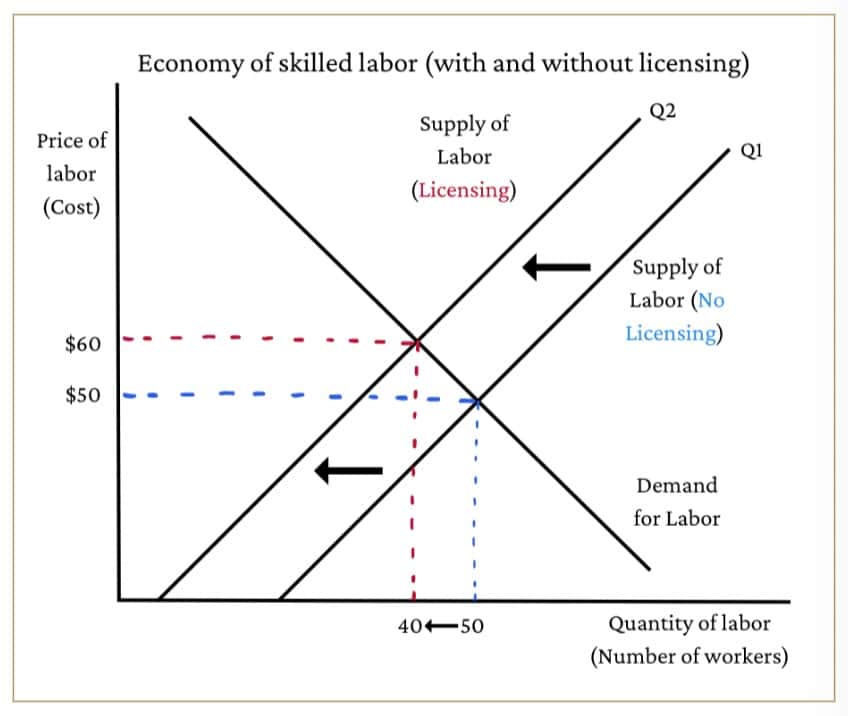
An example helps illustrate how licensing changes conditions in the market for skilled labor services. For this example, let’s assume we’re talking about the market for makeup artists. According to the Institute for Justice, this profession requires 600 hours of education and passing three exams to be eligible to work in West Virginia. Further, it is only licensed in 37 out of 50 states and the District of Columbia.
In this diagram above, let’s assume that the price of labor (wages) for makeup artists can span from $0-100, and the quantity of makeup artists willing to work at a given wage spans from 0-100. In an unfettered market, without any licensing, we would see that the number of people demanding the services of makeup artists and the supply of makeup artists willing to work for a given wage reach an equilibrium at $50 per hour and 50 makeup artists.
Now let’s assume we’re in West Virginia or one of the other 36 states that license makeup artists. The supply of makeup artists is restricted by licensing as the supply curve shifts to the left. Recall from earlier that engaging in this work without a license is illegal. So now, there
may be fewer makeup artists in the economy overall, but those that remain legally working command higher wages for their services. The new equilibrium of the supply of makeup artists willing to work is only 40, and customers demanding those services now pay $60 per hour.
Between the two scenarios, we can quickly see two results. First, people are now paying more for the skills of makeup artists. Second, fewer makeup artists are working. Surely, customers would rather have the additional $10 per hour to spend on other goods. Likewise, the ten makeup artists out of work in this new economic regime would rather use their skills in their old profession instead of being unemployed or doing something less related or entirely
unrelated to their training.
The Reality Check: Examining Research Findings
For skilled workers and their customers alike, there are a number questions worth contemplating when weighing the merits and drawbacks of licensing. Is it beneficial for customers to incur the costs of licensing to save time searching for reliable service providers? Is it worthwhile for individuals to invest in training, exams, and licensing fees to enter certain professions and earn higher wages? What impacts does licensing have on the growth of those occupations?
Thankfully, there is a body of peer-reviewed research investigating these questions. Economic studies have indicated that the quality of services is similar based on whether the profession is narrowly or widely licensed. As for wages, research suggests that individuals in higher-paying occupations benefit the most from licensing premiums. However, whether those in lower-paying professions receive a wage premium is uncertain.
Given the bottlenecks that licensing introduces into the labor market, we should not be surprised that research finds those occupations experiencing slower employment growth. Similarly, given the inconsistencies across states, it should come as little surprise that licensed professionals are less likely to move from state to state due to the re-training and re-licensing processes they may undergo in their new locations.
The Lower Socio-Economic Challenge
The myriad effects invite deeper consideration when applied to individuals on the lower end of the socio-economic scale. For those in lower-wage occupations aspiring to gain more skills and earn
higher wages, the hurdles imposed by licensing may be insurmountable. Taking time away from a steady income to undergo specialized training and shouldering educational costs may not be a realistic option. Moreover, the evidence does not guarantee that a worker’s potential wage premium by going into a licensed occupation is enough to overcome the costs they incur.
Unfortunately, individuals with criminal records face even more significant challenges. The potential for disqualification based on their history is often unclear until they start the lengthy and costly licensing process.
The Path to Reform
Given the slim evidence that occupational licensing delivers the benefits argued by its defenders, lawmakers in West Virginia must
re-examine the licensing laws currently on the books. In doing so, they can eliminate what is unnecessary, revise the requirements for the licenses that should remain, and streamline the differences among the states to attract new residents and expand opportunities for current residents.
Occupational licensing reform is not just a policy matter; it’s a pressing issue affecting our economy, neighbors, and futures. Reforming occupational licensing to create more opportunities can unite us all.