The New Hampshire Attorney General on August 14 filed an appeal to the state Supreme Court that could change the way the state funds public education.
In the appeal, the AG’s Office argued that the court’s Claremont school funding decisions were so legally flawed that they should be overturned.
In a series of decisions starting in 1993, the Claremont rulings established an entirely new legal standard for public education funding. They held that the New Hampshire Constitution mandates the state government to fully fund 100% of the cost of an adequate education for each public school student.
The AG’s August 14 filing is the most thorough and comprehensive rebuttal to these cases the state has ever filed. It deserves a deep dive into the historical and legal arguments.
But for now, it’s worth highlighting one stunning flaw in the original Claremont rulings that finally gets its due 33 years after the first decision.
Where are the seminaries?
The Claremont plaintiffs argued in 1993 that the constitution’s Part II, Article 83 required the state to provide public schools with enough money to fully fund an opportunity for an adequate education for each of their students.
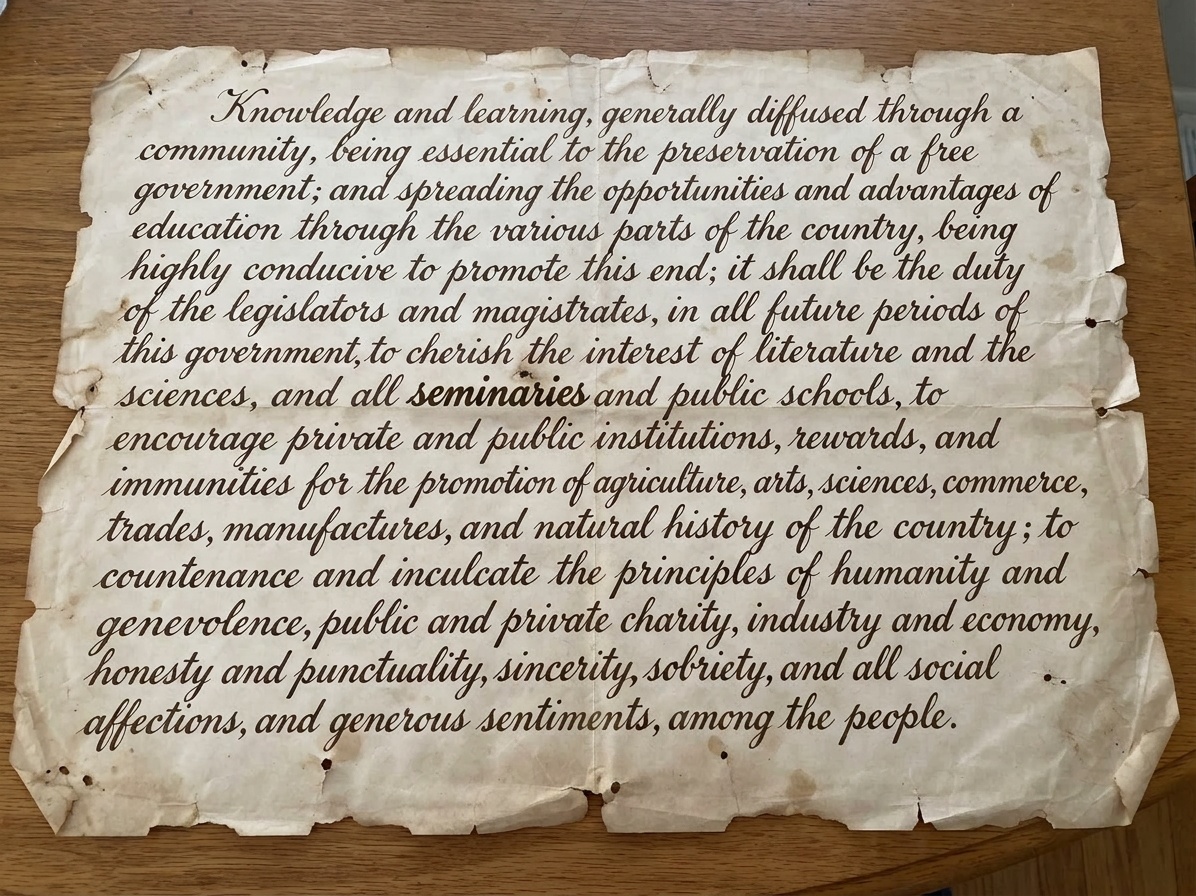
That section of the constitution, as ratified in 1784, read:
“Knowledge and learning, generally diffused through a community, being essential to the preservation of a free government; and spreading the opportunities and advantages of education through the various parts of the country, being highly conducive to promote this end; it shall be the duty of the legislators and magistrates, in all future periods of this government, to cherish the interest of literature and the sciences, and all seminaries and public schools, to encourage private and public institutions, rewards, and immunities for the promotion of agriculture, arts, sciences, commerce, trades, manufacturers, and natural history of the country; to countenance and inculcate the principles of humanity and general benevolence, public and private charity, industry and economy, honesty and punctuality, sincerity, sobriety, and all social affections, and generous sentiments, among the people.”
The Claremont plaintiffs argued that the state’s duty came from one word and one phrase.
“Cherish,” they argued, meant to “support” financially.
And “generally diffused through a community” meant to fund equally across the state.
Relying on uneven local property taxes for public school funding, therefore, was unconstitutional. (It was a bit more complicated than this, but this is the core argument.)
To be clear, there is merit in those claims.
Cherish did mean to support or to nurse.
And the historical context does support the view that the state was tasked with diffusing “knowledge and learning” throughout the state, to ensure that children from poorer communities had educational opportunities.
Properly understood, Part II, Article 83 can be read to task the state with a duty to support the diffusion of knowledge and learning across the state.
But the Claremont attorneys succeeded in pulling a sleight of hand on the court by omitting one crucial word from their argument.
Part II, Article 83 tasks “legislators and magistrates” with a “duty” to “cherish the interests of literature and the sciences, and all seminaries and public schools…”
The constitution thus creates a state duty to cherish “all seminaries.”
But seminaries are found only twice in the original Claremont ruling, both times in quotations of the constitution itself.
Nowhere does the court deal with the constitution’s language that distinguishes between seminaries and public schools, even though seminaries are listed first among the institutions to be cherished.
Today, a seminary generally means a religious school, but at the time it just meant a school or institution of learning.
John Adams, often quoted in the original Claremont case as the intellectual foundation of the case for “cherish” meaning to fully fund all public schools, wrote of the value of public support for both “seminaries” and public schools.
In 1761, he sought to distinguish colonial America from Europe by emphasizing the colonies’ creation of“colleges” and “seminaries” “to propagate and perpetuate knowledge,” followed by state mandates that towns create and support public schools so “that the education of all ranks of people was made the care and expense of the public.”
The historical record shows unmistakably that they believed governments should cherish both public and private institutions for the spread of knowledge. That’s what Section II, Article 83 of the New Hampshire Constitution means.
In the very next phrase after the one on which the Claremont decision rests, that section requires legislators and magistrates “to encourage private and public institutions” for the promotion of numerous good things.
Logically and legally, the phrase “cherish the interests of literature and the sciences, and all seminaries and public schools” cannot mean “fully fund only public schools.”
After 33 years, the AG’s Office finally deals at some length with this glaring omission in the foundational Claremont ruling.
It’s just one way in which the AG’s Office has built a stronger and more compelling argument against the Claremont rulings than the state has ever made before.
The original Claremont case made some strong claims against the propriety of the school funding regime that existed at the time. It would be tough to find anyone today who wants to go back to that.
But the AG’s Office makes a strong case that the current funding regime is also deeply flawed, both legally and practically. As the case moves forward, the plaintiffs will have to address the mystery of the missing word, along with many other flaws the AG’s Office has ably identified.