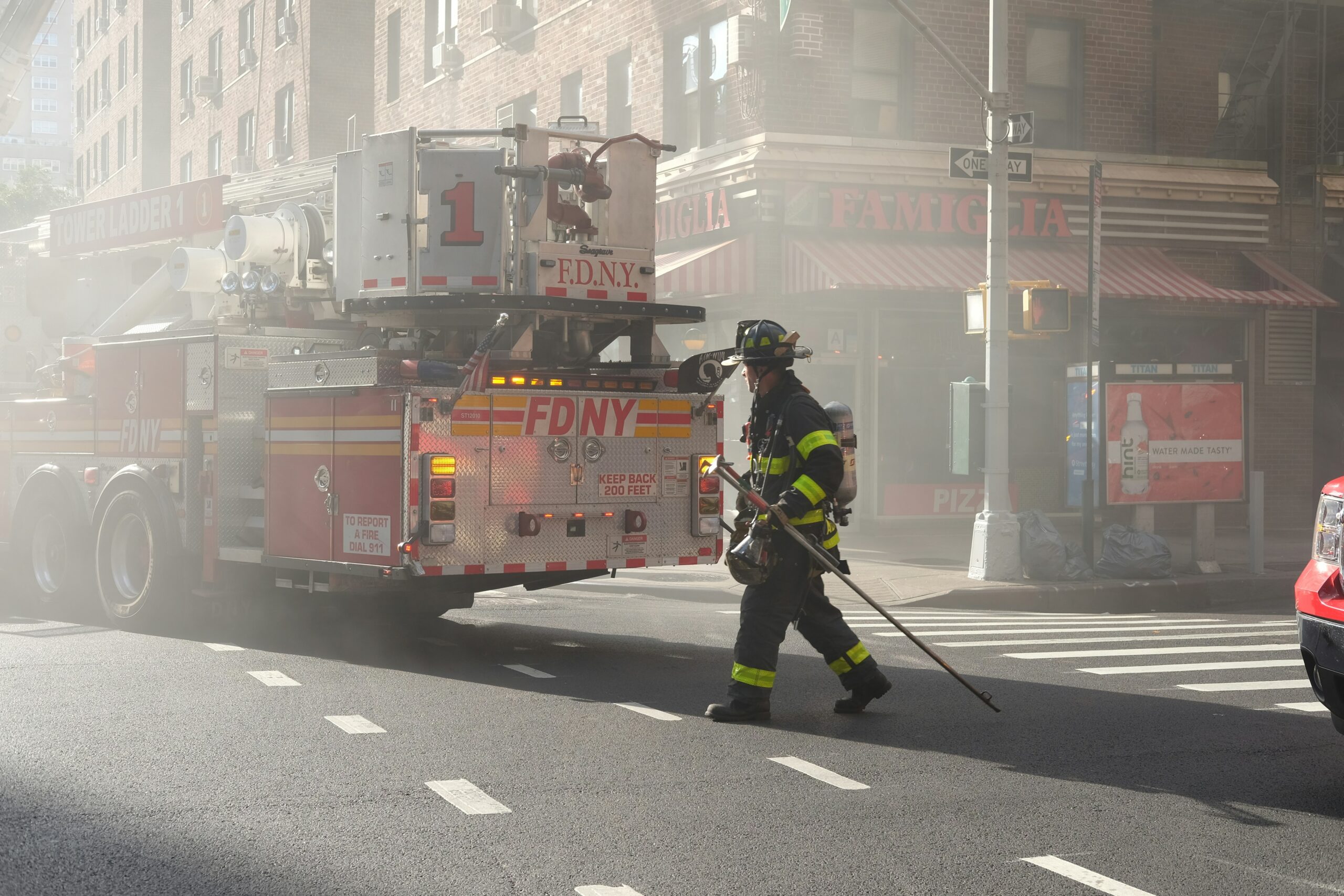
New York City firefighters and fire officers retiring last year after full careers were entitled to average annual pension benefits of $177,016, according to new data added to SeeThroughNY.net, the Empire Center’s government transparency website.
Among the 499 new retirees with at least 20 years of service, 150 were eligible for pensions over $200,000. Nearly 93 percent (462) of these full-career retirees were eligible for six-figure pensions.
Looking at the most recent data for all New York City Fire Pension Fund retirees – including those with fewer than 20 years in service, the average pension for all 16,157 FDNY retirees, as of fiscal year 2026, came to $103,619. Both amounts include in-service disability payments for some.
Overall, 1,000 retirees were eligible for pensions over $200,000, nearly 28 percent more than the previous year’s total of 784. Out of these, 76 were eligible for pensions over $300,000. Those 1,000 retirees make up about 6 percent of the pension roll but account for $242 million in annual benefits — roughly 14 percent of the fund’s $1.67 billion in yearly payouts.
268 FDNY retirees are eligible for pensions larger than the $258,750 salary paid to Mayor Zohran Mamdani. Unlike his salary, the pensions are exempt from state and city income tax.
The highest pension among all retirees went to John Sudnik, who was eligible for $427,977 after retiring in July, 2023. The next highest eligible pensions went to:
- Patrick McEvoy, Captain, $404,730
- Michael Ajello, Assistant Chief of Department, $387,579
- John Hodgens, Assistant Chief of Department and former Chief of Department, $385,551
- Michael Gala, Deputy Chief, $381,883
Sudnik went to court over his own benefit. He and fellow former Chief of Department Thomas Richardson petitioned for roughly $266,000 each in retroactive raises and a recalculated pension, which was dismissed by a judge in April 2025. The fund’s largest pension had been challenged as too small.
The Cost of the FDNY Revolt
Two of the five largest pensions in the FDNY fund belong to chiefs at the center of the 2023 revolt at fire department headquarters. In February 2023, then-Commissioner Laura Kavanagh demoted three assistant chiefs, and Chief of Department John Hodgens resigned in protest. He later returned to the post and retired in May 2025, eligible for $385,551 – the fourth-largest pension in the fund.
Five chiefs sued over the demotions and reassignments that followed, alleging age discrimination. Together they are eligible for $1.57 million a year, for life:
- Michael Gala, $381,883 (fifth-largest in the fund)
- Joseph Jardin, $319,125
- Michael Massucci, $312,273
- Fred Schaaf, $291,199
- Frank Leeb, $260,622
Not Just the Brass
The largest pensions do not belong only to the department’s leadership. Of the 10,340 people who retired at the rank of firefighter, 104 are eligible for pensions above $200,000 and two collect more than $300,000. Terence O’Connor, who retired in 2024 as a firefighter after 39 years, is eligible for $368,052 — the seventh-largest pension in the fund, ahead of all but four of the department’s former chiefs.
Among last year’s full-career retirees, the 234 who left at the rank of firefighter averaged $146,771. More than 87 percent of them (205) were eligible for six-figure pensions, and 16 cleared $200,000.
Three Decades of Escalation
The average pension awarded to a full-career FDNY retiree who received pensions in FY2026 has nearly quadrupled since 1990, rising from $45,878 to $177,016. While some of the gap between the earliest and latest cohorts reflects three decades of wage growth, most of it does not. The difference is primarily driven by the benefit formula itself, and by what counts as pay inside it.
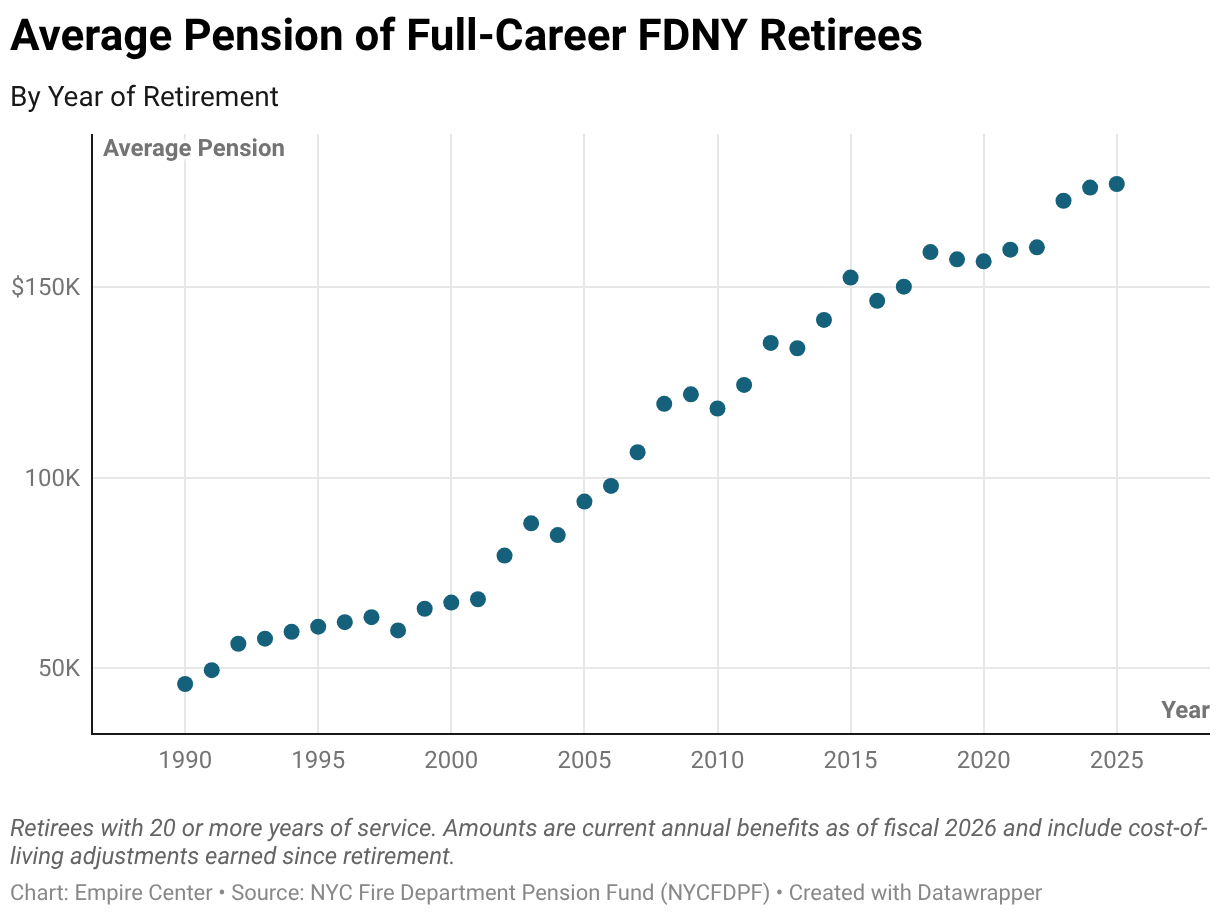
The figures include benefits from an optional program that allows members to make extra contributions to the pension plan, and the pension fund’s “Variable Supplement Fund” and “Christmas bonus” programs.
The pensions are constitutionally guaranteed by New York taxpayers and exempt from New York State income tax. New York City government retirees, including firefighters, also receive city health care coverage at no cost.
The data are only publicly available thanks to a 2014 Empire Center lawsuit, which won a state court ruling requiring the fire pension fund to disclose retiree names alongside benefit amounts. A parallel ruling later applied to the NYPD pension fund.
The Empire Center, based in Albany, is an independent, not-for-profit, non-partisan think tank dedicated to promoting policies that can make New York a better place to live, work and raise a family.