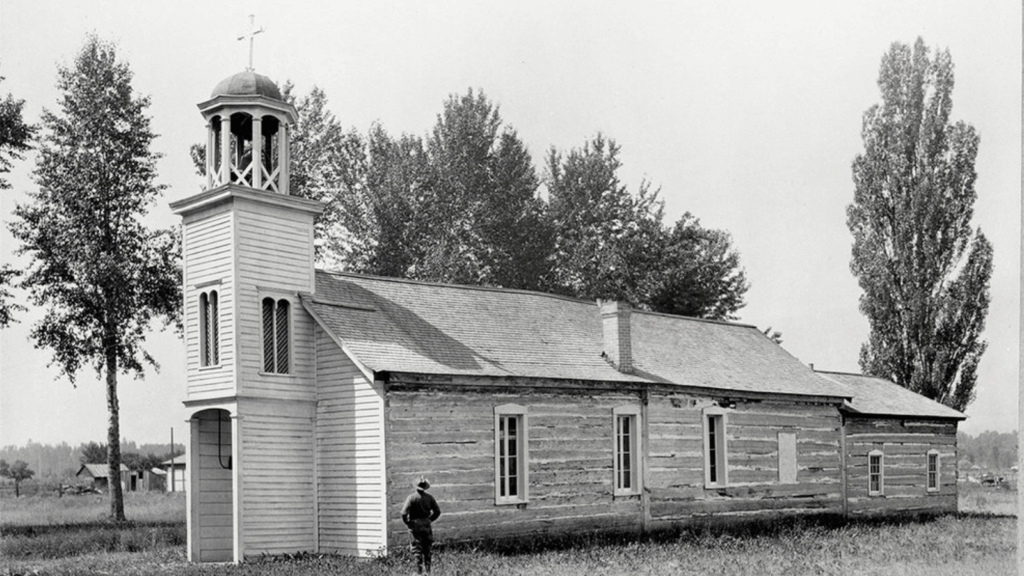
“He fulfilled a promise he made to the Salish a year before, namely, to return and build a mission that would serve the indigenous community.”
Rock Creek near Philipsburg in Granite County, Montana, is one of my favorite fishing destinations in the world. In most of the last 25 years, I’ve spent as much as two weeks in early September pulling in cutthroats, browns, and a few rainbows. There’s never a bad day on Rock Creek, even if all you catch are glimpses of nature’s awesome beauty and bounteous animal life.
Driving over the Skalkaho Pass from Philipsburg to Hamilton in the Bitterroot Valley is always on my schedule when I’m in the area, and not just because of the scenic views. The famous pies at the Coffee Cup Café in Hamilton are to die for. And a half hour north in Stevensville is an interesting spot listed in the National Registry of Historic Places: St. Mary’s Mission & Museum. It’s the site of the first permanent settlement of non-indigenous people in what is now Montana.
This is not a story that aligns with commonly held but largely mythical stereotypes. Millions are taught these days that Native Americans were a peaceful race when Europeans invaded, seized their land, and killed their women and children. Reality is more complicated. Warfare among indigenous people was normal. In the East, the Iroquois hated and fought the Algonquins. In the Great Plains, the Lakotas and the Crow were bitter enemies, as were the Cheyenne and the Arapahoe. In western Montana’s Bitterroot Mountains, the Salish people (whom Lewis and Clark found to be remarkably friendly) were killed by the Blackfeet and Lakotas for nothing more than asking whites to send them a Catholic priest or two.
Certainly, white Europeans could be cruel and rapacious, and I make no excuses for occasions when they broke agreements or committed horrific crimes against innocent people. But the St. Mary’s story is something else entirely.
In 1841, the famous Jesuit (and native Belgian) Father Pierre-Jean De Smet arrived in what is now Stevensville, Montana, with several priests in tow. He fulfilled a promise he made to the Salish a year before, namely, to return and build a mission that would serve the indigenous community.
Four years later, another Jesuit priest joined the St. Mary’s Mission: Father Antonio Ravalli, for whom Ravalli County was named by the Montana legislature in 1893. Ravalli’s contributions were truly remarkable, from art and architecture to medicine. He constructed a gristmill and a sawmill at the mission. He inoculated the Salish against smallpox, which likely saved hundreds of lives while nearby tribes were devastated by the disease. He died at 72, revered by the locals, and is buried in the mission’s cemetery in Stevensville.
Warriors of the Blackfeet tribe attacked and desecrated the mission’s original church, prompting the missionaries to order it leveled in 1850. A new one arose in 1866 and still stands. From April until October, one can visit the church and mission site today.
For a thorough account of the St. Mary’s Mission on the occasion of its 175th anniversary in 2016, I refer readers to Ellen Baumler’s article, “A Cross in the Wilderness” in Montana: The Magazine of Western History. She recounts a memorable moment in 1941:
The small mission chapel continued to serve St. Mary’s parish. In 1941, more than eight thousand people traveled to St. Mary’s Mission to attend the centennial celebration of Catholicism in the Northwest. Archbishop Amleto G. Cicognani, the apostolic delegate from the Vatican, along with thirty bishops from across the United States, celebrated pontifical high Mass. Although no one was alive to remember Father DeSmet, several old-timers recalled Father Ravalli. One of them, born in a log cabin fifteen miles from the mission, was a non-Catholic who said, “He was a great man, one of the greatest to ever ride this valley. He shook my hand and blessed me as a boy. I’d be proud to have him do the same today.”
The St. Mary’s Mission and Museum in Stevensville is well worth your time when you’re in western Montana.
#####
Lawrence W. Reed writes a monthly column for the Frontier Institute in Helena, on whose board he serves. He is president emeritus of the Foundation for Economic Education and blogs at www.lawrencewreed.com