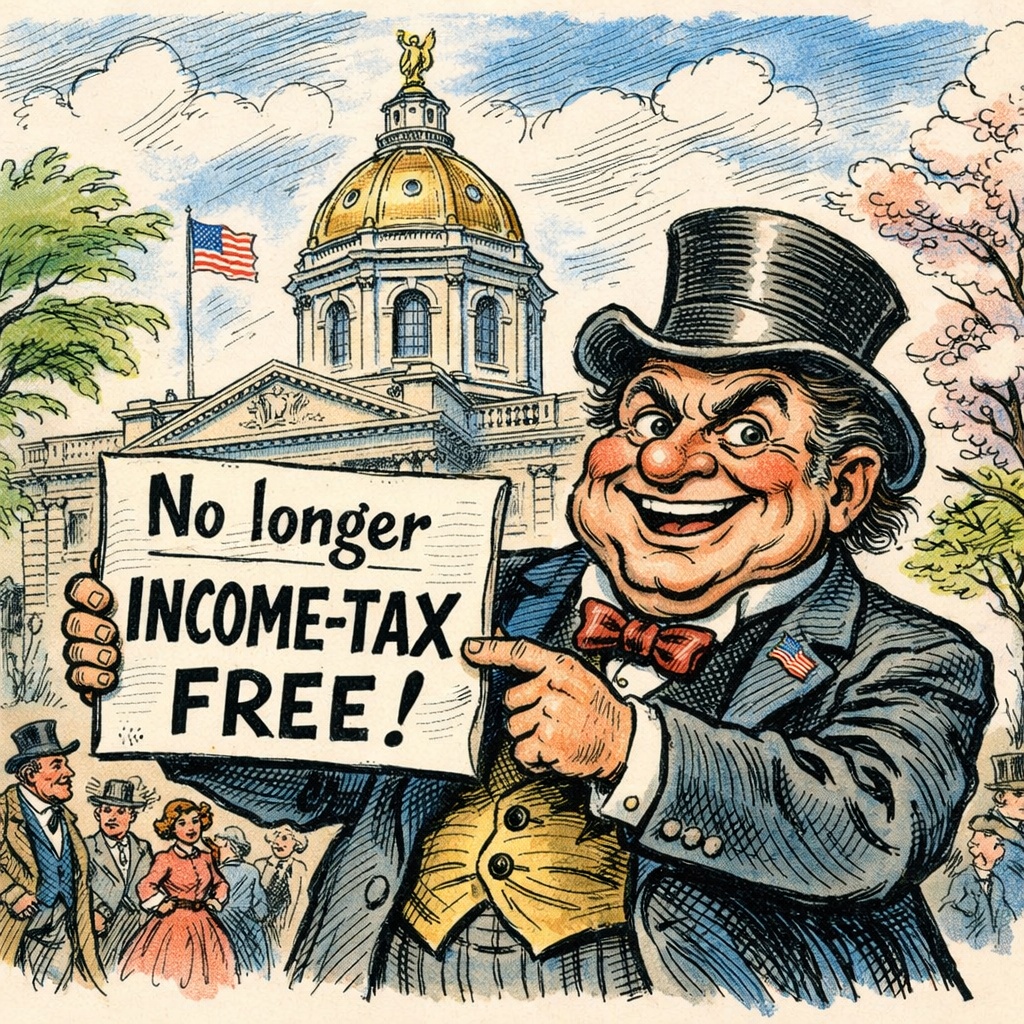
 Socialist gadfly Andru Volinsky held a press conference on Tuesday to propose a dual broad-based tax for New Hampshire: a 3% state income tax paired with a “true 3% statewide property tax.”
Pitched as a tax cut, his plan would raise $1 billion in state tax revenue, he said.
How would a new income tax amount to a tax cut?
The revenue would go into the Education Trust Fund and from there to school districts, Volinsky said. Voila! Local governments would then cut property taxes by the equivalent amount.
Asked by the media whether future legislatures could be compelled to distribute this revenue to school districts, he conceded that they could not.
The same goes for local governments. Volinsky assumes that they would use this state windfall to cut property taxes. But nothing would prevent local governments from shifting current education spending to other purposes while maintaining high property tax rates.
Speakers at Volinsky’s press conference said New Hampshire could look to Delaware’s example for a state with an income tax and low property tax rates.
Well. Delaware does have low property taxes. By law, following a reassessment school district property tax revenue increases are capped at 10%, and county revenue increases at 15%.
Volinsky sets his personal income tax rate at 3%. When Delaware created its personal income tax in 1917, the rate was 1%, according to records kept by the Institution on Taxation and Economic Policy. The rate tripled to 3% in just five years. It doubled to 6.25% in 1949, hit 11% in 1962, and peaked at 19.8% in 1974.
In 57 years, Delaware’s personal income tax increased by a bewildering 1,880% before taxpayers had enough. After sitting at 19.8% for five years, it took 18 years for the income tax rate to drop back to single digits. Today it sits at 6.6%.
Connecticut offers another cautionary tale. In 1991, Connecticut became the last state to adopt an income tax. It was sold as a solution to high property taxes. Residents were told that it would be a flat tax of 4.5%, which is how it began.
Just five years later, the tax was made progressive, with rates from 3-4.5%. Today the rates range from 2-6.99%.
Last year, Connecticut’s property tax burden was the third-highest in the country, behind only Illinois and New Jersey.
Connecticut’s total state and local tax collections per capita are also the third-highest in the nation at $9,718, per the Tax Foundation.
An income tax is an effective tool for increasing state revenue and reducing economic growth. It is not a recommended tool for lowering property taxes.