Introduction
The Charter School movement began with the passage of North Carolina’s charter school law, House Bill 955, NC Session Law 1995-731. Charter schools were set up for teachers, parents and pupils to establish schools that operate independently of existing schools. According to the founding statutes, charter schools were set up to improve student learning, increase learning opportunities for all students, encourage the use of different and innovative teaching methods, create professional opportunities for teachers, provide parents and teachers with expanded choices and hold schools accountable for meeting measurable student achievement results (General Statures 115C-238.29A)
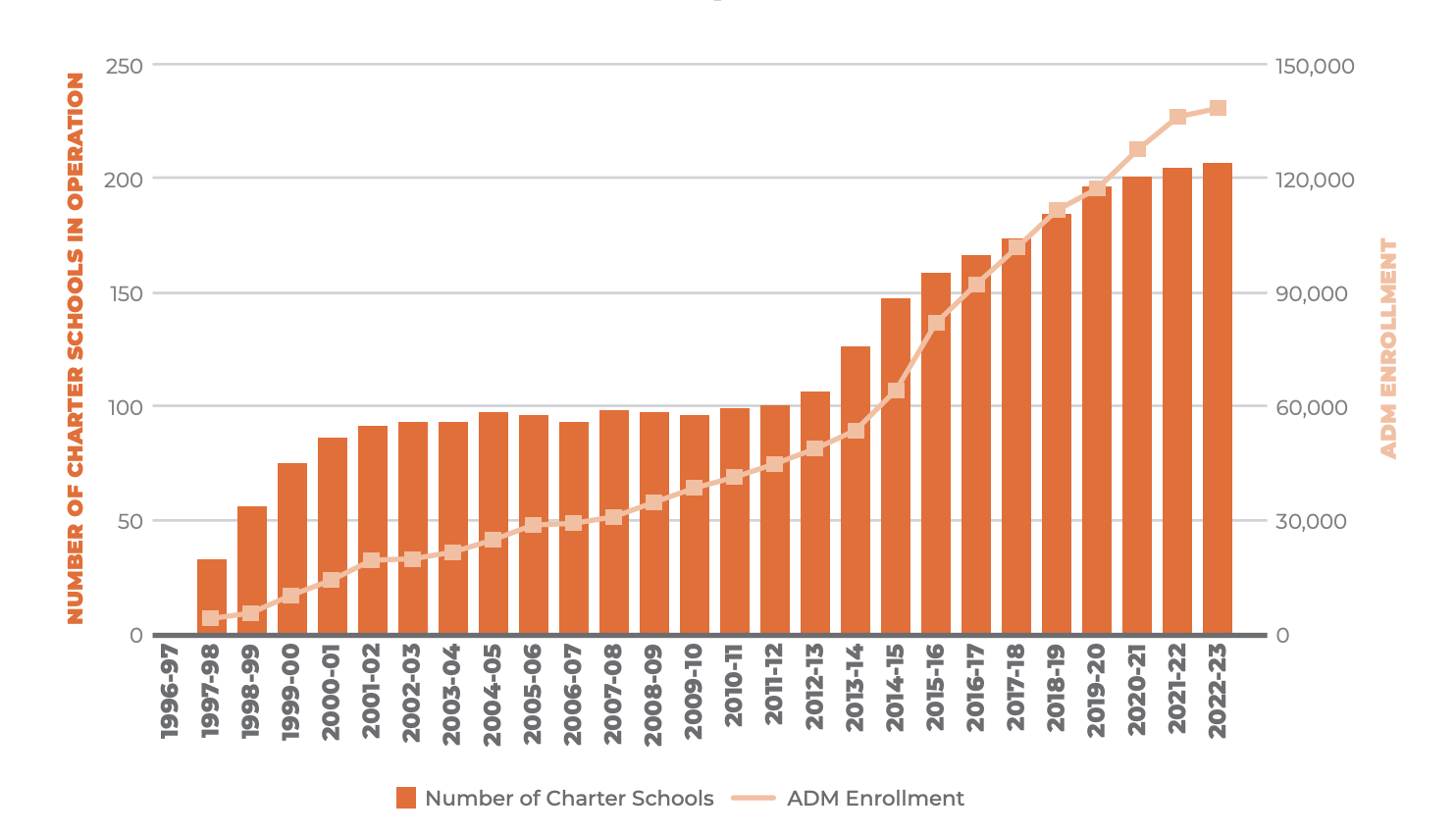
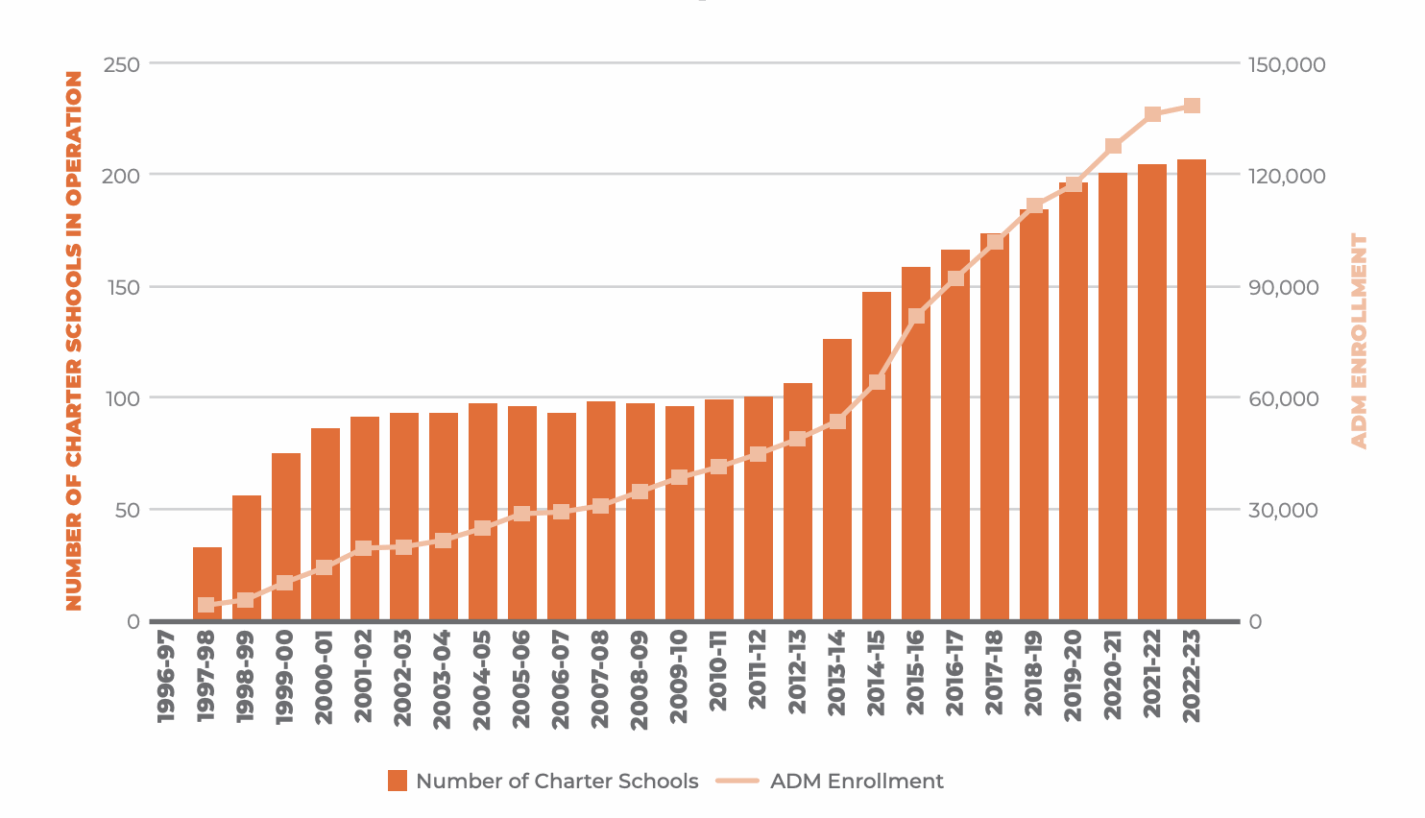
Today Charter schools comprise one of the fastest growing and least understood types of public schools in North Carolina. Since the 100-school cap on charter schools was lifted in 2011, the number of charter schools in North Carolina has exploded to 206 schools with an enrollment of over 137,00 students. While the pandemic produced enrollment declines in many traditional public schools, charter school enrollment in North Carolina increased 18.7% from 2019-20 to 2021-22.
Even though they have been around for 25 years, confusion still surrounds charter schools. They are tuition-free public schools that have more freedom than district-run public schools. In exchange for this freedom, charter schools are required to meet certain state regulations, including participation in the state testing program.
The charter for each new charter school is awarded by the State Board of Education. Schools are accountable to the board. Unlike public schools, which are governed by elected school boards, charter schools are operated by nonprofit boards. Each board is responsible for ensuring that the charter school follows relevant laws and the provisions of its charter.
If a charter school fails to live up to the provisions of its charter, the school can be put on probation or permanently closed. Since 1996-97, 54 charter schools have been closed for failure to maintain sufficient academic progress or financial sustainability.
Charter schools enjoy additional flexibility with regard to administrative regulation and teacher certification requirements. Charter schools also have the option of contracting with charter management companies that provide administrative and technical services.
According to state law, any child who is eligible for admission to a public school in North Carolina is eligible for admission to a charter school. Local boards of education cannot compel a child to attend a charter school. Charter schools are not allowed to limit admission to the school based on intellectual ability, achievement, aptitude, or athletic ability. Nor shall admission be limited on the basis of race, creed, national origin, religion, or ancestry. One year after opening, charter schools are required to make efforts to ensure the population of the school “reasonably reflect[s]” the racial and ethnic composition of the general population of the school district in which the charter school resides.
The demand for charter schools continues to grow. Since 2011, charter school enrollment has increased 208%. According to the 2022 Office of Charter Schools Annual Report, North Carolina Charter Schools have a waitlist of 77,000 students statewide. Some of this demand is a function of natural population growth. Some of it derives from policies that have restricted demand for charter schools. In recent years, enrollment provisions for siblings and for specific grades, and modification of teacher certification requirements have helped charter schools respond to the demands of growth.
Two significant charter school bills were approved this past session. S.L.2023-110 among other things created a Charter School Review Board to authorize charter school applications. Unlike the State Board of Education whose members are largely appointed by the Governor, the new board will be mostly appointments by the State House and Senate. Under the new legislation the State Board of Education will hear appeals of such decisions. Previously, the State Board would authorize all charter applications, on the recommendation of the Charter School Advisory Board. In addition, SL 2023-107 authorizes counties – if they so choose – to contribute capital funds to charter schools. That provision is a major victory, since charter schools receive no capital funds and building expenses are a charter school’s largest budget expenditure.
Key Facts
- According to the North Carolina Department of Public Instruction, the statewide average per pupil expenditure for charter schools for the 2021-22 school year was $12,482. At the same time, the statewide average expenditure for traditional public schools was $12,345 and $1,029 per student for capital expenses. To date, charter schools receive no state or local capital funding to help with debt, and capital costs which can often be significant. As previously mentioned, recently passed legislation will give counties the option to contribute to charter school capital costs if they so choose.
- North Carolina charter schools are in 64 of the state’s 100 counties. Charter schools allow families to cross county boundaries to attend their preferred school, and most North Carolina families have access to a charter school. In addition, North Carolina has two virtual charter schools to help meet the needs of students who wish to attend school online.
- As of the 2021-22 school year, charter school students represented 9.7% of the public-school population in North Carolina, up from 6.1% in 2019.
- Since 1997, there has been a total of 77 charter terminations. This includes schools that were in operation and those that may have been in the planning year program prior to opening the school to students.
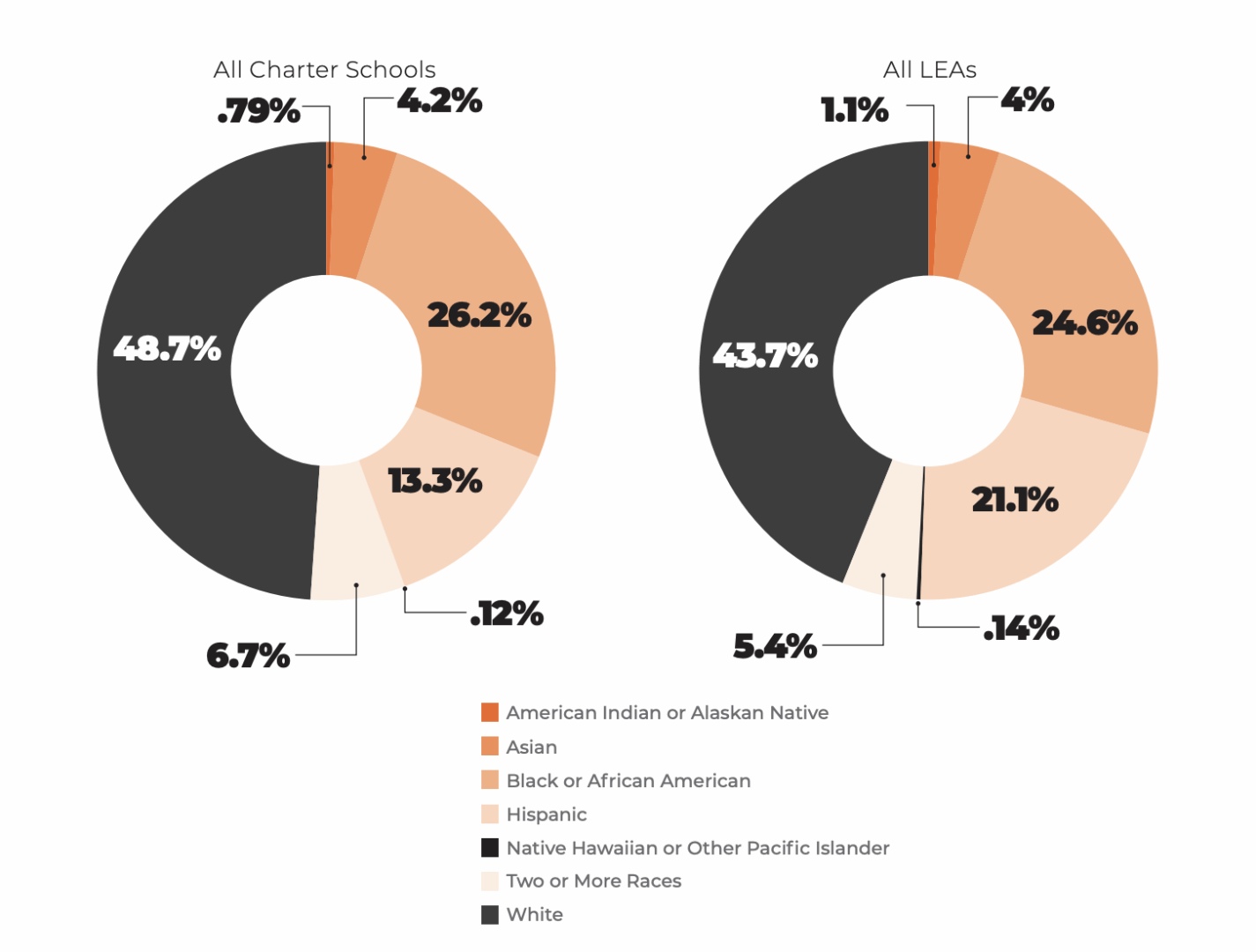
- North Carolina charter schools enroll a higher percentage of Black students (26.2%) than traditional public schools (24.6%).
- The U.S. Department of Education granted charter schools and public schools a waiver from federal testing requirements during the COVID-19 pandemic.
Recommendations
1. The State Board of Education should establish uniform performance standards for charter schools and traditional public schools.
All public schools should have the same performance standards. If a charter school fails to meet the goals of its charter it is shutdown. If a public school does not meet its goals or perform well academically, it is not shutdown. The standards for public and charter schools are not the same.
2. Lawmakers should eliminate funding disparities that result from district schools being able to restrict funds from accounts whose monies must, by law, be shared with charter schools.
North Carolina law affirms the principle that district, and charter schools should be funded equitably. Still, the way local school funds are administered has created a system where, on average, a public charter school receives between 55 and 75 cents per student in local funds for every local dollar provided to a district school.
3. Allow all schools – public, private, and charter to build in all zones.
Charter and private schools are frequently at a disadvantage because of zoning laws which restrict development in certain areas. Selected permitting must end. In addition, local governments should be prohibited from requiring traffic and transportation improvements as a condition of approval.
North Carolina Charter Schools in Operation and ADM Enrollment
Source: Highlights of the North Carolina public school budget, 2023
Charter Schools: 2022 Ethnicity and Racial Data
Source: 2022, Charter school annual report to the general assembly of North Carolina