Introduction
“Bull Durham,” “Last of the Mohicans,” “Dirty Dancing,” and most other beloved North Carolina films were produced without film production grants or incentives. In fact, they were made years before state officials ever thought the industry required government help.
Several features make North Carolina an attractive location for filming. The state offers a diverse climate, rural to urban landscapes, mountainous to coastal terrain, a cornucopia of settings, and a good production infrastructure. It’s also a right-to-work state with competitive wages and cost of living.
Add to that a series of major reforms beginning in 2013 that reduced tax rates (including the corporate income tax), checked the growth of state spending, and eliminated intrusive red tape. Taken together, these attributes have recommended North Carolina even more highly as an attractive place in which to do business, invest, and relocate. Indeed, CNBC ranked North Carolina the top state for business in 2023.
A freer business climate powerfully incentivizes untold numbers and kinds of business enterprises that create domestic jobs.
Enjoying lower costs of doing business is good for business, and by extension, it’s good for job creation, investment, and the state’s economy. But the message behind the North Carolina Film and Entertainment Grant fund is this: We only want certain kinds of business to enjoy a lower cost of doing business. Established, in-state enterprises are left to deal with a comparably higher cost of doing business.
Unlike other economic incentive programs, film grants don’t require recipients to earn them over time by hitting specific local job-creation targets or fulfilling other long-term promises. When the project is over, the grant money is gone and so are the jobs.
The biggest beneficiaries of film grants are outside film production companies even if they don’t produce in North Carolina. They can pit North Carolina’s “bid” for film productions against other states’ bids (and foreign nations’, too). This bidding war turns into a race to the bottom, with each state under constant pressure to increase their giveaways.
Key Facts
- North Carolina started offering film production tax credits in 2005 as an open-ended subsidy offering up to $7.5 million per production. Lawmakers greatly expanded the subsidy in 2010 to offer up to $20 million per production. The tax credit was repealed in 2014. It was replaced the following year by a modest grant program of $10 million that lawmakers have since tripled.
- In 2019, the General Assembly overrode Gov. Cooper’s veto to enact a bill that would modestly expand the grant program by lowering thresholds for eligibility and increasing the maximum award amount for a television series filmed in the state.
- State film incentive programs were a fad popular in the early 2000s. By 2009, all but six states had some kind of film incentive. Meanwhile, studies consistently found the programs to have significantly negative returns on investment, so states began getting out of the bidding war. Now, about one-third of states don’t offer film incentives.
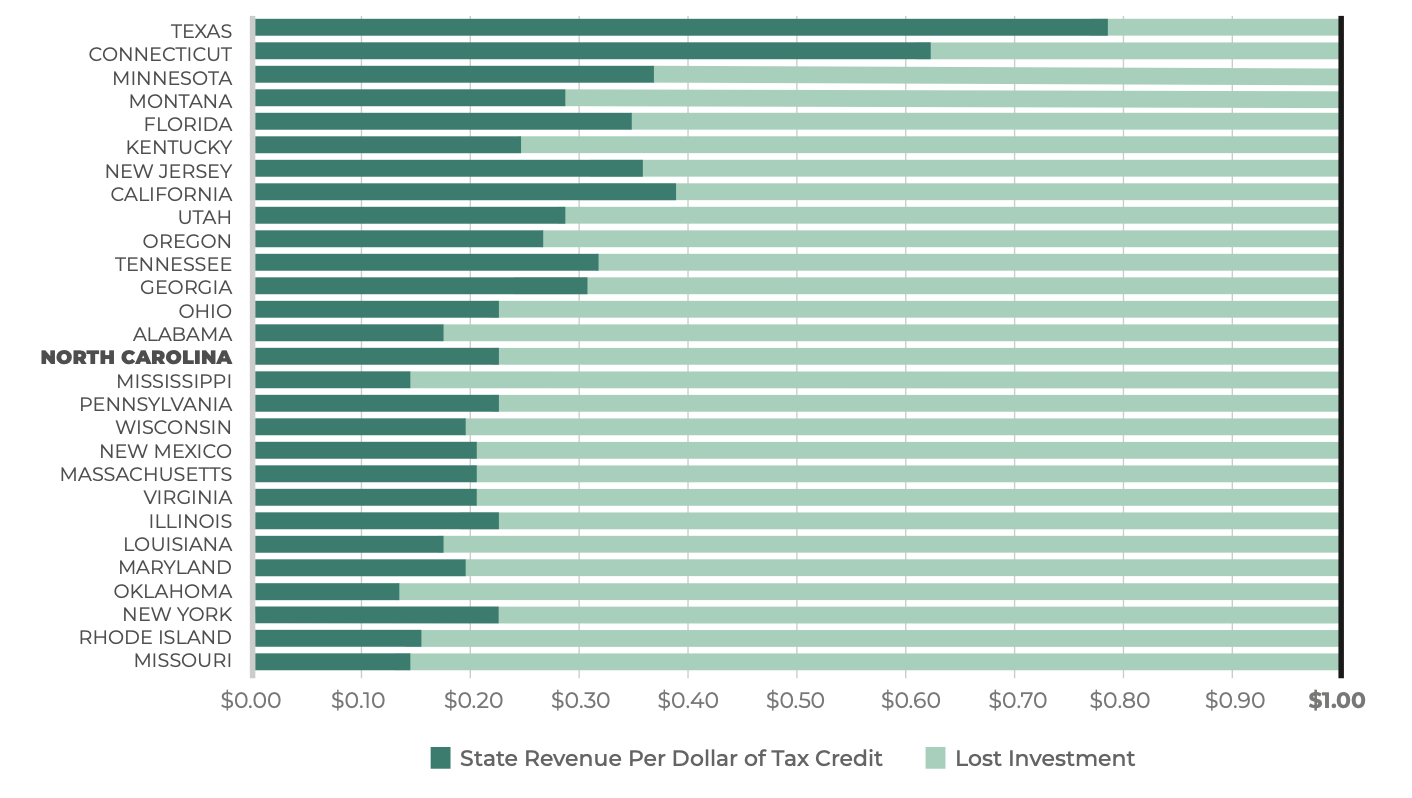
- Multiple third-party studies of North Carolina’s program incentivizing film productions showed negative returns, ranging from just over 19 cents per dollar of tax credit given to a high of 61 cents per dollar (in a study that did not account for opportunity costs and whose authors acknowledged that “a more detailed report is likely to conclude that the loss to the State is even greater”).
- Peer-reviewed research consistently finds that state film incentive programs have no impact on their states’ economies or industries and basically benefit only outside film production companies and current workers.
- Out-of-state recipients of film incentives have even sought to leverage the programs to extort state lawmakers into passing laws conforming to their social politics. Hollywood activists have actually threatened not to take handouts in North Carolina, Georgia, Louisiana, and elsewhere unless policymakers passed certain unrelated legislation they favored. Policymakers who’ve told taxpayers these incentives are critical to growing the state’s economy are unable to call their bluff.
- Thanks in part to a decade’s worth of tax and regulatory reforms, North Carolina boasts a freer business climate, a vibrant economy, and lower costs of doing business. Those are appealing factors to add to the state’s many natural amenities in attracting outside film productions. Importantly, they’re already attracting hosts of other business endeavors that will be here for the long haul.
Recommendations
- End the film production grant program.
State leaders should ignore, not reward, outside film productions’ demands for higher incentives bids in their search for a state to pay them for their short-term business endeavors. - Allow the state’s significant across-theboard, pro-growth reforms to attract outside film productions, just as they attract other enterprises.
Thanks in part to more than a decade of tax and regulatory reforms, North Carolina boasts a freer business climate, a vibrant economy, lower costs of doing business, and beautiful natural amenities. These are already attracting hosts of other business endeavors that will be here for the long term.
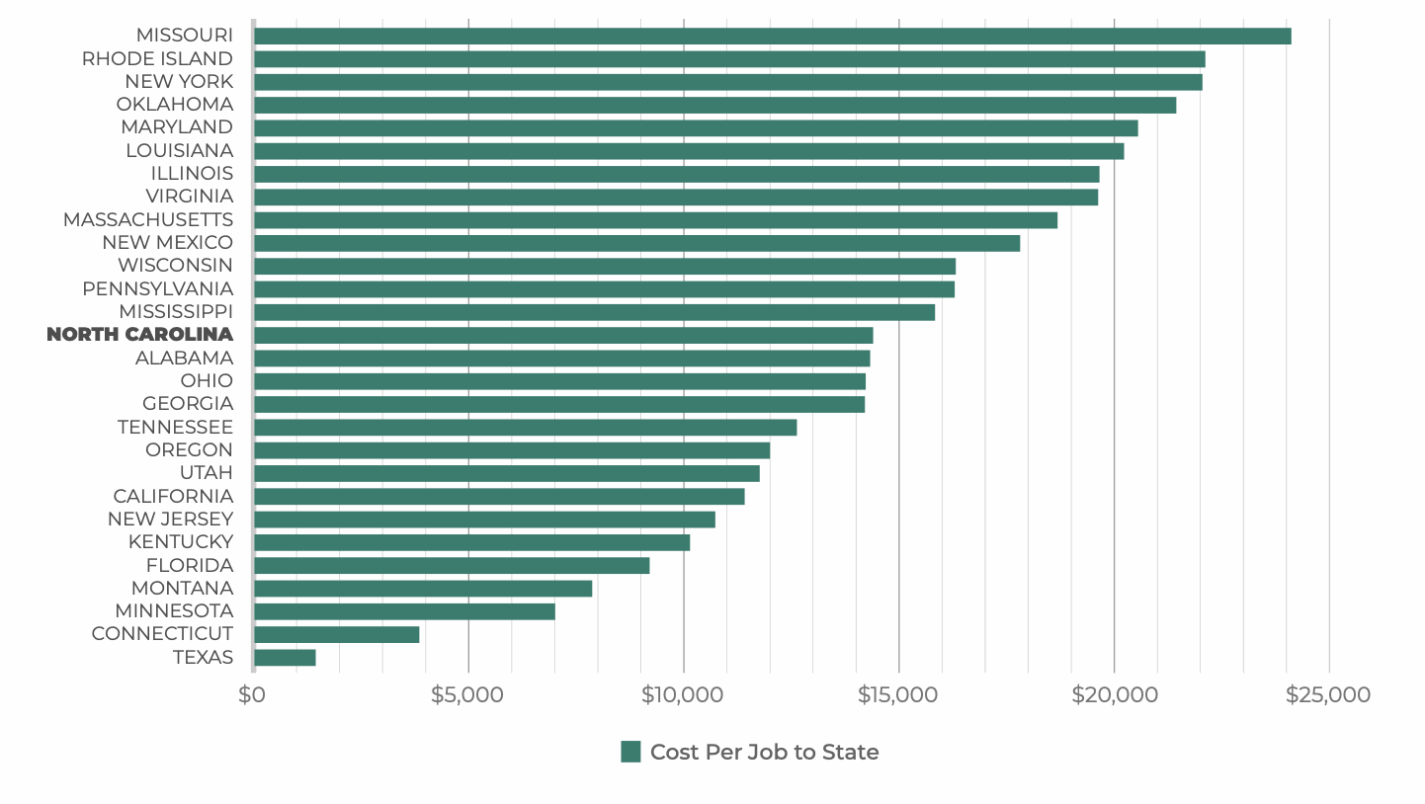
States Get Negative Returns On Investment Trying To Incentivize Film Productions
How Much States Spend In Incentives Per Temporary Film Job