Share this Story on Facebook, X, Text, LinkedIn, Gmail, Yahoo Mail, or Outlook
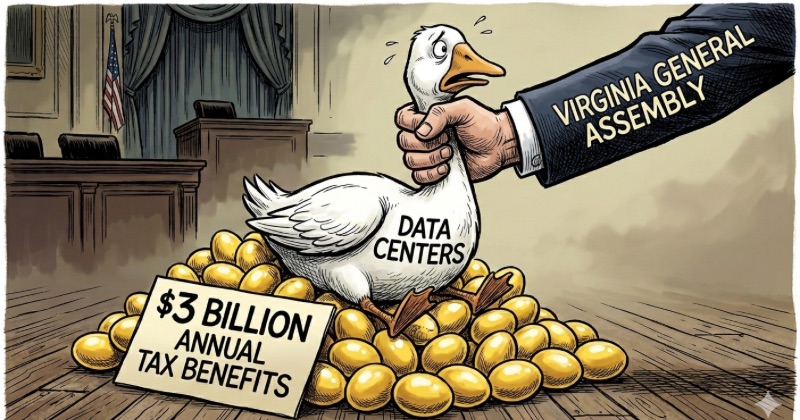
Building Virginia into the leader of the data center industry for the United States and the world has been a bipartisan goal of several recent governors and General Assemblies. The golden egg laying goose they nurtured is now in danger of being butchered.
What is happening to this one industry during the 2026 General Assembly needs to be an alarm bell in the night for the entire Virginia business community.
The majority Democrats in one chamber of the legislature have voted to strip away a key sales tax exemption almost a decade before it was due to expire, mainly because they want the additional revenue. The majority Democrats in the other chamber want to turn the tax exemption into a net-zero renewable energy whip, denying it unless the data centers swear off natural gas and diesel.
It is not just one party. As the competing budget bills were debated Thursday, the minority Republicans demonstrated only confusion. In the Senate, they mounted an effort to maintain the sales tax exemption by voting against the related committee amendment. Almost simultaneously, Republicans in the House went the other way and tried to strip the exemption from that version of the budget.
Quite a few Republicans have voted in favor of a third sacrificial altar being built for the industry, an effort to force data centers to pick up 100 percent of the future costs of utility energy capacity purchases and transmission upgrades. Supporters are bragging this will lower the bills on all other customers, making this politically attractive.
Such a major change in the cost allocation formula needs the approval of the regulatory State Corporation Commission, and the bill only mandates that a petition be filed there. Again, the general business community needs to be engaged because the way to really make residential customers happy is to raise electric bills on every business, not just data centers.
The first thing that all must understand about the disputed sales tax exemption is that it is commonplace. Since Virginia first imposed the sales tax exactly 60 years ago, several major industries have been granted exemptions on the purchase of equipment vital to their operations, and you can read that long list in the Code of Virginia.
The data center industry takes up about three of the 20 paragraphs, because its exemption has been tied up with so many conditions. But you will also find exemptions for manufacturing, railroads, airlines, shipbuilding and ship repair, breweries, basic research, printing and oil and gas extraction.
The data center exemption, which covers mainly the computer equipment they use to operate, only stands out because it has been so wildly successful. Once built, the centers engage in an aggressive pattern of refreshing those computers with newer, larger versions every few years. The exemption applies to those, too.
Those who claim that ending the exemption after 2026, as proposed, will not force the existing data centers to close are probably correct. But the addition of new ones will decelerate, perhaps as the authors of this move intend. Also likely to slow will be the cycle of internal upgrades, and that will mean shrinking local tax revenue.
Because while the state has exempted the sales tax on the initial purchases, once installed the equipment is subject to annual personal property taxes. That is also the case with most of the other items bought by the other industries with the initial sales tax break – they then owe either annual personal property tax or annual machinery and tools tax on the items.
Not long ago the shipyard in Newport News was still paying annual machinery and tools tax on equipment it had installed during World War II. The personal property tax imposed on the data centers is the real golden egg they produce for Virginia’s cities and counties. The Department of Taxation has documented that the taxes they pay far exceed the benefit of the sales tax exemption, and then there are the many indirect taxes they generate.
But the Senate’s budget writers looked at that report and only saw the short term gain they might reap by cutting off the sales tax exemption. As the industry stops building new facilities in Virginia and puts its best and newest upgrades into other states, that revenue stream will shrink. Many voters will cheer if the industry sputters, no question, but their localities will miss the money.
The loss of the sales tax exemption as the Senate now demands might be a better outcome for the industry – and for all the other industries in Virginia watching from the sidelines – than what the Democrats in the House of Delegates have approved. Unlike the other two sacrificial altars, House Bill 897 so far has not attracted Republican support.
The push is on nationally to encourage the industry to develop its own electricity generation sources, sometimes adjacent to its server warehouses. Most already have backup power on site, ready to cover any blip in the grid. The House legislation, not yet discussed in the Senate, restricts their current and future choices. Natural gas and diesel must go.
The Virginia Clean Economy Act sets targets for the retirement of hydrocarbon energy for Virginia’s two largest electric utilities, backing that up by allowing them to meet the goals by purchasing renewable energy certificates (RECs). This bill is a mini-VCEA for every current and future data center, and the hydrocarbon retirement and REC acquisition targets are more aggressive than those for the utilities.
What will prevent a future General Assembly from going down the list of all the other industries that currently enjoy a similar sales tax exemption on equipment purchases? Why not impose a net zero or even fully zero emissions scheme on all of them to qualify for the tax break? Do not doubt that is where Virginia will go next if this idea passes and is signed into law by Governor Abigail Spanberger (D).
First, they came for the data centers. It will not stop there.

Steve Haner is a Senior Fellow for Environment and Energy Policy. Steve Haner can be reached at Steve@thomasjeffersoninst.org.
Share this Story on Facebook, X, Text, LinkedIn, Gmail, Yahoo Mail, or Outlook