For years, the John Locke Foundation’s Center for Food, Power, and Life has been warning of electricity price hikes in the wake of the 2021 passage of the Carbon Plan law. A recent research brief even included a section entitled “Why we have been warning that higher electricity rates are coming.” Here are some highlights:
- Our 2022 analysis before the NCUC showed not only that the four Carbon Plan portfolios then under discussion were all too expensive and would raise monthly bills significantly, but also that even a least-cost decarbonization portfolio would necessarily raise bills.
- In 2023, we discussed in Carolina Journal that “deliberate policy choices” would be responsible for future electricity rate increases and highlighted testimony from utilities engineer Dustin Metz of the Public Staff to the North Carolina Utilities Commission (NCUC) warning that customer rates could “approximately double” before 2030.
- Our 2024 “Lighting the Path” report detailed the enormous costs that North Carolina ratepayers would accrue if the Carbon Plan’s pursuit of carbon neutrality by 2050 relied on wind and solar as opposed to nuclear.
- A series of research briefs in 2024 laid out six reasons why power bills would be increasing, starting with “[c]losing down working [coal] power plants and building new ones.”
Suddenly, however, rising electricity bills have been discovered by news media, perhaps because rate hikes seem to be a winning issue for Democratic candidates following the gubernatorial elections in Virginia and New Jersey. There seems to be a fixation on just the fuel costs of power plants to the exclusion of all other costs, which — since renewable facilities have “zero fuel costs” — gives the misimpression that renewables (heavily subsidized) are the cheapest options.
More than fuel costs: The different costs facing electricity generating resources
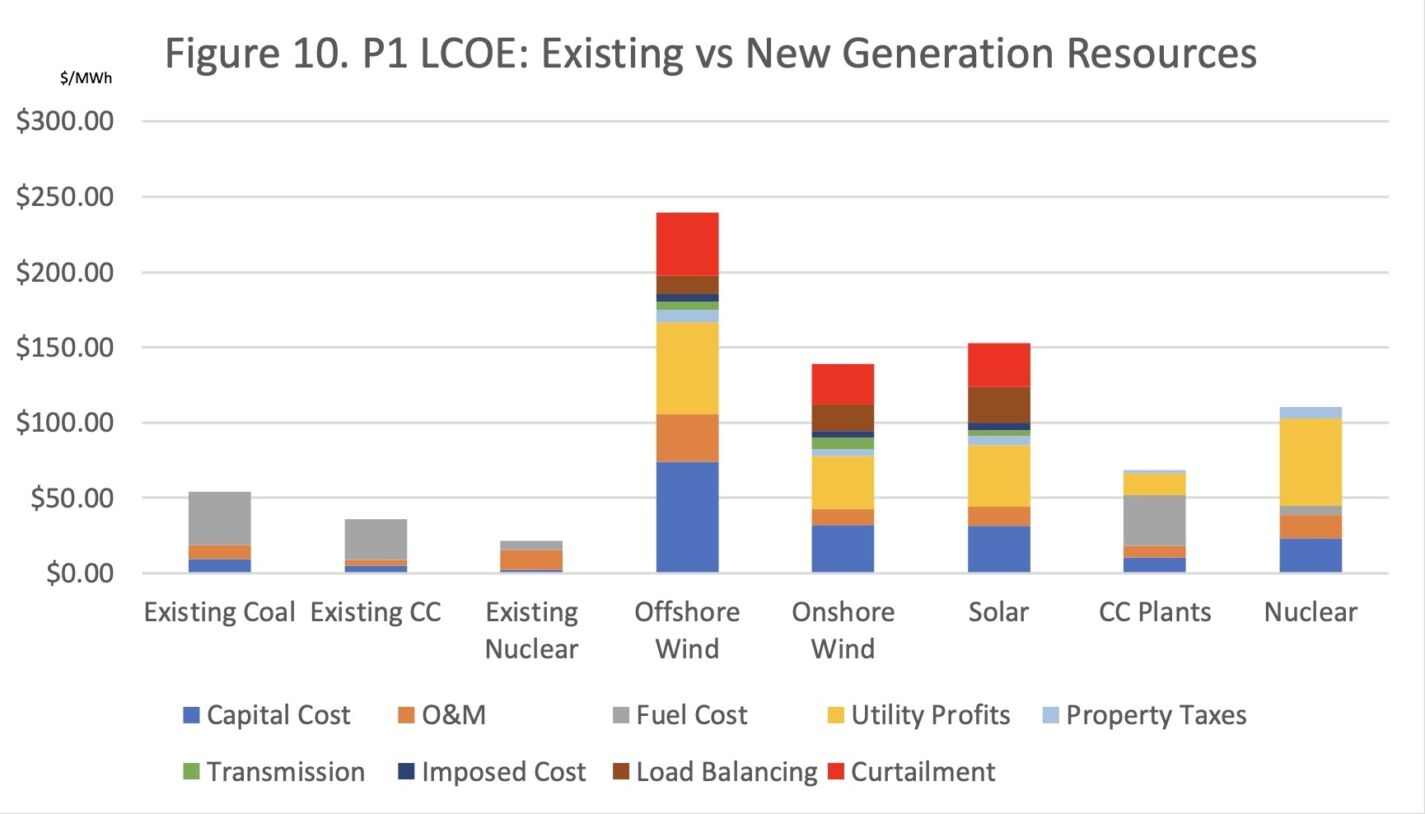
Source: Locke, “Analysis of Duke Energy’s Carolinas Carbon Plan and a Least Cost Decarbonization Alternative”
A part of the interim report from Gov. Josh Stein’s Energy Policy Task Force, relying on a report from the Environmental Defense Fund, stated that, “From 2017 to 2024, nearly two-thirds of the increase in residential [electricity] bills [in North Carolina] was due to increasing fuel costs, principally natural gas.”
A look at natural gas prices in North Carolina over that particular time does indeed show a marked increase, though it has been in decline after the 2022 spike owing to the supply shock of the Russia/Ukraine war:
Natural gas fuel prices in North Carolina, 2017–24
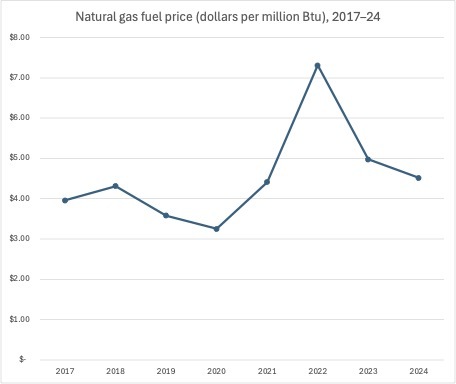
Source: U.S. Energy Information Administration
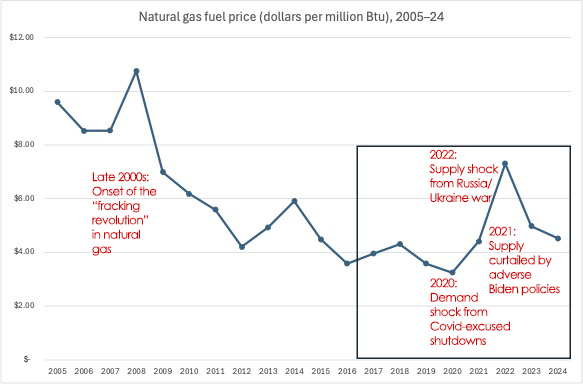
That said, why did the Environmental Defense Fund choose 2017 as the starting point? A period of 2017 to 2024 (eight years) seems random and somewhat limited.
Using the last 20 years of data (from 2005 to 2025), here are natural gas prices. I’ve added an inset identifying the years of data used by the task force’s report and also noted several major items that would have influenced prices during that time.
Natural gas fuel prices in North Carolina, 2005–24
Source: U.S. Energy Information Administration
As you can see, natural gas prices have declined significantly since 2005, just as the hydraulic fracturing revolution was beginning to take place. They showed relative stability from 2010 on, and possibly a continued decline until the supply shocks of the early 2020s. In 2017, prices were at about their lowest level in the last 20 years.
The price of a good is determined by the interaction of how much is available (supply) and how much is wanted (demand). Regardless of how demand changes, however, the removal of governmental supply constraints means there is reason to expect mitigation of natural gas price increases.
Importantly, President Donald Trump is much more favorable to natural gas than was President Joe Biden, who campaigned against oil and natural gas and followed through with over 200 executive actions against them, including a day-one moratorium on new leases on public lands. Trump has rolled back Biden’s moratorium, undone many other antagonistic executive actions, and sought instead to further American energy exploration and dominance in oil and gas.
Closer to home, North Carolina has long languished with only one interstate pipeline for natural gas, Transco (see my report “Power Plays: How an Activist Bureaucracy Obstructs NC’s Energy Future, and What to Do About It” for details). Soon, however, the state will be supplied by a second natural gas pipeline, the Mountain Valley Pipeline Southgate project, and also by the Southeast Supply Enhancement expansion of Transco.
Those supplies will be crucial to powering the state with additional, reliable facilities. Nevertheless, if the governor were serious about keeping power bills affordable for North Carolinians, he would seek to keep coal power plants — which are low-cost and already paid for — active. Their reliability has been on display during the state’s recent emergency needs, whether a dangerous heat wave or a deadly cold snap. Repeal of the Carbon Plan law’s carbon neutrality mandate by 2050, which is forcing coal plants into retirement, would go a long way toward keeping the grid reliable. At the same time, it would also protect households from rate hikes owing to having to build replacement facilities — or worse, from having to overbuild unreliable solar facilities.