
Share this Story on Facebook, X, Text, LinkedIn, Gmail, Yahoo Mail, or Outlook
Governor Abigail Spanberger’s major campaign pledges to lower electricity bills have already been crushed by the harsh reality of last week’s Winter Storm Fern. Virginians everywhere are about to see their highest energy bills ever, and the energy sources Spanberger wants us to adopt were all but useless during the crisis.
Day after day, if you checked the energy reports from regional grid operator PJM Interconnection, it was clear that coal, nuclear, natural gas and oil were providing 90 percent or more of electricity during the crushing cold spell. There were only a few hours when the existing wind and solar assets approached 10 percent of our supply, and never during the bitter cold nights.
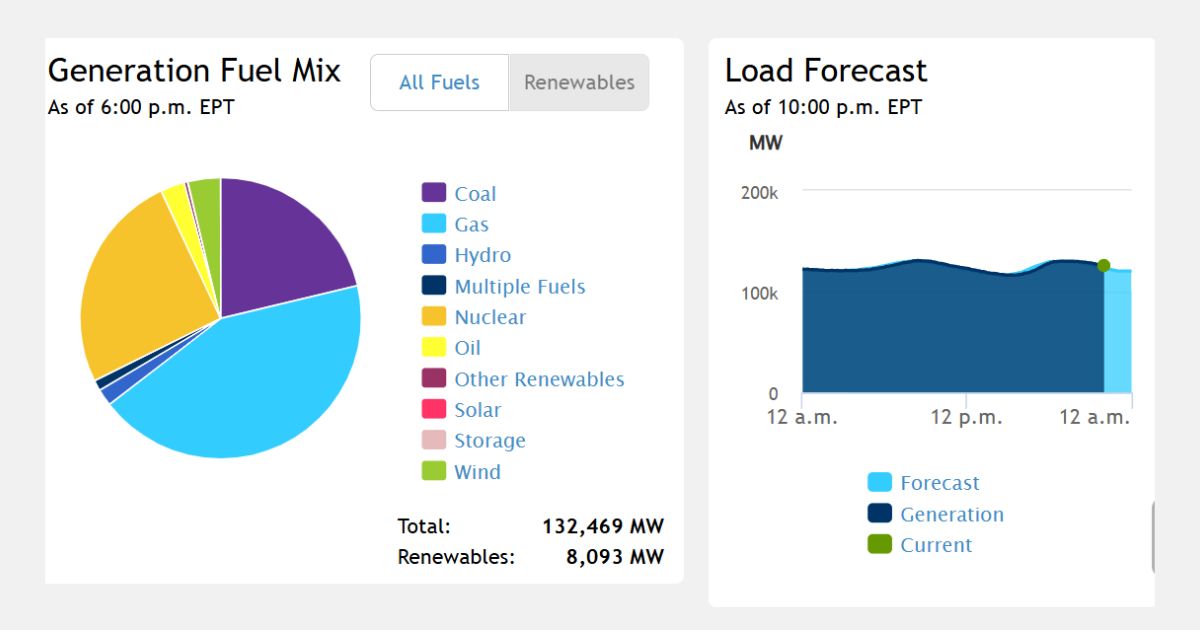
That is not the whole story. The energy demand in Virginia includes a growing number of large data centers, many with large backup generators installed behind their utility meters. Hundreds and perhaps thousands of their diesel generators have been running all week at the request of federal energy managers to protect PJM’s grid. Those gas- or diesel-powered electrons are not counted by PJM on that website.
The backup generators at those power-draining server facilities are a particular target of Democrats in the 2026 General Assembly and the anti-hydrocarbon activists and donors dictating their policy. The generators are often a focus when people in a locality try to prevent new plants. Inconveniently for them, a post-storm analysis from PJM may demonstrate they saved the day.
The long stretch of below normal (but far from record) cold was not the Governor’s fault, but expecting and planning for such challenges is very much her job. The many price increases during 2025, some going into effect January 1, are also not directly Spanberger’s fault. But she supports the net-zero philosophy of the Virginia Clean Economy Act, which drove many of those increases.
For those of you served by Dominion Energy Virginia, when you get that super-sized bill, you might want to run it through a very useful tool on the utility website. Look for “Bill Calculator Worksheet” at the very bottom of this page. It is a spreadsheet that starts with the number of kilowatt hours on your bill and tells you how much you spent on base rates, fuel, taxes and about a dozen more of those ubiquitous rate adjustment clauses or RACs.
The total residential price for 1,000 kilowatt hours is now $171.51. The three RACs directly related to compliance with the Virginia Clean Economy Act account for $22.58 of that, mainly to pay for the offshore wind facility. Fuel is another large component at $32.59. Running your own bill through is an education.
Then save a copy for future comparison as Spanberger and the solar, wind and battery advocates among her fellow Democrats get their bills through the 2026 General Assembly. The success or failure of their affordability agenda will be easy to assess in a couple of years. They will claim that if PJM had enough wind and solar assets, plus batteries, they could have kept up with the storm’s demand. No evidence will change their minds, it seems.
The other large utility, Appalachian Power Company in Western Virginia, has nothing as transparent or user-friendly as the Dominion bill calculator. Something like that should be mandatory for all providers, and a Republican state senator is trying with Senate Bill 104. A Republican House member’s bill to require annual reports on the efficiency of all the utility power plants was derided before being defeated last week, with the solar marketing lobby leading the charge.
One Republican-sponsored bill to repeal the 2020 Virginia Clean Economy Act, which already forced the retirement of reliable thermal generation in Virginia, has been defeated on a party-line vote. Senator Bill DeSteph (R) of Virginia Beach has another full repeal bill still pending, along with a bill targeted at repealing just the renewable portfolio standard (RPS) elements of the law.
The RPS provisions in that law require Dominion and Appalachian to produce or buy a growing number of renewable energy credits, and pay a penalty in the form of a deficiency payment when they fall short. On that Dominion bill breakdown, $7.68 was charged for the purchase of RECs (Rider RPS). The regulatory State Corporation Commission’s staff looks at Dominion’s own data and sees billions of dollars in future RPS fines for its customers.
With about two weeks to go until the 2026 General Assembly’s first major deadline, the date when the House and Senate must act on their own member’s bills, quite a few major energy matters are still pending. The reality of serving people during the harshest of weather should now be the test used to evaluate all these energy policies. Will the bills help or hurt; will they add expenses or lower them?
Would Virginia have been able to manage without the natural gas or even coal plants if all the expensive battery assets demanded in pending legislation were in place? No, the 135 gigawatt hours of stored energy envisioned under their current versions wouldn’t even cover one of the past six challenging days here in Virginia.
Will the Democrats now back down on pending legislation that throws up even higher barriers to the future addition of reliable natural gas generation? Blocking any future natural gas is the goal of legislation to rewrite the utility integrated resource planning process, and of House Bill 1175, which imposes new regulatory high hurdles.
Will they rethink their drive to promote expanded use of electric vehicles, which both adds stress to PJM’s grid and moves people away from the gasoline and diesel vehicles that kept moving last week? A Virginia dependent on electric vehicles would have suffered far worse last week.
Our many days iced in and locked down under a stretch of cold unknown around here for decades, still going on, was a wake-up call. The Virginia Clean Economy Act has already failed, and its goal of eliminating all hydrocarbon fuels is truly dangerous.
Steve Haner is a Senior Fellow for Environment and Energy Policy. Steve Haner can be reached at Steve@thomasjeffersoninst.org.
Share this Story on Facebook, X, Text, LinkedIn, Gmail, Yahoo Mail, or Outlook