
Is the state contribution to public education funding growing or shrinking?
The complexity of New Hampshire’s school funding formula, and misconceptions about how that formula works, cloud the answer.
But there are a few easy ways to cut through the fog:
- State education aid primarily funds students, with some additional aid going to schools. The state allocates the vast majority of its funding on a per-student basis. There’s a set amount of base aid for every student, then additional aid for students who qualify for additional services. Some funding, such as school building aid and Career and Technical Education transportation reimbursements, falls outside of the per-pupil formula. But that is a small fraction of the state’s contribution. The state has even awarded additional funding through “extraordinary needs grants” and “hold harmless grants” to help schools in poorer communities and those experiencing larger enrollment declines.
- Legally, federal aid does not count as state funding, but the Statewide Education Property Tax (SWEPT) does. The Statewide Education Property Tax is a state tax and has always counted as part of the state’s contribution to education funding. Federal funding, however, is separate from state funding. No federal moneys are counted toward the state’s education funding obligations. Knowing this helps us compare apples to apples.
- Because the state formula was written to fund students, state education spending rises or falls with enrollment. As a rule, if public school enrollment falls, the total dollar amount of state aid will fall. For that reason, looking only at the total amount of state aid from year to year can be misleading. A more accurate measure of the state’s contribution is per-pupil spending.
How has state education funding changed since 2010?
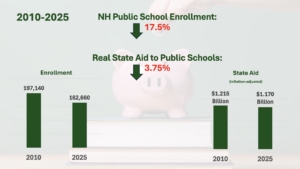
If we look back 15 years, we can see that the total dollar amount of state public education aid fell by 3.75% when adjusted for inflation.
But using only that number would be misleading.
Over that same period, public school enrollment fell by 17.5%. That’s a decline of 34,480 students (as tracked by state district fall enrollment reports). Because state aid is tied to the student, we have to look at per-pupil spending to see whether the total amount of funding fell because of political decisions or demographics.
From 2010-2025, the state increased the amount of money each pupil is given. After adjusting for inflation, per-pupil state aid increased by 25%.
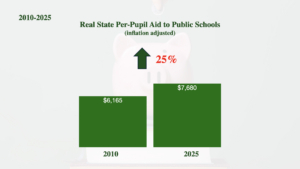
Schools are getting 25% more state dollars per student, above the increase in the cost of living, than they did 15 years ago. Yet claims that the state has reduced funding continue to confuse voters and lawmakers.
This month, the NH School Funding Fairness project released a chart designed to show that the state’s share of education funding had fallen by nearly $200 million since 2010.
That false impression is created by several measurement errors. The chart:
- Does not include the loss of 34,480 students.
- Includes federal American Rescue Plan Act funding in its 2010 state funding total.
- Includes SWEPT in its 2010 state funding total but not in its 2025 total.
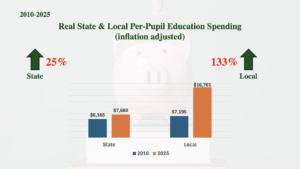
Fixing those errors lets us compare apples to apples. When we do that, we see that that schools have received substantial increases in both state and local revenue per student from 2010-2015.
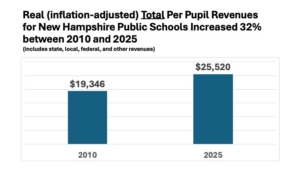
Including state, local and federal funding, total New Hampshire public school revenues grew by 84% in nominal terms from 2010-2015, or 32% after adjusting for inflation.
Whether the state should contribute more financial resources to public education is a worthy (and never-ending) debate.
Whether the state has increased or decreased its contribution in the recent past, however, falls outside of the scope of that debate. It’s just math.
The math shows that even after adjusting for inflation, the state contributes 25% more per pupil to public education in 2025 than it did in 2010. During that time, local per-pupil spending increased by 133%, after adjusting for inflation.
For a look at longer-term trends going back to the turn of this century, see our previous research.
The data analysis for this research was conducted by Dr. Ben Scafidi, director of the Education Economics Center at Kennesaw State University.